


Reconstructing step by step the exchange—hardly can it be called a dialogue—between the Priestly Fraternity of Saint Pius X (FSSPX) and the Holy See over the past year allows a better understanding of the timing, gestures, and silences that have led to the episcopal consecrations scheduled for tomorrow, 1 July, in Écône. A request for an audience made in August 2025 received its first papal response in a personal letter from the Pontiff dated 29 June 2026, when tens of thousands of faithful were already on their way to Switzerland.
August 2025: the request for an audience and the silence
According to the communiqué issued by the Fraternity’s General House, it was in August 2025 that the Superior General, Father Davide Pagliarani, “requested the grace of an audience with the Holy Father,” newly elected, in order to present to him “filially the current situation” of the Fraternity. In a second letter he expressed “openly and explicitly” the need to secure the continuity of the episcopal ministry so as to administer to the faithful the sacraments of Holy Orders and Confirmation (General House of the FSSPX, 2 February 2026).
The audience was never granted. During those same months, while so many others were received, the Fraternity’s only reply was silence. There was no gesture of détente in liturgical or doctrinal matters, nor any review of the restrictions on the traditional Mass, in a line of continuity with the previous pontificate.
The contrast is eloquent. That same August, on 28 August 2025, the Pope granted a private audience to the religious sister María Lucía Caram (InfoVaticana); on 1 September, to the Jesuit James Martin, known for his activism on behalf of LGBTQ communities (ACI Prensa). Months later, during his visit to Spain, the Pontiff found time to bless the ambulances that the same Sister Lucía Caram was sending to Ukraine (El País, 9 June 2026). For someone who has pastoral and sacramental responsibility for hundreds of thousands of souls, the absence of even a single audience in almost a year is, at the very least, difficult to explain.
2 February 2026: the announcement of the consecrations
Having exhausted the avenue of an audience and having received “in recent days” a letter from the Holy See which—in the Fraternity’s own words—“does not respond at all to our requests,” Father Pagliarani publicly announced on 2 February 2026, the feast of the Purification, during a ceremony at the seminary of Flavigny-sur-Ozerain, his decision to proceed with new episcopal consecrations on 1 July (General House of the FSSPX). The reason invoked: the “objective state of grave necessity” of souls and the will to guarantee the sacramental continuity of a work that has been present throughout the world for almost forty years.
12 February 2026: a cardinal, not the Pope
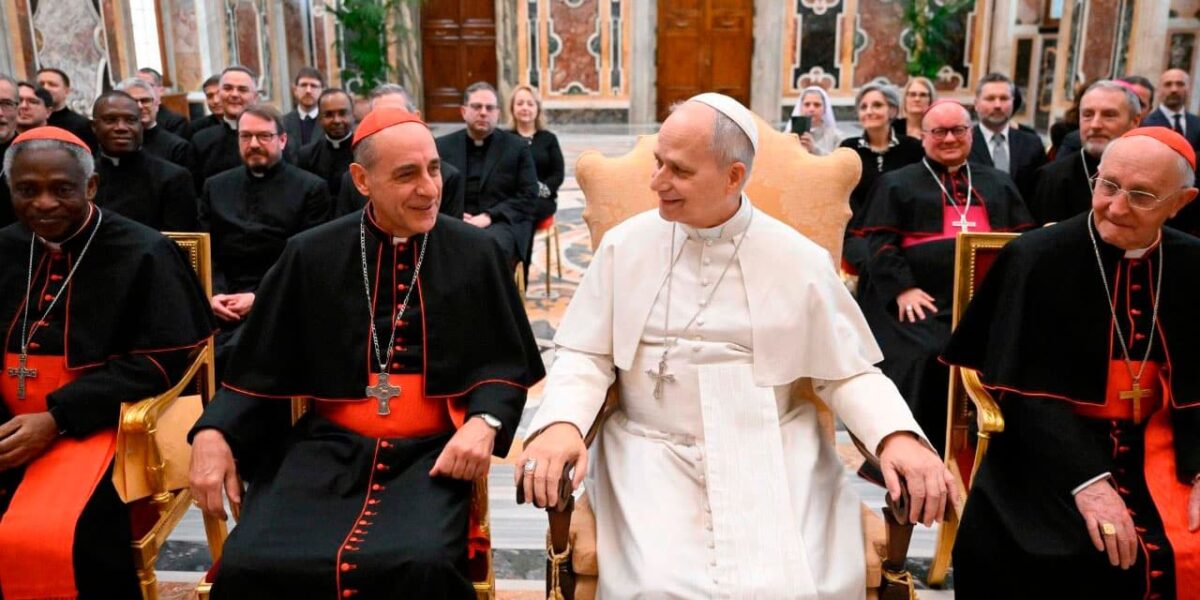
Only after the public announcement did the first meeting of any real rank take place. It was not a papal audience, but a meeting at the Palace of the Holy Office between Pagliarani and Cardinal Víctor Manuel Fernández, Prefect of the Dicastery for the Doctrine of the Faith—and a figure noted for his progressive profile and scant liturgical sensitivity—held on 12 February 2026 “with the approval” of Leo XIV (Vatican News).
The communiqué signed by Fernández proposed “a path of specifically theological dialogue,” but conditioned it on the Fraternity suspending the consecrations, warning that ordaining bishops without a pontifical mandate “would imply a decisive rupture of ecclesial communion (schism).” In short, a dialogue without any practical guarantee: at no time was it offered that a bishop in communion with Rome would ensure, during that process, the ordinations, confirmations, or the holy oils for the Fraternity’s seminaries. Had that sacramental continuity been guaranteed during the dialogue, one may ask whether the itinerary would have been different.
13 May and 16 June: the warning hardens
On 13 May 2026, the Dicastery for the Doctrine of the Faith formally declared that consecrations without a pontifical mandate would constitute “a schismatic act” entailing latae sententiae excommunication for both consecrators and consecrated. On 26 May, the Fraternity made public the names of the four chosen: Fathers Pascal Schreiber (Switzerland), Michael Goldade (United States), Michel Poinsinet de Sivry and Marc Hanappier, both French (InfoVaticana).
On 16 June, at the gates of Villa Barberini in Castel Gandolfo, Leo XIV pronounced his first public words on the matter: “We have invited them, and I am still considering making a new appeal to say to them: Do not do this.” Yet he concluded by placing the responsibility on the other side: “It is their decision […]. If they take that decision, I regret it. But we must move forward.”
24–27 June: the profession of faith and the consistory
On 24 June, the feast of the Nativity of Saint John the Baptist, the Fraternity addressed an open letter to the Pope and the entire College of Cardinals, accompanied by a profession of faith of 154 points (FSSPX; InfoVaticana). The text was published on the eve of the extraordinary consistory of cardinals on 26 and 27 June (ACI Prensa).
29 June: the Pope’s first and only letter, on the eve
Almost a year after that request for an audience in August 2025, the first and only direct and personal communication from Leo XIV to Pagliarani is a letter dated 29 June 2026, the solemnity of Saints Peter and Paul, made public on 30 June—just over a day before the ceremony (InfoVaticana; Vatican News).
In it, the Pontiff writes “with a paternal spirit” and pleads: “Come back!” Yet the content is a warning of grave consequences: the schismatic act would deprive the faithful “of the licit—and in some cases even valid—reception of the Sacraments.” The precision regarding validity is what is truly new and delicate: until now Rome maintained that confessions and marriages celebrated by the Fraternity, although illicit, were valid. The letter of 29 June alters that balance and places, for the first time and in the Pope’s own voice, the sacramental fate of hundreds of thousands of faithful—the validity of their confessions and marriages—at the centre of the conflict.
And it does so when nothing can any longer be reversed: registration to attend Écône involves celebrations from 29 June to 2 July, and the Fraternity expects nearly 15,000 faithful and 1,300 priests, religious brothers and sisters from around the world (FSSPX). The ceremony, presided over by Bishop Alfonso de Galarreta as principal consecrator and Bishop Bernard Fellay as co-consecrator, will be broadcast live on 1 July (FSSPX Actualidad).
A chronology that defies logic
Lined up, the facts sketch a sequence difficult to justify as dialogue. It is not a question of debating doctrine or the canonical gravity of the step the Fraternity is taking. It is a question of timing. Whoever writes in August asking to be heard receives no audience; whoever announces in February an extreme decision is, only then, received by the cardinal least inclined—not by the Pope—and is offered a dialogue conditioned on no guarantee whatever of sacramental continuity for its seminaries and its faithful. The Pope’s only personal word arrives on the eve, when more than fifteen thousand people are already on the road and everything is irreversibly arranged.
It is difficult to understand that if time was found, over months, to receive Sister Lucía Caram, James Martin and so many others, the direct response to the one who has pastoral care of hundreds of thousands of souls should be reserved for the final hours, and that its content should be the written warning that their confessions and marriages could be invalid. It is not a question of substance, but of form; and form, here, says much. Call it what one will: the chronology of an asymmetrical exchange, or of a failed exchange.