


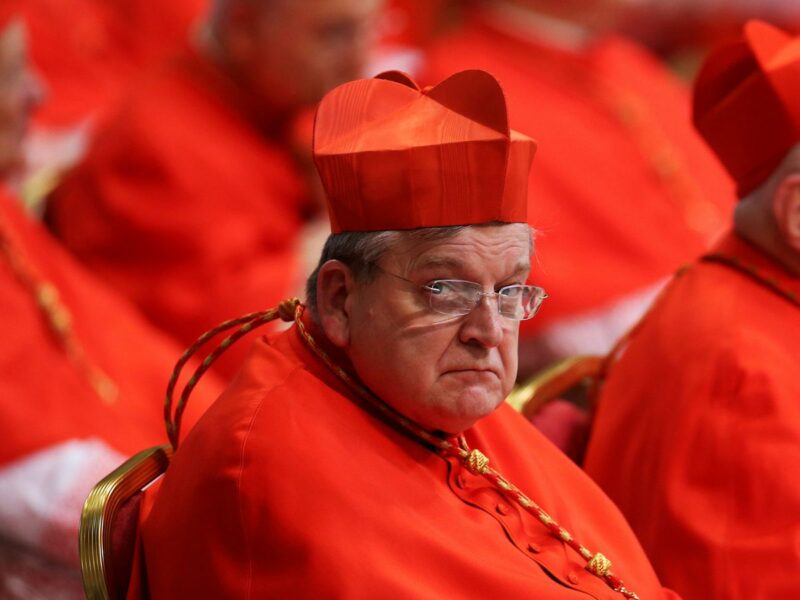
Cardinal Raymond Leo Burke has offered an assessment of the extraordinary consistory held on June 26 and 27 at the Vatican, expressing satisfaction at the resumption of these meetings of the College of Cardinals, while voicing reservations about the working format inspired by synodality. He also commented on the imminent episcopal consecrations announced by the Priestly Fraternity of Saint Pius X (FSSPX), insisting that no state of necessity exists to justify them and urging the Holy See to resume dialogue with the Fraternity.
In an interview granted to journalist Michael Haynes for the outlet Per Mariam, Burke welcomed the fact that Leo XIV has already convened two consistories in the first months of his pontificate. In his view—reiterating his January remarks—these gatherings allow the cardinals to get to know one another better and to discuss matters of importance for the life of the Church.
Nevertheless, the American cardinal expressed reservations about the working method employed, based on small discussion groups. He recalled that the traditional format of a consistory consisted of an open debate in the presence of all the cardinals, where each could hear the interventions of the others and respond to them.
“Synodality remains an unresolved question”
Burke believes that the adoption of this method responds to the Pope’s insistence, yet he holds that those who have objections should express them clearly.
“The question of synodality remains unresolved,” he stated. According to him, there is no clear definition of what this concept precisely means, nor does it have an established tradition in the history of the Church. Therefore, he considers it necessary to carry out a “critical examination” to determine whether it constitutes an appropriate way of conducting consultation within the Church.
The cardinal also regretted that the consistory’s agenda was focused almost exclusively on social and cultural issues, leaving aside some ecclesial crises of the first order. Among them he expressly mentioned the situation created by the Priestly Fraternity of Saint Pius X, a matter that, he indicated, some cardinals did raise during the sessions even though it was not on the agenda.
In Burke’s judgment, when the College of Cardinals meets it should seek to reach concrete pastoral conclusions and not limit itself to formulating general principles. “When we cardinals gather to discuss something, we should arrive at some pastoral action, at a better way of caring for souls,” he noted.
Hope that Rome will reopen dialogue with the Priestly Fraternity of Saint Pius X
Regarding the episcopal consecrations scheduled for July 1 by the FSSPX, Burke stated that he is not involved in the conversations held by the Holy See, but acknowledged that he sees no signs of a last-minute intervention by the Vatican to prevent them.
The cardinal maintained that conferring an episcopal consecration without a pontifical mandate entails latae sententiae excommunication for those who directly participate in the act, in accordance with canon law. However, he rejected rumors suggesting a possible excommunication of all members of the Fraternity.
“I think there are many faithful who belong to the FSSPX, including priests, who do not have a schismatic spirit; they simply love the tradition of the older use of the Roman Missal,” he affirmed.
For that reason, he advocated that the Holy See appoint several cardinals to reopen dialogue with the leaders of the Fraternity, convinced that it is still possible to move toward reconciliation.
“There is no state of necessity”
Burke likewise rejected the argument used by the FSSPX to justify the new episcopal consecrations, based on the supposed existence of a state of necessity within the Church: “the present situation does not constitute a state of necessity because, in fact, the idea behind it is that the faithful who are in the FSSPX cannot live their Catholic faith in the Church without having a church within the Church.”
The cardinal recalled that Christ promised to remain with His Church until the end of time and that the faithful are called to remain in it even in times of crisis. “No situation justifies doing something that is intrinsically evil,” he concluded.