


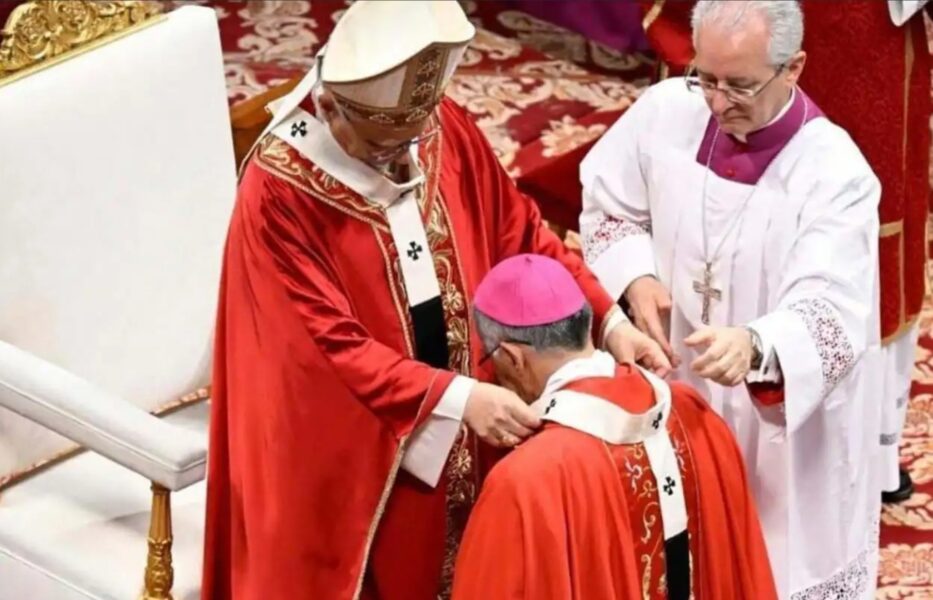
On the solemnity of Saints Peter and Paul, this Monday, June 29, Pope Leo XIV will preside at 9:30 a.m. in St. Peter’s Basilica over the stational Mass of the patrons of Rome and, during it, will bless the sacred pallia and personally impose them on the shoulders of the new metropolitan archbishops appointed in the past year. This was confirmed by the Notificazione of the Office of Pontifical Liturgical Celebrations, signed by Msgr. Diego Ravelli, which asks the metropolitans to present themselves before 8:45 a.m. in the Chapel of St. Sebastian wearing the simple white mitre.
In his second year of pontificate, Leo XIV thus consolidates the return to tradition already marked in 2025: that the Successor of Peter himself place the woolen band, rather than—as Francis decreed from 2015 onward—a bestowal of the pallium in Rome followed by a later imposition in each archdiocese by the apostolic nuncio. The reform of a decade ago had been read by many as a weakening of the visible bond between the metropolitan and the Roman Pontiff; the return to the earlier rite fully restores that pedagogy of communion.
What the pallium is—and what it means
The pallium is a narrow band of white wool, adorned with six black crosses, which the metropolitan wears over the chasuble in liturgical celebrations within his ecclesiastical province. Woven from the wool of lambs blessed each January 21, the feast of St. Agnes, and kept beside the Confessio of St. Peter until its blessing, it expresses three inseparable realities: metropolitan jurisdiction over the suffragan dioceses, hierarchical communion with the Bishop of Rome, and the pastoral solicitude of the shepherd who carries on his shoulders—as the Good Shepherd carries the sheep—the flock entrusted to him. Since the ninth century, metropolitans have been required to request the pallium from the Apostolic See within three months of taking possession of their see.
This year, thirty-five metropolitan archbishops from the five continents will receive the pallium, in a list ranging from Kraków, Vienna, Westminster, or Prague to Conakry, Lomé, Lahore, or Berbérati. Two of them already wear the purple: Cardinal Grzegorz Ryś, Archbishop of Kraków, and Cardinal Konrad Krajewski, Archbishop of Łódź. And it is precisely this detail that opens the central question of this report.
The traditionally cardinalatial sees
Not all metropolitan archdioceses carry the same historical weight. Some are, by constant custom, cardinalatial sees: those whose ordinary has almost without exception been raised to the College of Cardinals, to the point that the red hat seems attached to the see itself. Others have known a cardinal only occasionally, and most do not belong to this category. We review the 2026 list under this lens.
Habitually cardinalatial sees
Five of the archdioceses receiving the pallium this year are sees whose cardinalate is virtually assured:
- Kraków (Poland). De facto primatial see of Polish Catholicism, illustrated by Adam Sapieha, by Karol Wojtyła—the future John Paul II—, Franciszek Macharski, and Stanisław Dziwisz. Its current archbishop, Grzegorz Ryś, has already been a cardinal since 2023: in him, see and purple once again coincide naturally.
- Vienna (Austria). The Austrian primatial see has enjoyed an unbroken succession of cardinals in the last century: Piffl, Innitzer, König, Groër, and Christoph Schönborn. Its new ordinary, Josef Grünwidl, succeeds Schönborn and has not yet been created a cardinal.
- New York (United States). The most prominent see of U.S. Catholicism, with an almost continuous roster of cardinals: Spellman, Cooke, O’Connor, Egan, and Dolan. Its new archbishop, Ronald A. Hicks, succeeds Cardinal Timothy Dolan.
- Westminster (Great Britain). Head of the Catholic Church in England and Wales since the restoration of the hierarchy in 1850. Wiseman, Manning, Vaughan, Bourne, Hinsley, Hume, Murphy-O’Connor, and Nichols confirm that the purple ordinarily accompanies this see, now in the hands of Charles Phillip Richard Moth.
- Prague (Czech Republic). Primatial see of Bohemia, marked by figures such as Beran, Tomášek, Vlk, and Duka. The cardinalatial tradition here is firm, reinforced by its historic role of ecclesial resistance under communism; its new archbishop is Stanislav Přibyl.
To these five must be added the case of Łódź, which is not a traditionally cardinalatial see: the purple is brought by the person of its new archbishop, Cardinal Konrad Krajewski—papal almoner—and not by the dignity proper to the see itself.
Sees that have known the cardinalate occasionally
A second group consists of archdioceses that have had a cardinal, though without the red hat being stably linked to the see:
- Cebu (Philippines). The group’s most solidly traditional see: the “cradle of Christianity” in Asia has given two consecutive cardinals, Julio Rosales (1969) and Ricardo Vidal (1985). Its new ordinary is Alberto S. Uy.
- Cotabato (Philippines). See of Cardinal Orlando Quevedo, O.M.I., created by Francis in 2014; today it is governed by Charlie M. Inzon, O.M.I.
- Calcutta (India). The Jesuit Lawrence Trevor Picachy was its archbishop and cardinal from 1976, in the years of Mother Teresa. It now receives the pallium Elias Frank.
- Cape Town (South Africa). Owen McCann was created cardinal in 1965 by Paul VI; its new archbishop is Sithembele Sipuka.
- Aparecida (Brazil). Brazil’s national Marian shrine had two successive cardinals: Aloísio Lorscheider and Raymundo Damasceno Assis, created by Benedict XVI in 2010. He is succeeded by Mário Antônio da Silva.
- Morelia (Mexico). A singular case: until Alberto Suárez Inda, created cardinal by Francis in 2015, the see had never had a cardinal. The Vatican spokesman at the time stressed that it was a gesture of the Pope toward a region afflicted by violence, not a tradition of the see. One cannot, therefore, speak of a cardinalatial see, but of a single precedent; the new archbishop is José Armando Álvarez Cano.
The rest of the list
The remaining archdioceses—Brisbane, Mobile, Madurai, Belém do Pará, Katowice, Grouard-McLennan, Nueva Segovia, Keewatin-Le Pas, Edmonton, Piura, Juiz de Fora, Sorocaba, Denver, New Orleans, Sassari, Bucaramanga, Conakry, Lahore, Lomé, Sherbrooke, Berbérati, Benevento, or Gorizia—do not follow a pattern of cardinalatial sees. Two nuances that sometimes lead to error should be noted: that Cardinal Robert Sarah was Archbishop of Conakry does not make that see cardinalatial, since he received the red hat years later and in service to the Curia; and that Benevento, an Italian archdiocese of ancient dignity, having had cardinals in past centuries does not place it today among the cardinalatial sees.
A snapshot of Leo XIV’s governance
The distribution of pallia in 2026 confirms an ecclesial geography with a marked missionary and peripheral accent
in line with the direction of recent pontificates. Yet the decision to impose them once again with his own hands, on the altar of the Confessio, above the Apostle’s tomb, says something more: that for Leo XIV the pallium is not a delegable formality, but the living sign that each metropolitan—whether or not he is one day called to the purple—receives his mission in and from communion with the Chair of Peter.
The 35 new metropolitan archbishops receiving the pallium (2026)
The official list is reproduced in its given order. Beside each traditionally cardinalatial see, its status is noted in parentheses.
- Cardinal Grzegorz Ryś — Kraków, Poland (cardinalatial see)
- Cardinal Konrad Krajewski — Łódź, Poland
- Msgr. Shane Anthony Mackinlay — Brisbane, Australia
- Msgr. Mark S. Rivituso — Mobile, United States
- Msgr. Antonysamy Savarimuthu — Madurai, India
- Msgr. Alberto S. Uy — Cebu, Philippines (with cardinal in its history)
- Msgr. Júlio Endi Akamine, S.A.C. — Belém do Pará, Brazil
- Msgr. Andrzej Przybylski — Katowice, Poland
- Msgr. Charles Duval, C.SS.R. — Grouard-McLennan, Canada
- Msgr. Charlie M. Inzon, O.M.I. — Cotabato, Philippines (with cardinal in its history)
- Msgr. Elias Frank — Calcutta, India (with cardinal in its history)
- Msgr. Josef Grünwidl — Vienna, Austria (cardinalatial see)
- Msgr. David William V. Antonio — Nueva Segovia, Philippines
- Msgr. Susai Jesu, O.M.I. — Keewatin-Le Pas, Canada
- Msgr. Stephen Andrew Hero — Edmonton, Canada
- Msgr. Luciano Maza Huamán — Piura, Peru
- Msgr. Ronald A. Hicks — New York, United States (cardinalatial see)
- Msgr. Charles Phillip Richard Moth — Westminster, Great Britain (cardinalatial see)
- Msgr. Marco Aurélio Gubiotti — Juiz de Fora, Brazil
- Msgr. José Roberto Fortes Palau — Sorocaba, Brazil
- Msgr. Sithembele Sipuka — Cape Town, South Africa (with cardinal in its history)
- Msgr. José Armando Álvarez Cano — Morelia, Mexico (unique cardinalial precedent)
- Msgr. Stanislav Přibyl, C.Ss.R. — Prague, Czech Republic (cardinalatial see)
- Msgr. James R. Golka — Denver, United States
- Msgr. James Francis Checchio — New Orleans, United States
- Msgr. Francesco Antonio Soddu — Sassari, Italy
- Msgr. Luis Augusto Campos Flórez — Bucaramanga, Colombia
- Msgr. François Sylla — Conakry, Guinea
- Msgr. Mário Antônio da Silva — Aparecida, Brazil (with cardinal in its history)
- Msgr. Khalid Rehmat, O.F.M. Cap. — Lahore, Pakistan
- Msgr. Isaac Jogues Kodjo Agbéménya Gaglo — Lomé, Togo
- Msgr. Guy Boulanger — Sherbrooke, Canada
- Msgr. Dennis Kofi Agbenyadzi, S.M.A. — Berbérati, Central African Republic
- Msgr. Michele Autuoro — Benevento, Italy
- Msgr. Giampaolo Dianin — Gorizia, Italy