


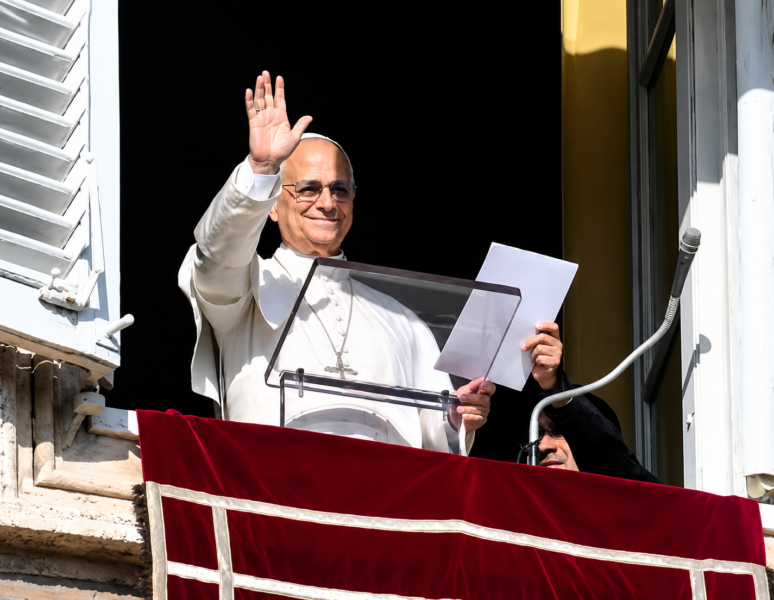
Pope Leo XIV presided over the recitation of the Angelus this Sunday from the window of the Vatican Apostolic Palace, on the XIII Sunday of Ordinary Time, focusing his meditation on the demands of following Christ. Drawing from the Gospel of Saint Matthew (Mt 10, 37-42), the Pontiff explained that Christian love does not consist solely in feelings or external gestures, but requires a total surrender to Christ that involves detachment, sacrifice, and welcoming one’s neighbor.
During his reflection, the Pope developed three ideas that characterize authentic love: detachment from whatever may hinder full surrender to God, the capacity to lose part of oneself in order to give to others, and the concrete welcome of those who come in the name of Christ. In the face of a culture marked by the desire to possess and retain, Leo XIV recalled that the Gospel proposes the logic of gift, affirming that “whoever keeps life only for himself, in reality loses it.”
The Pontiff illustrated this teaching with examples from family life, noting that both marriage and the upbringing of children require learning to let go and to trust. He also recalled that Christ himself carried this logic to the extreme by giving himself on the Cross, thereby making new life possible for all humanity through his sacrifice.
Below, we reproduce the full text of the reflection delivered by the Holy Father:.
Words of the Holy Father before the Angelus
Brothers and sisters, happy Sunday!
Also in today’s Gospel (Mt 10,37-42) we hear some exhortations from Jesus for living discipleship and being witnesses of his Kingdom. It is not about performing some external act, but about committing ourselves entirely to a relationship of love with Him. And for love to bear fruit, it requires at least three things: detachment, loss, and welcome.
First of all, detachment. Jesus says: “Whoever loves father or mother more than me is not worthy of me; whoever loves son or daughter more than me is not worthy of me” (v. 37). At the moment he begins to send his apostles on mission, the Lord wants them to be free from any attachment. But this applies to everyone: even the most important affections find their fullness thanks to the love Christ gives us. Let us think, for example, of married life: it can only be lived fully by “leaving” one’s parents’ home (cf. Mt 19,6) to give oneself to the conjugal relationship. Let us also think of the growth of children: they are helped to fulfill themselves and to be happy by educating them to “walk on their own feet” and make their own decisions. Saint Augustine says: “It is painful to separate from what you love. But the farmer also temporarily loses what he sows” (Sermon 330, 2). Only by “losing” that seed, cast into the earth, will he be able to see it flourish.
In this sense, love is also loss. It is difficult for us to understand this, especially in a world where losing seems a weakness and there is an obsession with having and possessing. Yet love only bears fruit when it gives itself: when we are willing to lose a little of our own self to make space for the other, to lose a little time to listen to a friend, to lose a little comfort to share in a situation of difficulty. Whoever keeps life only for himself —says the Gospel— in reality loses it (cf. v. 39), because he does not open himself to the joy of love and becomes barren. That is why Jesus invites us to embrace the Cross: He offered himself, lost himself, and precisely in this way we have been able to receive his life in abundance. Likewise, if we live according to the logic of gift, we too will be able to generate new life in our relationships.
Finally, welcome. Indeed, love is expressed in concrete decisions and actions, in a commitment made of small daily gestures, such as offering a glass of water to someone who is thirsty (cf. v. 42). Jesus, when sending his disciples ahead of him, asks them to go without provisions, that is, to be in need, so that they may thus elicit the welcome of those they meet on their way. And in this way, welcoming those who come in the name of Jesus means welcoming him and the heavenly Father who sent him. Love for the Lord always passes through the welcome of our brothers and sisters.
Dear friends, let us ask the Virgin Mary, who loved her Son while also knowing how to lose him, to help us be humble and joyful witnesses of Christ’s love.
After the Angelus
Dear brothers and sisters:
I wish to express my closeness to the Venezuelan sisters and brothers affected by the recent earthquakes that caused numerous victims and injuries, as well as extensive material damage. While I pray to the Lord for the eternal rest of the deceased, I renew my spiritual closeness to their families, to the injured, and to those struck by this tragedy. Likewise, I express my gratitude and encouragement to all those who generously work in search and assistance efforts.
And now I greet all of you, Romans and pilgrims: thank you for coming in this heat!
I greet the faithful of the diocese of Kumba, in Cameroon, and those from various other countries.
I greet the young Camillian religious; the parish groups from Priolo Gargallo, Avola, Regalbuto, and Bari; the scouts from Rovereto, and the young people from Mestrino, in the diocese of Padua, who have received First Communion and Confirmation.
To all of you, I wish a happy Sunday! Until tomorrow, on the occasion of the solemnity of Saints Peter and Paul.