


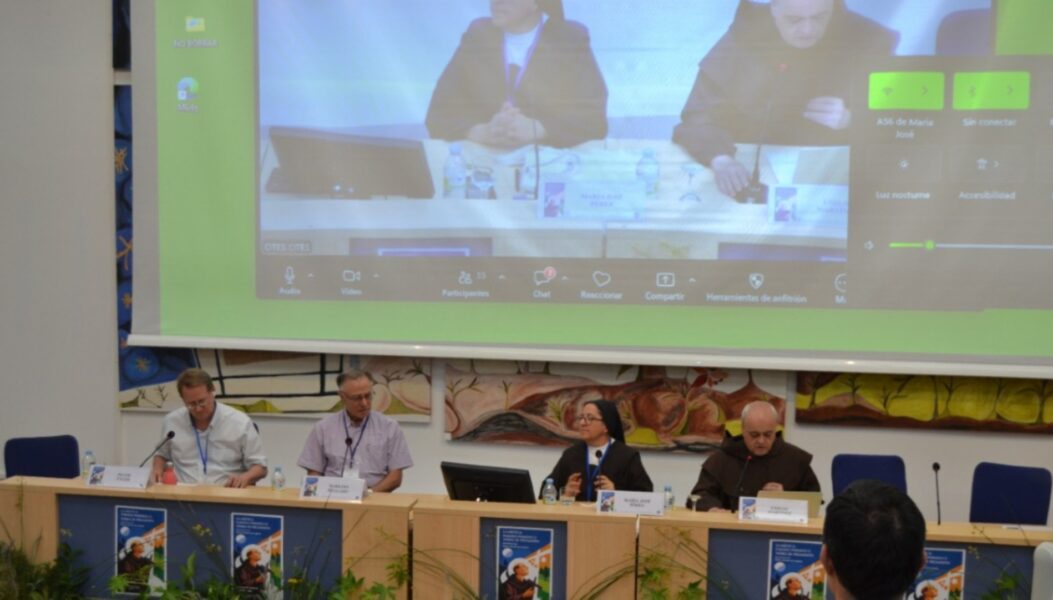
The International Teresian Sanjuanist Centre (CITeS) and the Pontifical Faculty Teresianum brought together some of the world’s leading specialists in mystical theology from 22 to 26 June to mark the three-hundredth anniversary of the canonisation of St John of the Cross and the centenary of his proclamation as a Doctor of the Church.
For the Teresian Carmel, 2026 has been a doubly jubilee year. On 27 December 1726, Benedict XIII inscribed Brother Juan de Yepes, the Discalced friar from Fontiveros, in the catalogue of the saints. Two hundred years later, on 24 August 1926, Pius XI proclaimed him Doctor Ecclesiae universae with the encyclical that established him as the “mystic doctor” par excellence. Three centuries of veneration and a century of doctrinal magisterium converged in a Jubilee Year that the Order of Discalced Carmelites wished to crown with an academic event of the highest order.
Under the title “Mysticism: lost paradise or promised land?”, the international congress dedicated to the centenary of St John of the Cross’s doctorate was held from 22 to 26 June 2026, divided between two venues of deep Carmelite symbolism: the Pontifical University and Pontifical Institute of Spirituality Teresianum in Rome and the International Teresian Sanjuanist Centre (CITeS) – University of Mysticism in Ávila. All sessions could also be followed live online, and registration—whether in person or online—was free.
A reflection on the experience of God
The purpose underlying the gathering was not merely scholarly. St John of the Cross, together with St Teresa of Jesus and St Thérèse of Lisieux, is one of the three great masters of the experience of God recognised by the Church. For this reason the Discalced Carmel presented the congress as a profound reflection on Christian mysticism itself: is it a “promised land” open to every baptised person, or a “lost paradise” reserved for a few? Far from being merely rhetorical, the question ran through the four major thematic days that structured the meeting.
On Monday 22 June, in Rome, the congress opened with its gaze fixed on the doctorate of St John of the Cross itself. Historian Silvano Giordano reviewed the path from 1926 to 2026; British Carmelite Iain Matthew—author of The Impact of God, one of the most widely read introductions to the saint—expounded his mysticism, and Asunción Escribano addressed the poet and theologian. The afternoon was devoted to a panel of experiences that built bridges between mysticism and poetry, contemplative life, art, everyday life, ecology and psychiatry, with contributions including that of Anglican psychiatrist Christopher Cook.
Tuesday 23, a transitional day towards Ávila, was marked by a distinctly devotional gesture: the pilgrimage to Segovia, to the Discalced Carmelites’ convent where the tomb of St John of the Cross rests. That same afternoon an exhibition dedicated to the saint was inaugurated at the University of Mysticism, remaining open to the public until September.
From the analysis of sources to the neurosciences
Once transferred to the city of St Teresa, the congress unfolded its theological core between 24 and 26 June. Wednesday’s session, devoted to the sources and history of mystical experience, brought together names of considerable weight. Rowan Williams, former Archbishop of Canterbury and one of the most respected voices in contemporary spiritual theology, asked “What is Christian mysticism?”; Mariano Delgado examined the historical tensions between the Church and mystics, and Peter Tyler addressed the delicate terrain of interreligious dialogue. The afternoon focused on mysticism “in the feminine,” with the daughters of Teresa and John.
Thursday 25 placed mysticism in dialogue with systematic theology: the phenomenology of experience (Miguel García-Baró), the relationship between Bible and mysticism (Silvio Báez), the divine attributes (Denis Chardonnens) and the performativity of Sanjuanist language (Juan Antonio Marcos). Friday 26 closed the cycle with mysticism “with open eyes,” that is, embodied in life: Meister Eckhart as a mirror (Silvia Bara), dialogue with modern psychology (Jean-Baptiste Lecuit) and with the neurosciences (Francisco Javier Sancho Fermín, director of CITeS).
The closing lecture was delivered by the distinguished Arabist and literary critic Luce López Baralt, who spoke on St John of the Cross “between the summit of ecstasy and bodily visions.” The choice was no minor one: López Baralt is the leading scholar of the possible resonances of Islamic mysticism in the work of the saint from Ávila, a debate that continues to provoke discussion a century after his doctorate.
One anniversary, two congresses
This event should not be confused with the First International Congress “St John of the Cross: Presence and Figure” organised by the Catholic University of Ávila (UCAV) last May between the Lienzo Norte and Fontiveros, which had a more literary orientation. The density with which the double centenary has been celebrated in Ávila—the Teresian cradle and spiritual homeland of the Reformed Carmel—was, in itself, good news: the figure of the Discalced friar from Fontiveros, far from being a museum piece, has once again challenged the Church and twenty-first-century culture from the only authority St John recognised, that of love purified in the night.
The full programme remains available on the website of the University of Mysticism (mistica.es).