


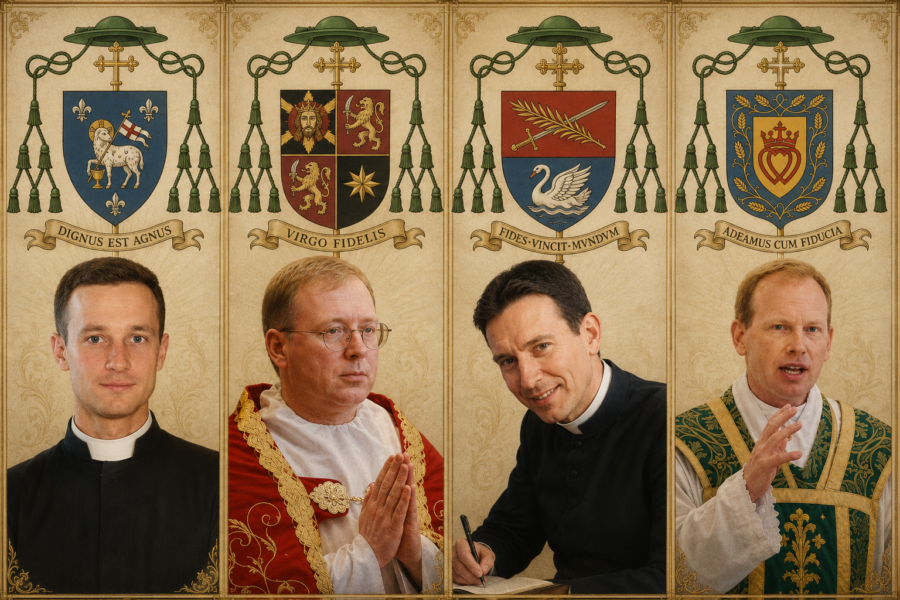
The Priestly Fraternity of Saint Pius X (FSSPX) has made public the episcopal coats of arms and mottos of the four priests who will receive the episcopate. Far from merely presenting their heraldic arms, the General House accompanies each shield with a detailed explanation of its symbolism, showing how each future bishop has sought to synthesize in it his spirituality, his pastoral program, and certain aspects of his personal history.
Father Pascal Schreiber: fidelity to the Cross
According to the Fraternity, Bishop Pascal Schreiber’s coat of arms is divided into four quarters, following an ancient heraldic tradition of German-speaking countries. These quarters contain references both to his personal history and to his episcopal ministry.

The first quarter reproduces the triumphant face of Christ the King according to the celebrated vision of Saint Nicholas of Flüe, patron of Switzerland and the saint who, according to the published explanation, was at the origin of the future bishop’s priestly vocation. The face is surrounded by six rays symbolizing divine omniscience and wisdom, as well as the believer’s path toward the knowledge of God.
The two central quarters incorporate the Schreiber family coat of arms: a rampant lion holding a quill, a traditional symbol of strength and royalty, but also an allusion to the meaning of the surname (“writer”). The fourth quarter shows an eight-pointed star, which the FSSPX interprets as a reference both to Christ—“the bright morning star”—and to the Virgin Mary, Stella Maris, as well as evoking once again Saint Nicholas of Flüe. The colors black, red, and gold likewise recall Germany, the country where the Zaitzkofen seminary is located.
Read also. The Four of Écône: Father Pascal Schreiber
The chosen motto, Virgo Fidelis (“Faithful Virgin”), comes from the Litany of Loreto and expresses the future bishop’s trust in Mary’s fidelity. The Fraternity recalls that this title was especially dear to Archbishop Marcel Lefebvre, who incorporated it into the Statutes of the FSSPX as a model of fidelity and unity for all its members.
Father Michael Goldade: the primacy of Christ the King
Bishop Michael Goldade’s coat of arms features a blue field—traditionally associated with the Virgin Mary—surrounded by twelve ears of wheat that frame a small golden shield bearing the well-known Heart of Vendée, formed by the Sacred Hearts of Jesus and Mary crowned by the cross.

The explanation attributes several meanings to the twelve ears of wheat. First, they recall the states of North Dakota and Kansas, where the future bishop was born and raised, both major wheat producers. They also evoke the twelve members of his family, the twelve sons of Jacob, the twelve Apostles, and the twelve baskets collected after the multiplication of the loaves. Wheat also appears as a symbol of the Eucharist and of the Holy Sacrifice of the Mass, “the heart of the Society of Saint Pius X.”
The small golden shield refers both to the divinity of Christ and to the surname Goldade, while the Heart of Vendée represents the family’s devotion to the Sacred Hearts and, at the same time, the emblem of the Fraternity itself.
Read also. The Four of Écône: Father Michael Goldade
His motto, Adeamus cum fiducia (“Let us approach with confidence”), is taken from the Letter to the Hebrews (4:16) and constitutes, according to the FSSPX, an act of absolute trust in the Virgin Mary as Mediatrix of all graces and “Throne of grace.” The motto also links to the beginning of the Holy Mass—“I will go up to the altar of God”—and to the conviction that all graces flow from the Eucharistic sacrifice.
Father Michel Poinsinet de Sivry: the centrality of the Eucharist
The French priest’s coat of arms is divided horizontally into two parts. The upper section shows a sword crossed by a palm, while the lower section reproduces a white swan on a blue background.

According to the published explanation, the sword represents the spiritual struggle of the Church and the Word of God, “the sword of the Spirit,” called to combat the maxims of the world. The palm symbolizes the victory achieved by the martyrs and by all witnesses to the faith. In the lower part, the swan, taken from the family coat of arms, expresses fidelity—by maintaining a single partner throughout life—and purity, associated with its white plumage.
Read also. The Four of Écône: Father Michel Poinsinet de Sivry
The motto, Fides vincit mundum (“Faith conquers the world”), comes from the First Letter of Saint John (5:4). The Fraternity explains that it recalls Christ’s definitive triumph over the world and the militant condition of the Church on earth, evoking both the Augustinian image of the “two cities” and that of the “two standards” of Saint Ignatius of Loyola. The motto seeks to convey a message of hope amid the difficulties the Church is currently experiencing.
Father Marc Hanappier: trust in Providence
Bishop Marc Hanappier’s coat of arms is presided over by the Agnus Dei, the Paschal Lamb with the banner of the Resurrection, from whose side flows blood that falls upon a golden chalice. The whole is surrounded by three fleurs-de-lis on a blue background.

The Lamb represents the glorious Christ of the Apocalypse, victorious through his sacrifice, whose blood is offered sacramentally in the chalice of the Mass for the salvation of souls. The three fleurs-de-lis simultaneously evoke the kingship of Christ, the purity of the Virgin Mary, and French tradition, also alluding to the coat of arms of the city of Versailles, where the Hanappier family resides.
Read also. The Four of Écône: Father Marc Hanappier
The episcopal motto, Dignus est Agnus (“Worthy is the Lamb”), is taken from the Apocalypse (5:12). According to the Fraternity, it summarizes the centrality of Jesus Christ in the history of salvation, the priesthood, and the Holy Sacrifice of the Mass. The text concludes by recalling that only the Lamb can open the sealed book of history and that “nothing and no one can be considered independent of Him,” for only in the light of the Cross can the mystery of evil and redemption be understood.
One of the last steps before July 1
The publication of the coats of arms and mottos constitutes one of the final public preparations before the episcopal consecrations scheduled at the seminary of Écône. Through these symbols, the Fraternity has sought to offer a first glimpse of the spirituality and pastoral priorities of the four priests who, barring any change, will receive the episcopate on July 1.