


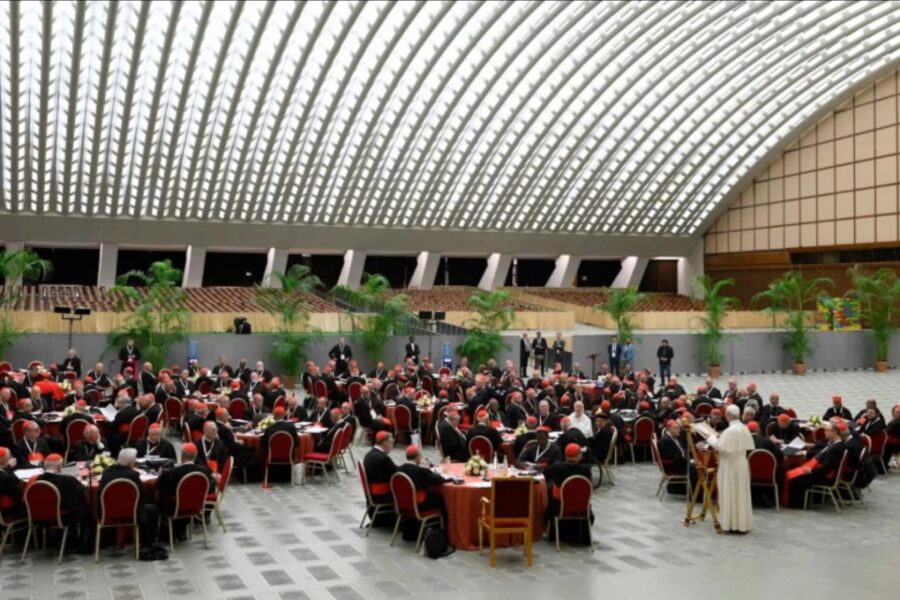
The second session of the extraordinary Consistory, held this Friday in the Paul VI Hall, focused on the fifth chapter of the encyclical Magnifica humanitas. Among the topics discussed, several groups proposed going beyond the doctrine of just war to speak of a “right to proportionate legitimate defense.”
The Paul VI Hall hosted the second session of the extraordinary Consistory on the afternoon of June 26, a day that began—not by chance—with a prayer for the “painful situation in Venezuela” and for the numerous victims of the recent earthquake. Under the title “The Culture of Power and the Civilization of Love”, the meeting was devoted to reflecting on the fifth chapter of Pope Leo XIV’s encyclical Magnifica humanitas.
The session was moderated by Cardinal Pablo Virgilio Siongco David, who gave the floor to Cardinal Víctor Manuel Fernández, Prefect of the Dicastery for the Doctrine of the Faith, in charge of the introductory relatio. Pope Leo XIV attended the opening of the proceedings and returned later for the plenary meeting, closing the day himself with the final prayer around seven-thirty in the evening.
The warning against the “normalization of war”
Eleven groups—eight from the first bloc and three from the second—presented their conclusions to the assembly. According to the communiqué issued by the Holy See Press Office, all agreed in denouncing “the dehumanizing force of the culture of power,” its universal reach, and the temptation to yield to the logic of the powerful. Particular mention was made of the normalization of war and of polarization, which lower society’s threshold of tolerance for violence and favor dangerously simplistic solutions to conflicts.
In response to this diagnosis, the conciliar fathers insisted on the responsibility of building peace and a “civilization of love,” offering credible witness that— they stressed—must begin within the Church itself: a language of listening, forgiveness, reconciliation, restorative justice, and concrete gestures.
Unity of the Church and dialogue with Islam
Unity within the Church was presented as a condition of its credibility, together with dialogue with other confessions and religions, “in particular Islam.” Several groups recalled the Church’s work in the Holy Land and in Eastern Europe as examples of situations that, at times, “can only be resolved through the intervention of God.”
References were also made to the role of political authority—to which a request was made to free it from its “toxic bond” with economic power—to the family, to education, and to the need for bold evangelization. Various interventions likewise highlighted the weight of the Holy See’s diplomacy and that of the nuncios so that the voice of the Church continues to be heard.
The twilight of the just-war doctrine?
The most delicate point of the day undoubtedly came when numerous participants raised the need to move beyond the logic of just war—since “the Gospel cannot be imposed by force”—and to speak instead of a right to proportionate legitimate defense.
The matter is no small one: the just-war doctrine, with roots in St. Augustine and St. Thomas Aquinas, forms part of the Church’s classical moral heritage. Its reconsideration within the College of Cardinals marks, at the very least, a shift of considerable theological significance.
In this context, deep gratitude was expressed to Pope Leo XIV for the encyclical, for his condemnation of armed conflicts, and for his repeated appeals for peace. The reflection also touched on the munus petrinum as a guarantee of the Church’s independence from political power, and on the advisability of symbolic gestures that serve as visible signs of peace.
A call to responsibility
In the personal interventions that closed the session, some cardinals thanked the Consistory for the space for dialogue and reaffirmed the importance of collaborating with leaders of other religions. Others dwelt on the reaction sparked by the encyclical’s recognition of the Church’s “delay” in condemning slavery—words that, they said, “have opened hearts.”
The cardinals ultimately underscored that Magnifica humanitas itself constitutes a call to the College of Cardinals to assume the responsibility of building peace, even through symbolic initiatives such as the World Day of Prayer for Peace convened by St. John Paul II in Assisi in 1986. Around 7:30 p.m., the Pope returned to the hall to preside over the closing prayer.