


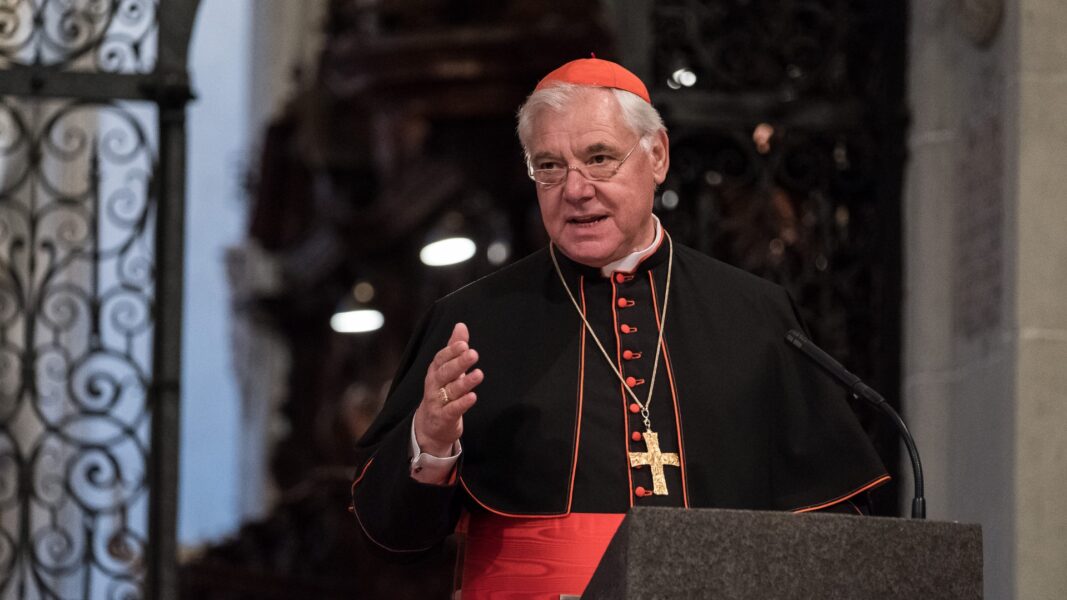
Cardinal Gerhard Ludwig Müller took advantage of the extraordinary consistory convened by Leo XIV to propose that the Holy See issue a doctrinal response to the manifesto recently sent by the Priestly Fraternity of Saint Pius X (FSSPX) to the Pope and the cardinals, and also suggested preparing a structure inspired by the former Pontifical Commission Ecclesia Dei to welcome priests and faithful who might leave the Fraternity if a formal break with Rome ultimately occurs.
The information, revealed by journalist Nico Spuntoni in Il Giornale, places the FSSPX question among the matters addressed during the consistory’s proceedings, even though it was not officially on the agenda of the sessions called by the Holy Father.
A response to the Fraternity’s doctrinal manifesto
The intervention by the prefect emeritus of the Congregation for the Doctrine of the Faith took place just days after the Fraternity delivered to Pope Leo XIV and the members of the College of Cardinals a profession of faith asserting that the Holy See has departed from Tradition and the perennial Magisterium of the Church.
Müller believes this accusation cannot go unanswered and argued for the preparation of a doctrinal document that would explicitly reaffirm the Church’s continuity with Catholic Tradition in the face of the theses upheld by the FSSPX.
The proposal carries special weight coming from the man who for years headed the dicastery responsible for doctrinal questions related to the Fraternity and who took part directly in the talks held between Rome and the FSSPX during the pontificate of Benedict XVI.
Preparing to welcome those who leave the FSSPX
Müller reportedly warned that if the episcopal consecrations scheduled for 1 July in Écône result in a formal rupture with the Holy See, priests, religious, and faithful who do not wish to remain in that situation and seek to restore full communion with Rome could depart.
With that scenario in mind, he suggested the advisability of having a specific structure capable of accompanying any eventual process of reconciliation.
The proposal would be modeled on the former Pontifical Commission Ecclesia Dei, established by Saint John Paul II through the motu proprio Ecclesia Dei adflicta after the episcopal consecrations performed by Archbishop Marcel Lefebvre in 1988.
The commission facilitated the incorporation into full communion of numerous priests and communities linked to the pre-conciliar liturgical tradition. From it emerged or under its oversight were founded institutes such as the Priestly Fraternity of Saint Peter (FSSP), the Institute of Christ the King Sovereign Priest (ICRSS), the Institute of the Good Shepherd (IBP), and other communities that preserved the traditional liturgy while remaining fully integrated into the Church.
Francis suppressed the Ecclesia Dei Commission in 2019 and transferred its competencies to the then Congregation for the Doctrine of the Faith.
Uncertainty about Rome’s response
According to the information published by Il Giornale, the Dicastery for the Doctrine of the Faith is considering the possibility that the canonical consequences of the forthcoming consecrations may differ from those adopted in 1988.
On that occasion, sanctions were imposed on both the consecrating and the consecrated bishops. This time, however, there is still no certainty about the scope of any measures the Holy See might adopt, a circumstance that is reportedly generating unease within the Fraternity itself.
It is precisely this uncertainty that, according to the sources cited by the Italian daily, explains the advisability of preparing mechanisms that would allow a swift welcome for those who might eventually request to return to full communion with Rome.
The traditional liturgy reappears at the consistory
The communities that arose under the aegis of Ecclesia Dei demonstrated for decades that it was possible to maintain the use of traditional liturgical books in full communion with the Roman Pontiff. That balance changed during the pontificate of Francis with the publication of Traditionis Custodes in 2021, which significantly restricted the use of the liturgy prior to the 1970 reform.
Nevertheless, various Vatican observers believe that within the current College of Cardinals there is a more favorable sensitivity toward this issue. In that context are also placed the reports released last year by journalist Diane Montagna, according to which the majority of the bishops consulted before the promulgation of Traditionis Custodes had expressed opposition to the restrictions ultimately approved.
An intervention that did not go unnoticed
Although no debate on the German cardinal’s intervention was opened during the consistory session, Il Giornale reports that, once the proceedings concluded, several cardinals of differing sensibilities privately expressed appreciation for the clarity of the proposals put forward by Müller.
With the episcopal consecrations announced by the FSSPX only days away, the German cardinal’s intervention makes clear that, beyond possible canonical consequences, Rome is also beginning to consider what pastoral response the Church should offer to those who, in the event of a rupture, wish to remain united to the Successor of Peter without renouncing the liturgical and spiritual tradition they have lived for years.