


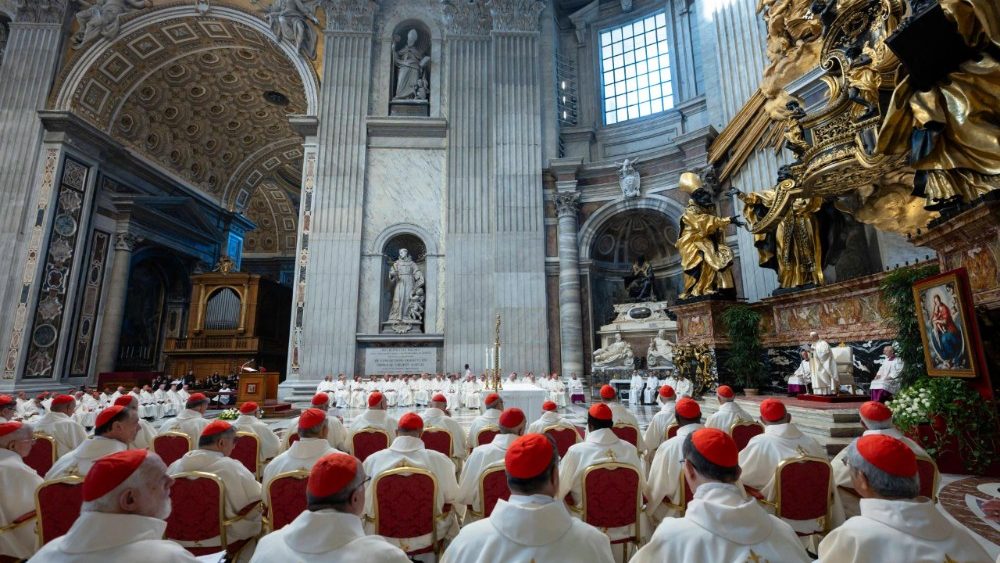
Pope Leo XIV inaugurated this Friday the extraordinary consistory that brings together the College of Cardinals in Rome with a call to strengthen ecclesial communion and to face together the challenges of the Church and the world.
In the Mass celebrated in St. Peter’s Basilica, the Pontiff called for working for peace amid the conflicts that tear humanity apart, encouraged continuing the application of the synodal path from the unity of faith, and defended an exercise of authority based on listening and service: “The Petrine ministry finds in me one who asks for help, not one who commands.”
We leave below the complete homily:
Dear and venerable brothers:
we have gathered around the altar of the Lord, beside the tomb of Saint Peter, to begin the Consistory. We come to celebrate this Eucharist from all corners of the world: together with our lives, we offer to God the communities and peoples we carry in our hearts, as well as the projects and pastoral experiences, both joyful and difficult.
This variety of feelings and thoughts now converges, that is, finds its luminous center which is Christ. He himself, in person, addresses us saying: “I am the true vine” (Jn 15:1). Through Jesus, grace and truth flow into our lives (cf. Jn 1:17), renewing us inwardly; these divine gifts are also the fruitful sap of the Consistory we inaugurate today. It is the Gospel itself that prepares the conditions for this to be fruitful: “Remain in me as I remain in you” (Jn 15:4). On the one hand, the Master warns us that “apart from me you can do nothing” (v. 5); on the other, he desires that his disciples bear “much fruit” (v. 8). Yes, much; the grace of God does not produce in those who receive it a stunted growth, but an exuberant development. The eternal Word, in fact, became man so that all “may have life and have it abundantly” (Jn 10:10). Begun in faith, this life is even strengthened by the test of pruning, because it is cultivated by the Father’s care.
Therefore, while we ask God to grant us strength and wisdom, it is significant that our Consistory takes place on the eve of the solemnity of the holy apostles Peter and Paul. Let us pause together on this commemoration, which recalls the pillars of the Catholic and Roman Church, the two missionary martyrs whose preaching was fused with their lives, to the point of becoming part of the Sacred Scriptures.
Listening today to the words of Saint Paul to the Corinthians, we can appreciate the happy consonance with those of the Gospel. The various charisms, indeed, the ministries and ecclesial activities are like the branches of the one vine, that is, of the one Lord (cf. 1 Cor 12:4-6), who pours the Holy Spirit into his Church. To this organic unity corresponds the criterion that makes all these ecclesial services good and rewarding: the criterion of the common good (cf. v. 7).
Dear brothers, from the Word of God we have just heard I would like to draw some indications for our discernment in these days.
First, the example of Saints Peter and Paul encourages us to share in faith true freedom. Indeed, it is precisely the relationship with the Lord Jesus that frees us from sin and fear: While he calls us to follow him, he himself sends us into the world as successors of the apostles. Proclaiming the Gospel, celebrating the sacraments, and dedicating ourselves to the Lord’s flock become reality and bear fruit to the extent that we believe in him, the Good Shepherd. Faith is that virtue, never to be taken for granted, that gives life to the Church, because it corresponds to the grace that nourishes the branches of the one vine. The living Church is the Church that believes, by the gift of the Holy Spirit poured into our hearts: this is the Church that bears much fruit. Just as divine grace precedes human freedom, so too the faith of the Church precedes our own and requires that we bear witness to it with enthusiasm. This mission has Christ as its beginning and its end: in the words of the psalmist, “proclaim his salvation day after day. Declare his glory among the nations” (Ps 96:2-3).
Second, let us ask for the gift of peace in unity. While we invite all peoples to the faith, in which we are truly free, international tensions and conflicts gravely wound the human family. Yet there is no lack—indeed, they are multiplying—in the Church and in the world of initiatives and experiences that call for respect for human dignity, justice, law, in a word, for what is human. This is a reason for hope, because it bears witness to the beauty of God’s work, who created us in his image and likeness, as a sign of his glory in the world. When this sign is wounded, we are all wounded. When it is corrupted, we all suffer the consequences. When it is annihilated, we all feel torn apart. That is why war is never worthy of man, and will never be blessed by God, because the Creator has endowed us with intelligence and will to resolve conflicts as human beings and not as animals, even when equipped with hyper-technological weapons. The unity of the human family precedes individual peoples and nations. It is not only a biological datum, but an ethical principle. Peace is a duty of justice because we are one single human family, a magnifica humanitas that finds in Christ its only head and redeemer.
Reflecting on the encyclical I promulgated on May 15 last, it is necessary to continue along the path traced by Saint Paul VI: when he “introduced the expression ‘civilization of love,’ the world was marked by the Cold War, the arms race, and strong economic imbalances. In that context, the Church indicated an alternative path to the ideological opposition between systems, envisioning a social order in which justice and charity are intertwined” (Encyclical Letter Magnifica humanitas, 186. Cf. St. Paul VI, Regina Caeli, 17 May 1970). In this way, Christian witness becomes a prophecy of a new world, an evangelization and service, a cultural and social project that integrally promotes human development. The Church, in proclaiming the Gospel amid joys and persecutions, never takes sides: she is for all, and to each she addresses the same word of conversion and salvation.
Third, let us enjoy today and always concord in obedience, that is, in the listening that recognizes the gift of the Word, made flesh for us. Through this exercise, the Holy Spirit guides us, pointing out to us the pastoral problems and opportunities, purifying intentions and correcting what deviates from the common path. The implementation of the Synod, for which we are striving, invites all to advance in the unity of faith, in the promotion of peace, and in obedience to the living Word, who is Jesus. In this perspective, “the enormous and rapid cultural changes require that we pay constant attention in order to express the perennial truths in a language that allows their permanent newness to be perceived” (Francis, Apostolic Exhortation Evangelii gaudium, 41). The one Word, made man, is expressed in all languages: Christ dead and risen is the true vine, who bears fruit through all the cultures that Christians transform from within. Thus, when the ideologies of the world wither, the Holy Spirit makes fraternal understanding, charity, and missionary impulse flourish in the Church.
Working together, our collegiality summarizes the synodality in which all the baptized participate, in the unity of the people of God. Synodality and collegiality are, in fact, forms of Christian fraternity that unite us as baptized and as bishops. Therefore, the help you may offer me in the exercise of the Petrine ministry finds in me one who asks, not one who commands. The authority of the primacy, in fact, belongs to one who listens and only thereby guides, to one who learns and only thereby teaches, always following the one Master. May the intercession of the holy apostles Peter and Paul accompany us on this exciting journey.