


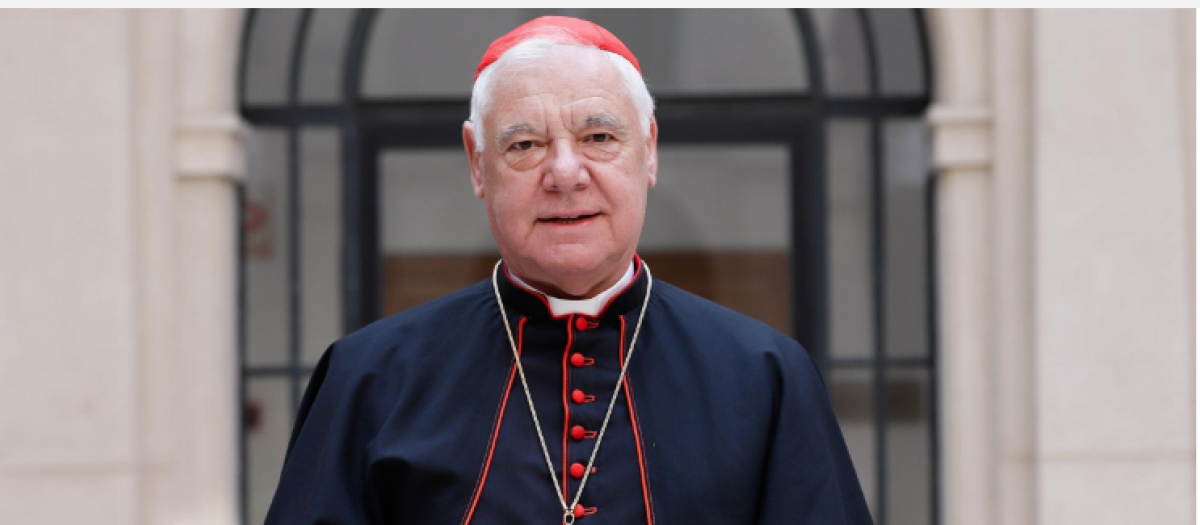
Cardinal Gerhard Ludwig Müller has responded to the proposals promoted by the German Synodal Way that seek to open the door to lay preaching during Holy Mass. In an article published by Kath.net, the former Prefect of the Dicastery for the Doctrine of the Faith maintains that this practice contradicts the teaching of the Second Vatican Council, breaks the unity of the Eucharistic celebration, and distorts the nature of sacramental priesthood.
The cardinal recalls that the Second Vatican Council expressly affirmed that the Liturgy of the Word and the Eucharistic Liturgy are “so closely united with each other that they constitute one single act of worship.” From this principle he concludes that it is not possible to separate both parts of the celebration, entrusting the first—including the homily—to a layperson and reserving the second to the priest.
“It is not possible to tear apart the Liturgy of the Word and the Eucharistic Liturgy of Holy Mass, having the first, with the homily, led by a layperson and the second celebrated by an ordained priest,” he states.
The ordained priesthood also includes the ministry of the Word
Müller grounds his argument in the Church’s constant doctrine, recalling that priestly ministry is not limited to Eucharistic consecration but inseparably comprises the proclamation of the Gospel, the celebration of the sacraments, and the pastoral governance of the community.
Drawing on the constitution Lumen gentium, he recalls that priests are sacramentally configured with Christ “to proclaim the Good News, shepherd the faithful, and celebrate divine worship.” Consequently, he maintains that the homily during Mass belongs to the celebrating priest by virtue of the sacrament of Holy Orders, with the collaboration of the deacon, who shares in that ministry according to the proper degree of his ordination.
In the same vein, he cites the recent statement of the Dicastery for Divine Worship, which has reiterated that the homily forms an integral part of the Eucharistic celebration and constitutes a ministry reserved to those who have received the sacrament of Holy Orders.
“Those who invoke Vatican II are the first to contradict it”
Müller recalls that the Second Vatican Council teaches that the Liturgy of the Word and the Eucharistic Liturgy form a single act of worship and that, therefore, they cannot be separated or assigned to different subjects, since the ministry of the Word during Mass belongs to the ordained priest.
“It is interesting that precisely those who so readily invoke Vatican II contradict it on the question of lay preaching during Holy Mass,” he writes.
In his view, these proposals do not represent a development of the Council but rather a departure both from the doctrine of Vatican II and from the teaching defined by the Council of Trent on ministerial priesthood.
The cardinal adds that fragmenting the proper functions of the priest and “externalizing” them according to a merely functional criterion leads, in practice, to a Protestant understanding of ordained ministry, in which sacramental priesthood ultimately dissolves into the common priesthood of all the baptized.
Harsh criticism of the German Synodal Way
Finally, Müller directs an especially severe criticism at those promoting these reforms from Germany.
“The permanent protesters of Germany should reconsider not only their relationship with the Petrine ministry of the Pope but also study the foundations of Catholic theology, instead of continuing to drive the Church in Germany against the wall with ideologies laden with resentment and power claims,” he states.
The words of the former Prefect of the Dicastery for the Doctrine of the Faith once again highlight the deep fracture existing in the German Church on liturgical and ecclesiological issues. While the Synodal Way continues to promote an expansion of the liturgical functions of the laity, Müller maintains that these proposals do not represent an application of the Second Vatican Council but rather contradict its teaching and call into question Catholic doctrine on ministerial priesthood.