


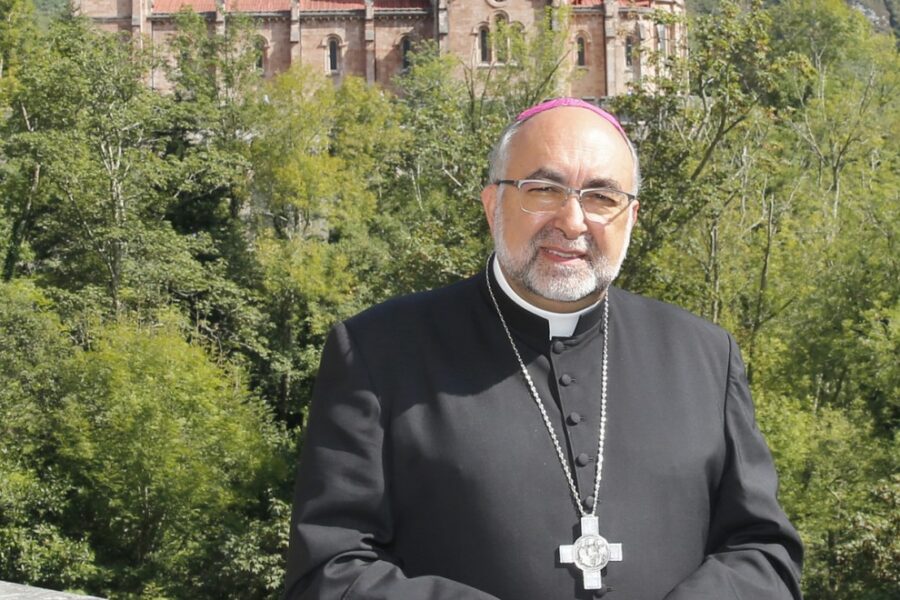
The Archbishop of Oviedo, Monsignor Jesús Sanz Montes, has unapologetically claimed the value of conservatism understood as fidelity to truth, goodness and beauty, has defended the Church’s right to intervene in public life and has offered a harsh diagnosis of the Spanish political situation.
In an extensive interview given to El Debate, the prelate also reflects on the beginning of the pontificate of Leo XIV, whom he presents as a figure called to restore hope to a Church and a society marked by a profound sense of orphanhood.
Far from accepting the political categories with which bishops are usually classified, Sanz Montes reclaims the term “conservative” from a perspective very different from the ideological one.
“I am conservative and, moreover, I profess my conservatism because I want to conserve the things that are worth keeping. The ones that are dispensable I set aside,” he states. Yet he also adds that he believes in genuine progress: “As I am also adventurous, I always believe in progress, because life has no pause button.”
For the archbishop, the two realities are not opposed. “I conserve truth, goodness and beauty, and I want to progress in them, as the Christian tradition—beginning with the Gospel—has taught me.”
“From the Wojtyła hurricane to the Prevost breeze”
Reflecting on Leo XIV’s recent apostolic journey to Spain, Sanz sums up the visit with an expression that encapsulates his view of both pontificates: “From the Wojtyła hurricane to the Prevost breeze.”
The archbishop recalls the impact of the election of Saint John Paul II after the years of crisis following the Second Vatican Council.
“He gave us back hope, the ‘Be not afraid.’ That was a constant throughout his pontificate.”
In his judgment, Leo XIV has taken up precisely that same message at a very different but equally complex historical moment.
Sanz describes a society marked by a triple orphanhood. He speaks of a political orphanhood, caused by “all the corruptions and their different sewers”; of a cultural orphanhood, the result of ideologies that seek to break with the Christian tradition; and also of an internal orphanhood within the Church, where in recent years “there has been a certain confusion and also a certain hopelessness.”
In that context he places the arrival of the new Pontiff.
“Suddenly a man appears whom we did not fully know and whom you recognize in his words, in his attitudes, in his texts and in his gestures as a father. A father who gives you life again, who wants to see it grow and who gives you hope.”
That is why, he adds, “people take to the streets as if saying: ‘We were waiting for you, even though we did not know it.’”
“The Gospel will always be a sign of contradiction”
The archbishop rejects a sweetened vision of Christianity according to which the proclamation of the Gospel can never be uncomfortable.
“Evidently the Gospel is a sign of contradiction,” he affirms.
And he explains why.
“When you defend life against the friends of death; when you defend truth in a world full of deceit; when you are a friend of the family against those who confuse it, dismantle it and, if they can, destroy it, you will be a sign of contradiction.”
For Sanz Montes, precisely there lies one of the most frequent temptations within the Church itself: to replace the proclamation of truth with a desire to please everyone.
“Here, feel-good-ism has no place, where, through a kind of false irenicism, you want to be on good terms with everyone.”
He clarifies, however, that such firmness does not imply seeking confrontation.
“I have no interest in raising barricades or digging trenches. But I defend with all my strength life, the family, freedom of education, truth, beauty and goodness. Sometimes that makes you uncomfortable, but you pay the price of being honestly who you are so as not to falsify your own identity.”
“Whenever I can, I get involved in politics”
The archbishop responds to those who maintain that the Church should stay out of public life.
“Whenever I can, I get involved in politics,” he replies with irony.
“I understand politics as the polis, the city. I am a citizen of this world who tries to speak his word and build his work.”
From that perspective, he maintains that the Church cannot accept being expelled from the public debate.
“Our word and our project must have a place. Through threats, labels and attacks some seek to take away our voice until they make us mute and to eradicate our presence until they make us absent.”
Against this, he claims the right and duty of Christians to participate in the building of society.
“We must not be mute or fugitives. We must speak our word and show our presence, because we are part of this city.”
A very harsh critique of the Spanish political situation
On current events in Spain, the archbishop speaks without mincing words of a climate of institutional and moral deterioration.
“We live in a profound orphanhood when we look at the political scene with all the corruptions and their different sewers,” he states.
In his view, there is a permanent machinery dedicated to whitewashing reality.
“There are plenty of advisers who work continuously adorning, whitewashing and sweetening what is a disaster.”
That communicative effort, he maintains, explains why part of society continues to support political leaders despite known scandals.
“There are many people working to convince a population—sometimes very vulnerable—through the whitewashing and the faking of a harsh reality. That explains why there are people who continue to support what is plainly shown to be corrupt, lying, where there are thieves and where people are perverted in the most obscene ways.”
Asked directly about the continuity of Pedro Sánchez’s government after the latest corruption cases, Sanz avoids naming the president explicitly, but makes clear what he believes the response should be when a political action loses its moral legitimacy.
“Politics is a most beautiful thing. It is an expression of charity, as the Church’s Social Doctrine says, provided it is upright and honest politics.”
And he adds:
“When it is perverted and ruined, the first thing that must be done is to acknowledge it and let others come in so they can try to do something different.”
Support for judges, prosecutors and journalists
The archbishop concludes the interview by showing his backing for those who, from different spheres, are helping to bring corruption cases to light.
“We must continue to support those who are bringing this unmasking to the surface.”
He specifically mentions “judges and prosecutors” and also “journalists who are free,” whom he considers essential for defending honesty in public life.
From that perspective, he insists that the Church must not stop reminding people of the moral principles that inspire Social Doctrine.
“We must not cease to insist on the Christian principles with which we have built a city, a law and a culture that bear the stamp of the holy Gospel.”