


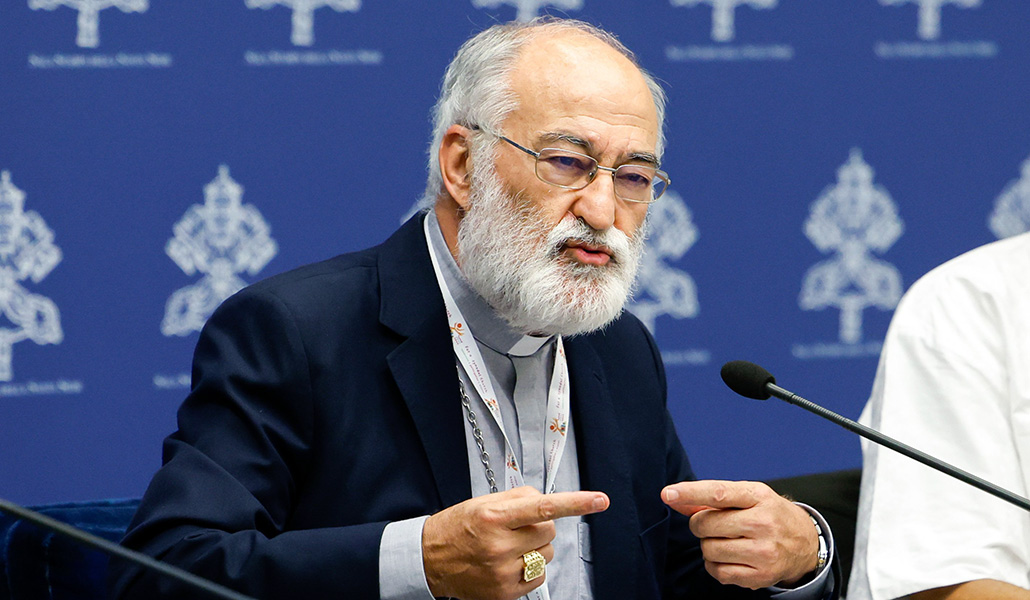
With the start this Friday of the extraordinary consistory convened by Leo XIV, Cardinal Cristóbal López Romero has defended the Pontiff’s decision to turn these meetings into an annual event and has highlighted the Pope’s international profile, stating that “few cardinals in the conclave had as broad a vision of the world and the Church as Prevost.”
In an interview given to the Italian daily Avvenire, the Archbishop of Rabat (Morocco) explains that these gatherings respond to a request made by the cardinals themselves during the general congregations prior to the conclave and that they seek to strengthen communion between the Holy Father and the College of Cardinals.
“We need to get to know one another better. It is good to share the richness of the diversity of our Churches. We must surround the Pope, support him and accompany him more closely,” the cardinal affirms.
A consistory that aims to become an annual event
The consistory that began this Friday is the second convened by Leo XIV in just six months, following the one held last January. However, the Pontiff already announced at that time his intention to institutionalize this instrument of governance and to convene it every year, with longer meetings.
López Romero views this initiative very positively, noting that it will also include a period of spiritual retreat.
“I greatly appreciate the proposal to convene an annual consistory lasting three or four days that also includes a moment of intense spirituality in the form of a brief retreat,” he states.
During these two days, the cardinals will address issues such as the proclamation of the Gospel in a world marked by war and international tensions, the implementation of the encyclical Magnifica Humanitas—especially regarding the building of peace—and the reception of the Synod on Synodality in view of the Ecclesial Assembly scheduled for October 2028.
“Leo XIV arrived prepared for the Petrine ministry”
The Moroccan cardinal believes that Robert Francis Prevost’s personal and pastoral background explains the serenity with which he has been exercising the Petrine ministry since his election.
“His experience as a missionary and bishop in Peru and the years leading the Order of Saint Augustine prepared him deeply for this service,” he affirms.
He also adds the knowledge gained during his time as Prefect of the Dicastery for Bishops.
“His time at the Vatican allowed him to understand the internal workings of the Curia and to play a decisive role in the appointment of hundreds of bishops.”
Above all, however, López Romero highlights the direct knowledge the Pope possesses of the universal Church.
“He has visited more than fifty countries on every continent, and not as a tourist. Very few cardinals in the conclave had as broad a vision of the world and the Church as his.”
Tradition and progress are not opposing concepts
Asked about those who present Leo XIV’s pontificate as a balance between tradition and renewal, the Archbishop of Rabat rejects that apparent opposition.
“Tradition and progress are not opposing concepts, but realities that complement each other,” he maintains.
In his view, the problem arises when Tradition is identified with certain historical customs.
“We must distinguish between Tradition and traditions. Tradition is rooted in Christ himself. We must return to the Gospel, not necessarily to the traditions of one, two or three centuries ago.”
The unity of the Church and the liturgical debate
For López Romero, divisions among Christians “constitute a scandal” that weakens the credibility of the proclamation of the Gospel, although he recalls that unity does not mean uniformity.
In this context, he also refers to the debate on the liturgy and the celebration of Mass according to the rite prior to the liturgical reform.
“Let us not deceive ourselves: the problem is not in the liturgy or in the language used during the celebrations. The issue is much deeper. It is about accepting or rejecting the documents of the Second Vatican Council and the understanding of the Church that derives from them.”
Evangelizing with one’s life
López Romero likewise insists that evangelization cannot be reduced to the mere verbal transmission of the Christian message.
“Many reduce evangelization to pronouncing certain phrases. But proclaiming the Gospel consists above all in living it.”
For this reason, he recalls that the Christian faith can only be credibly proclaimed when it is translated into a coherent existence, nourished by prayer, formation, liturgy and daily commitment to the Kingdom of God.
Cardinal López Romero’s statements accompany the start of a consistory with which Leo XIV seeks to consolidate a more stable mode of governance alongside the College of Cardinals. The Pontiff already announced after the January meeting his intention to turn these gatherings into an annual event, convinced that communion between the Pope and the cardinals also requires periodic spaces for listening, discernment and shared work.