


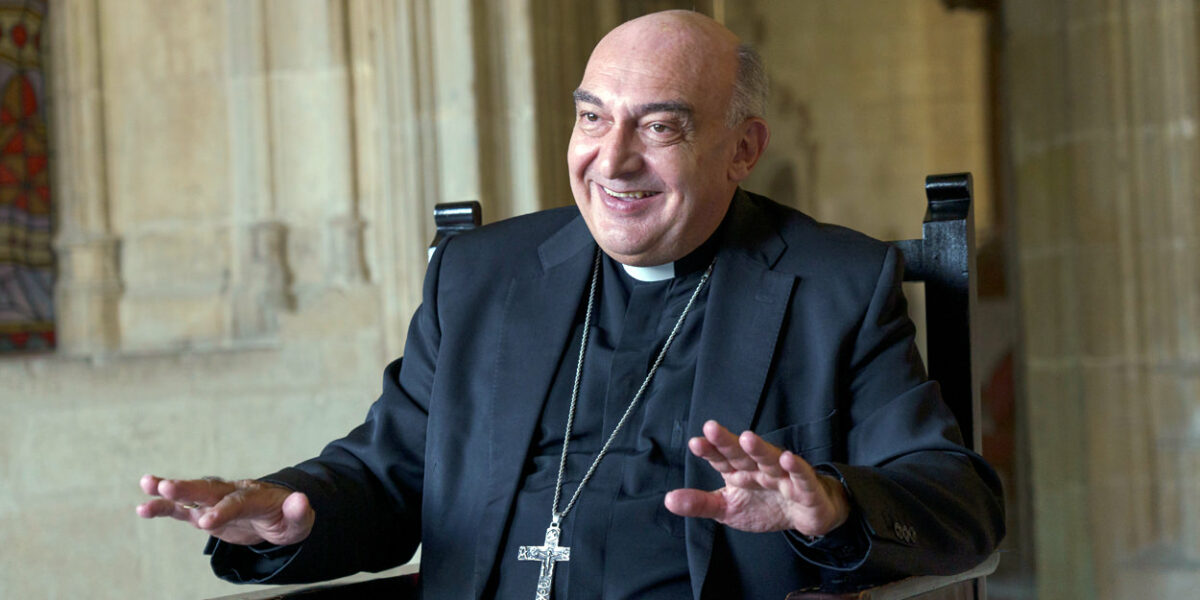
The debate on immigration continues to occupy a central place in public and ecclesial life in Spain. In this context, the Archbishop of Valencia, Enrique Benavent, rejected this Thursday the idea that the so-called “national priority” could serve as the criterion from which Christians should approach the migratory phenomenon and defended that “immigrants are part of our life” because “they care for the sick and the elderly, work the fields” and are present “in many sectors of social and economic life.”
The words of Benavent add to various statements in which bishops and the Spanish Episcopal Conference have insisted on the welcome of immigrants, while from different political and ecclesial spheres the right of States to regulate migratory flows in accordance with the common good has been claimed.
During a breakfast organized by Fórum Europa Tribuna Mediterránea in Valencia, the archbishop defended that “the priority of Christians is, when we have a person in need before us, not to distinguish whether a person is of one race or another.” “For us, all human beings are children of God,” he added.
Benavent insisted on that idea with an even more explicit statement: “When we can help someone, we cannot deny them help because of their race, language, religion or different country.” In his view, “when it comes to helping people in need, the priority is the vulnerability of the persons.”
The prelate nevertheless clarified that this moral obligation does not eliminate the proper responsibility of public authorities. “Another thing is that States have limited resources,” he stated. For this reason, he acknowledged that “evidently, there have to be criteria for distribution,” although he reiterated that the institutions of the Church “will always act guided by this priority.”
Returning to the migratory question, Benavent defended that immigrants “are part of our life” because “they care for the sick and the elderly, work the fields” and are involved “in many sectors of social and economic life.” “We must think that they should be treated as human beings with all their dignity,” he concluded.
The evangelization and growth of evangelical groups
Beyond the issue of immigration, the archbishop reflected on the rise of certain evangelical movements and admitted that the Church must ask itself about the way it presents the faith in an increasingly secularized society.
In this regard, he considered that “perhaps an excessive institutionalization of religion can be a difficulty for evangelization” and that “an excessive intellectualism in the way of presenting the faith can be a difficulty for evangelization for certain sectors.” Nevertheless, he warned that “we cannot remain with pure emotionalism.”
Benavent also stated that secularization has changed the way faith is transmitted and maintained that today it “is transmitted by witness,” rather than by family inheritance. Likewise, he defended that the Church “is not a monolithic institution,” but a reality in which diverse spiritualities and ways of living the faith coexist.
In the question-and-answer session he also addressed the debate on the use of Valencian in the liturgy. The archbishop denied that there is any prohibition on celebrating in that language, called for “depoliticizing” the issue and recalled that during his time at the head of the diocese of Tortosa, celebrations in Valencian and Spanish coexisted normally, without generating controversy among the faithful.
The statements of Benavent are part of a line of positions maintained by various members of the Spanish episcopate on the migratory question. The president of the Spanish Episcopal Conference, Luis Argüello, has rejected the so-called “national priority” and has defended that the response to immigration should be inspired by the Gospel, while the Bishop of the Canary Islands, José Mazuelos, has advocated for the regularization of immigrants already present in Spain and has called for separating immigration from political confrontation. These interventions have consolidated an episcopal discourse with positions close to the migratory policies promoted by the Government, relegating to a secondary place other principles of the Church’s social doctrine, such as the common good, subsidiarity or the right of States to regulate migratory flows.