


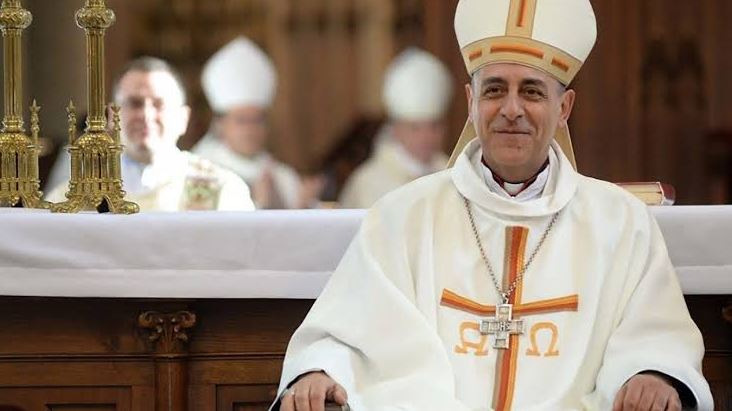
An extensive analysis published by El Wanderer has brought to light an academic article by Cardinal Víctor Manuel Fernández that, although written more than thirty years ago, raises questions that are difficult to ignore today. The reason is clear: the young theology professor who signed that study back then is now the Prefect of the Dicastery for the Doctrine of the Faith, the body entrusted with safeguarding the integrity of the Catholic faith.
A claim that goes beyond Christian hope
The article, published in 1995 under the title Romans 9-11. Grace and Predestination, concludes with a statement that lies at the heart of the entire controversy:
“I firmly trust that all will be saved; a trust that is not based on a wish, nor on my compassion for humanity, but on what I know of God and His concrete plans through His Revelation.”
It is not merely a matter of expressing the desire that no one be condemned. That hope has been present in many Catholic authors. The problem arises when this hope is presented as a certainty grounded in Revelation and in a supposed knowledge of God’s specific designs. At that point, the discussion ceases to be just another theological opinion and enters far more delicate territory.
Rereading St. Augustine… in order to correct him
From the very first pages of the article, the then-Argentine professor maintains that a correct interpretation of chapters 9 to 11 of the Letter to the Romans allows one to “relativize” much of the doctrine developed by the Church Fathers and the great medieval theologians on predestination.
The principal target of this revision is St. Augustine. His teaching is presented as the source of “questionable” formulations that supposedly conditioned reflection on grace and predestination for centuries.
However, it is difficult to accept this conclusion. St. Augustine was not corrected by the Church; on the contrary, his doctrine on the absolute primacy of grace was assumed by later tradition, decisively inspired the Second Council of Orange, and was integrated by St. Thomas Aquinas into the great scholastic synthesis.
A debatable reading of St. Thomas
The critique also extends to the way Fernández uses the work of the Angelic Doctor.
The current Prefect of the Doctrine of the Faith frequently cites texts in which St. Thomas exalts divine mercy, but scarcely allows room for those in which he affirms the reality of predestination, reprobation, and the possibility of eternal damnation.
This is no minor issue. For St. Thomas, mercy never eliminates justice; it perfects it. Nor does it turn universal salvation into a necessary conclusion.
It is therefore striking that the article ends by expressing certainty about the final destiny of all human beings, when Aquinas himself insists that the mystery of predestination belongs to the unfathomable designs of God.
What the Magisterium teaches
The Church has never taught that all human beings will be saved.
It has taught that God desires the salvation of all and offers every person the grace necessary to attain it. But it has also taught—from the words of Christ to the current Catechism—the real possibility of eternal damnation for those who freely reject that grace.
The Council of Trent expressly warned against any attempt to penetrate the mystery of predestination beyond what has been revealed. The Catechism recalls that God does not predestine anyone to hell, yet it equally affirms the existence of hell and human responsibility in the use of freedom.
Even Benedict XVI, in Spe Salvi, carefully distinguished between hoping for the salvation of all and affirming that such salvation constitutes a certainty. The difference is essential, and it is precisely here that one of the main objections to Fernández’s text arises.
The problem is not the 1995 article
As El Wanderer observes, the real problem is not that a young professor published a debatable article thirty years ago. That happens with relative frequency in academic circles.
The issue is that this professor is now the Prefect of the Dicastery for the Doctrine of the Faith and, as far as is publicly known, has never retracted the theses he defended then nor explained whether they still reflect his thinking.
For this reason, the discussion no longer belongs solely to theology specialists. It affects the doctrinal authority of the body charged with confirming the Church in the faith she has received.
A question that directly challenges Leo XIV
In his first encyclical, Leo XIV thanked those who help point out “what is not working in the Church.” Among those issues is also the responsibility of ensuring that those who hold the highest doctrinal offices do so in full continuity with the Magisterium.
No one expects the Holy Father to make hasty decisions or spectacular adjustments. Nor does that seem to correspond to his style of governance. But it is legitimate to expect him to bring clarity to questions that directly affect the faith of millions of Catholics.
The Church needs doctrinal certainties, not new ambiguities. And when those ambiguities appear to come precisely from the Prefect called to safeguard doctrine, silence ceases to be a solution.
The Dicastery for the Doctrine of the Faith must be a service to revealed truth and not a laboratory of theological hypotheses open to interpretations incompatible with the constant tradition of the Church.