


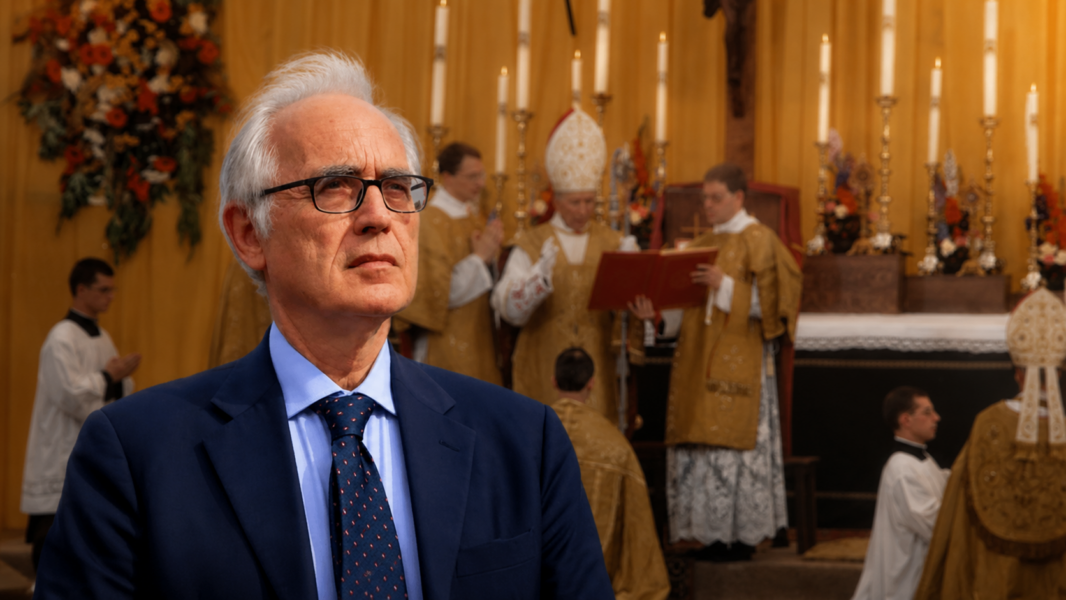
A few days before the announced episcopal consecrations that the Priestly Fraternity of Saint Pius X plans to celebrate on July 1 in Écône, the historian Roberto de Mattei has published on his Substack account a reflection on the theological, canonical, and pastoral implications of this decision. Without concealing the gravity of the moment, De Mattei analyzes the argument of the “state of necessity” invoked by the Fraternity, warns of the risk of a new fracture within the Church, and maintains that any lasting solution necessarily passes through the Successor of Peter. Below, we reproduce his article in full, translated into English.
We offer below the complete translation of the article:
What should one think and what should one do in the face of the episcopal consecrations announced by the Priestly Fraternity of Saint Pius X in Écône for next July 1, and the consequent latae sententiae excommunication that will be reaffirmed by the Holy See?
The first consideration to be made is that, if this comes to pass, we will find ourselves facing a painful trial, not only for the world of Catholic Tradition, of which the Priestly Fraternity of Saint Pius X has been a part since its founding on November 1, 1970, by Archbishop Marcel Lefebvre, but also for Pope Leo XIV. The Pontiff has identified the internal reconciliation of the Church as one of the principal objectives of his pontificate and would find himself, little more than a year after his election, having to confront a new tearing of the ecclesial fabric, with the risk of aggravating divisions that have awaited a solution for decades.
As for the substance of the controversy, one cannot fail to note what appears to be a genuine paradox. Among the many reasons put forward by Archbishop Lefebvre in 1988—and taken up today by the Priestly Fraternity of Saint Pius X to justify episcopal consecrations without a pontifical mandate—the argument of the state of necessity of the faithful in the face of the gravity of the ecclesial crisis is, at the same time, the weakest and the strongest.
The state of necessity is, by its very nature, an exceptional condition that allows one to depart from the ordinary application of certain norms in view of a higher good, which in the case of the Church is the salvation of souls. But who has the authority to verify the existence of that state and determine its beginning and its end? It is evident that this assessment cannot be left to the judgment of the Priestly Fraternity of Saint Pius X itself. If that were the case, one would have to conclude that the state of necessity ceases when the Fraternity considers that it has ceased, in effect attributing to it a power of judgment over the Holy See incompatible with the hierarchical and visible constitution of the Church. This would lead to a situation in which a particular subject would set itself up as the ultimate criterion for evaluating the actions of the supreme authority.
If the principle of the state of necessity were admitted as a general criterion of action, any bishop who considered that the Church was undergoing a grave crisis could feel authorized—or even morally obliged—to consecrate other bishops without a pontifical mandate in order to ensure the continuity of the faith and the sacraments. The consequence would be a proliferation of parallel jurisdictions and episcopi vagantes scattered throughout the world, with inevitable effects of fragmentation, disorder, and confusion precisely for the faithful whom one sought to protect.
The existence of an episcopal lineage derived from Bishop Richard Williamson—one of the four bishops consecrated by Archbishop Lefebvre in 1988 and later expelled from the Priestly Fraternity of Saint Pius X—shows concretely how the logic of the state of necessity, once detached from a higher principle of authority capable of delimiting and regulating it, can generate new divisions. This is a phenomenon that, regardless of judgments about the persons involved, demonstrates the intrinsic risk of episcopal consecrations based on subjective assessments of the state of necessity.
And yet, this argument, so fragile on the theological and canonical plane, presents itself as the strongest on the pastoral plane. Archbishop Lefebvre was not a speculative theologian nor a canonist, but a missionary and a pastor of souls. In his letter to the priests of April 27, 1987, he wrote: “The faithful who remain Catholic find themselves in many places in a spiritually desperate situation. It is this cry that the Church hears; it is for these situations that she grants jurisdiction through the law of supply.” For him, the decisive criterion was not the assertion of a right proper to the Fraternity, but the spiritual need of the faithful. The episcopal consecrations of 1988 were intended to be a response to that cry of souls.
We are faced, therefore, with the paradox. The Priestly Fraternity of Saint Pius X, by invoking the state of necessity, bases a large part of its justification on the primacy of pastoral requirements over strictly juridical and doctrinal considerations, thereby adopting precisely that primacy of pastoral praxis which constitutes one of the fundamental principles of the Second Vatican Council. The Dicastery for the Doctrine of the Faith, on the contrary, invokes Vatican II, but does not recognize the weight of the pastoral argument and employs against the Fraternity the terms and concepts of pre-conciliar theology, in the name of the binding force of doctrine and law.
In this confused situation, the only sensible advice that can be offered to those who harbor doubts is to adhere to the principle of logic and law: In dubiis standum est pro statu quo, donec ratio certa contrarium persuadeat (“In doubtful cases, the present state of affairs must be maintained until certain proof persuades to the contrary”). Reason advises that each person remain in the place where he finds himself, continuing with what he is doing and avoiding being drawn into sterile polemics and emotional proclamations that produce no other result than reopening old wounds and pouring vinegar on the Church’s sores.
The problem that arises today is much broader than the grave matter of the episcopal consecrations of July 1 and their canonical consequences. Nor is the question exhausted in the debate over the traditional liturgy or the interpretation of the documents of the Second Vatican Council. At the heart of the controversy lies the historical and theological judgment on the twentieth century, a century that profoundly marked the destiny of the Church and of the contemporary world.
A little more than a hundred years ago, the conflagration of the First World War put an end to the international order born of the Christian centuries, while the Bolshevik Revolution of October 1917 provoked an even greater conflagration in the world. But that same year in which Bolshevism seized power, the Virgin appeared to the three shepherd children of Fatima, explaining the true causes of the crisis of the modern world and assuring, after chastisements, wars, and persecutions, the final triumph of her Immaculate Heart. The message of Fatima was addressed to all humanity, but in a particular way to the Shepherds of the Church, in whose midst modernism had begun to spread its deadly poison. Against that evil, Providence raised up Saint Pius X. With the encyclical Pascendi Dominici Gregis, of September 8, 1907—ten years before the apparitions of Fatima—the great Pontiff denounced with prophetic clarity the process of self-destruction that would unfold in the following decades. Pascendi and Fatima constitute, respectively, the doctrinal diagnosis and the supernatural response to the crisis of modernity. These events, in turn, only acquire their authentic meaning when placed within a broader perspective that allows one to read the events of history as phases of a single struggle that runs through the centuries.
It is here that the vision of Saint Augustine acquires extraordinary relevance for our time. In The City of God, the great Doctor of the Church interprets history as the permanent confrontation between those who orient their lives toward God and those who reject the divine order. The Augustinian tradition, with its capacity to read historical events in the light of Providence, offers the interpretive key necessary to confront questions that continue to determine the life of the Church, with its apostasies, its persecutions, and its acts of heroism.
The final word, in this dramatic horizon, belongs to the one who possesses the divine mandate to guide the Church and whom the Priestly Fraternity of Saint Pius X itself recognizes as the legitimate Vicar of Christ: the reigning Pope, Leo XIV. No solution to the grave problems afflicting the Mystical Body of Christ can be found outside him or against him.