


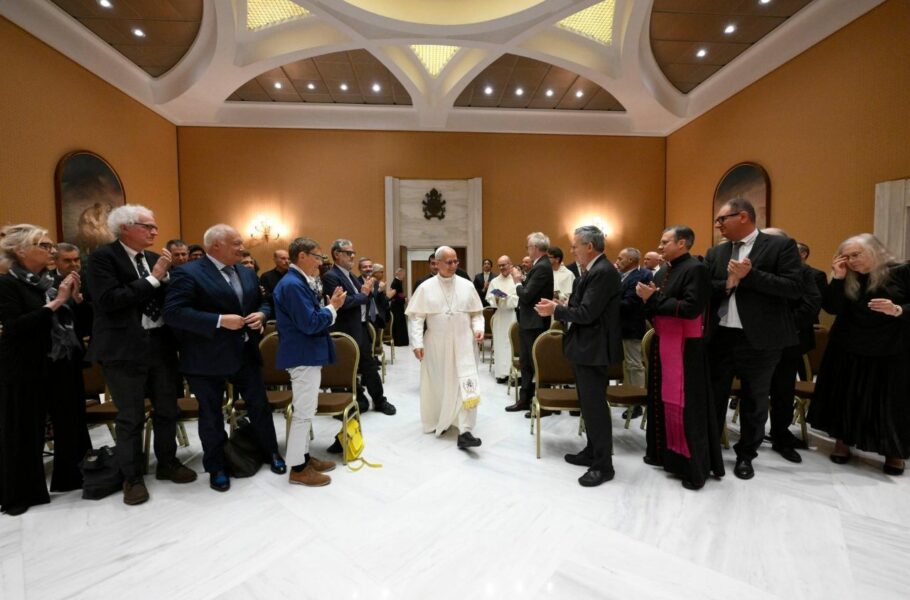
Pope Leo XIV received an international group of writers in Rome this Wednesday on the occasion of the centenary of the Vatican Publishing House (LEV), the official publishing house of the Holy See founded in 1926 during the pontificate of Pius XI.
During the meeting, held in the Paul VI Hall, the Pontiff reflected on the role of literature, the search for truth, the formation of human sensibility, and the relationship between artistic creation and faith. Before authors from different countries and cultural traditions, Leo XIV defined writing as an “act of truth” and revelation, capable of expressing who we are, what we hope for, and toward what future we are heading.
The Pope also argued that truth cannot become an object of ideological appropriation or a position to be imposed by force, but must be shared through dialogue and openness to the other. Citing a recent document of the Holy See, he stated that “truth is not a territory to be defended, but a good to be shared.”
Throughout his address, Leo XIV referred mainly to the human search for truth that unfolds in experience, literature, and encounter with others. However, he noted that this search, when authentic, leads to the fundamental questions of existence and can open the heart to God.
The Pontiff also highlighted the humanizing value of literature, recalling the words of Francis on the capacity of great texts to broaden the reader’s perspective and foster empathy. As he explained, writers help discover perspectives different from one’s own and allow a better understanding of the complexity of human experience.
In the final part of his speech, Leo XIV explicitly linked this exploration of the human condition with the Christian faith. Drawing inspiration from reflections by Cardinal Timothy Radcliffe, he maintained that when human beings sincerely delve into their own humanity, they do not move away from God but draw closer to Him, for the biblical God reveals Himself precisely in the concrete stories of men and women.
Below is the full text of Leo XIV’s address:
Good morning to all of you and welcome.
I am pleased to welcome you, writers from many parts of the world, gathered in Rome to commemorate the centenary of the founding of the Vatican Publishing House, the publishing house of the Holy See, established in 1926.
This is an opportune occasion to reflect on the importance of books and writing, a form of human expression in which you, with the diversity of your styles and languages, are masters and models.
Writing, as you well know, is an act of truth, of revelation, because it reveals who we are, what we believe and hope for, the world toward which we are heading, and the future we dream of. In this search for truth, we perceive that truth is discreet and reveals itself to us in our interior dialogue with God and in our open and respectful dialogue with our neighbor. Moreover, “truth is not a territory that must be defended, but a good that must be shared” (Magnifica Humanitas, 25). We are never masters of the truth; if anything, it is truth that conquers us. That is why I hope you will inspire others to be drawn to the truth, because you yourselves are drawn to it.
Furthermore, writing is an act of humanity. As the ancient author Terence observed: “I am human, and nothing human do I consider alien to me” (The Self-Tormentor, I, 1, 25). Literature encompasses the entire spectrum of human experience, to the point that Pope Francis highlighted its formative value: “Reading a literary text places us in the situation of ‘seeing through the eyes of others’ (C. S. Lewis), acquiring a breadth of perspective that broadens our humanity. In this way we develop an imaginative empathy that allows us to identify with the way others perceive, experience, and respond to reality. Without that empathy there can be no solidarity, participation, compassion, or mercy” (Letter on the Role of Literature in Formation, 34).
When you write stories and develop characters, you identify with them; you grasp their points of view, their emotions, their feelings, and their attitudes. This is the great exercise of humanity that you allow your readers to experience, because, in a certain sense, those who read live many lives besides their own. This helps us discover different perspectives, avoid considering our own opinions absolute, and reassemble, like a mosaic, the profile of that truth which always transcends us.
Finally, writing has to do with God. This may seem a bold statement, but several theologians have reflected and written about the harmony between the art of writing and the revelation of the biblical God. It is the very structure of Revelation that authorizes us to affirm it. As Cardinal Radcliffe wrote: “For Christians, nothing human is alien to Christ. Every attempt to address the fundamental questions of our life—how to love, how to be just, how to be free, how to face suffering and death—helps us understand Christ, the most human of all” (T. Radcliffe, Alive in God. A Christian Imagination, London 2019, p. 15).
When we descend into the depths of our humanity, we are not far from God; for it is there, amid profoundly human stories, that God reveals Himself. The God of the Bible manifests Himself in the liberation from slavery, in the birth of a child when all hope seemed lost, and in merciful and faithful love. He speaks through events and encounters, faces and stories. “God acts in our lives through what we do and what we are, and also through the many people we meet” (Free under Grace, Vatican City 2026, 83).
That is why I repeat to you, writers, what Saint Paul VI said to all artists: “We need you” (Homily at the Mass with Artists, May 7, 1964). We need your imagination, your narrative creativity, and the liveliness of your thought. We need you to create spaces of freedom and authenticity in which divine grace can make the promise of consolation and peace resound. I thank you every time you have sown seeds of reconciliation, encounter, and friendship.
For this reason, I encourage you in your work and gladly invoke upon you and your loved ones the blessing of the Lord.
Thank you very much.