


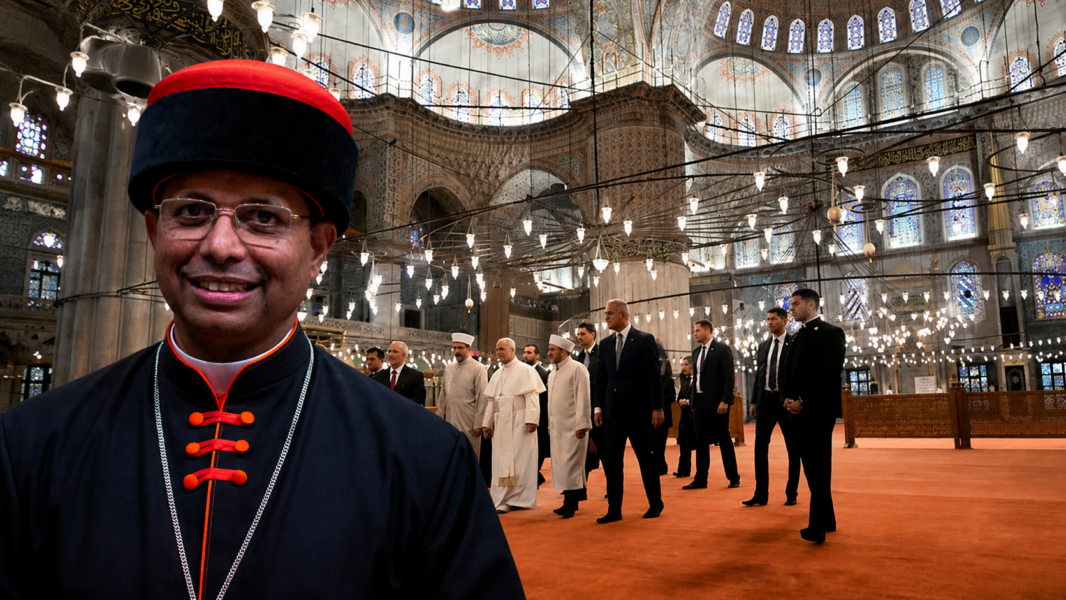
Cardinal George Jacob Koovakad, prefect of the Dicastery for Interreligious Dialogue, has defended that papal visits to mosques, synagogues, and other non-Christian places of worship should not be interpreted as a form of religious relativism or as an equivalence among all religions. He made this statement in an interview given to AdVaticanum, in which he addresses some of the most debated issues regarding the interreligious dialogue promoted by the Holy See.
Koovakad, appointed prefect of the dicastery in 2025 and considered one of the emerging figures of the Roman Curia, responds in the interview to questions about evangelization, dialogue with other religions, his meeting with Patriarch Kirill of Moscow, and the recent visit of Leo XIV to the Grand Mosque of Algiers.
“Dialogue does not replace the proclamation of Christ”
Throughout the interview, Koovakad insists on an idea he considers fundamental: interreligious dialogue cannot be understood as an alternative to evangelization or as a renunciation of the Church’s missionary mandate.
Drawing on the document Dialogue and Proclamation, the prefect recalls that the Church considers both realities as complementary dimensions of the same mission. “Dialogue does not replace proclamation, and proclamation must be carried out in a spirit of dialogue,” he states.
According to him, the Church recognizes the existence of “seeds of the Word” in other religious traditions, but this openness does not imply placing all religions on the same level or relativizing the uniqueness of Jesus Christ. On the contrary, he maintains that authentic dialogue can only develop from a clear Christian identity and from the conviction that Christ is the only Savior.
Koovakad admits that tensions may arise in practice. The explicit proclamation of the Gospel may be interpreted as a form of proselytism, while an excessive emphasis on dialogue may give the impression that the Church is renouncing the proclamation of revealed truth. For this reason, he advocates a balance based on discernment, respect for religious freedom, and fidelity to the Gospel.
Dialogue even amid conflicts
The prefect also addresses a particularly delicate issue: the advisability of maintaining relations with religious or political leaders linked to controversial situations or accused of violating human rights.
Far from considering that dialogue implies approval of all their actions, Koovakad maintains that the Church distinguishes between the respect due to persons and the moral judgment on certain policies or decisions.
In his view, the Church is called to keep spaces for encounter open even when there are deep disagreements, because dialogue is part of what he calls the “dialogue of salvation” initiated by God with humanity.
This same logic is what he uses to justify the meeting he held in 2025 with Patriarch Kirill of Moscow, whose closeness to the Kremlin and his support for the Russian invasion of Ukraine have been harshly criticized in various ecclesial and political circles.
Recalling the attitude maintained by Pope Francis, Koovakad argues that completely breaking off communication rarely favors peace and that dialogue remains necessary even when there are serious moral disagreements.
“The Church does not abandon its moral principles when it engages in dialogue,” the cardinal maintains, but rather seeks to uphold both fidelity to the truth and commitment to peace and reconciliation.
Dialogue in contexts of persecution
Asked about the situation of Christians living in countries marked by religious persecution or distrust toward Christianity, the prefect proposes a less institutional and more everyday vision of interreligious dialogue.
According to him, in these contexts dialogue does not usually begin with major theological encounters or solemn declarations, but through concrete gestures of coexistence, solidarity, and mutual assistance.
Jointly defending religious freedom, collaborating for the poorest, or rejecting the logic of revenge are, for Koovakad, real expressions of a dialogue that can help reduce tensions and build relationships of trust even in hostile environments.
In his view, Christian witness in these contexts also involves the capacity to forgive, to understand the other, and to remain open to encounter even when there are deep wounds or situations of suffering.
Papal visits to mosques and the risk of relativism
Asked about the recent visit of Leo XIV to the Grand Mosque of Algiers, Koovakad explained how the Holy See interprets this type of gesture within the framework of interreligious dialogue.
The prefect rejects the idea that these visits should be understood as a form of syncretism or relativization of the Catholic faith.
“Catholics should understand these gestures as symbolic acts of encounter and dialogue, not as a denial of the uniqueness of Christ or as an approval of all religious beliefs equally,” he states.
The cardinal also recalls that the Church distinguishes between “praying together” and “being together for prayer,” a difference he considers essential for understanding this type of encounter.
Therefore, he maintains that when a Pope visits a mosque, a synagogue, or a non-Christian temple, he is not participating in an act of religious indifferentism, but rather expressing respect for those who sincerely seek God and promoting peaceful coexistence among peoples.
At the same time, he warns that these initiatives must always be carried out with prudence to avoid any appearance of relativism or doctrinal confusion.
A cardinal with diplomatic and pastoral experience
Born in India and belonging to the Syro-Malabar Church, George Jacob Koovakad entered the diplomatic service of the Holy See in 2006 after training at the Pontifical Ecclesiastical Academy.
Throughout his career, he carried out diplomatic missions in Algeria, South Korea, Iran, Costa Rica, and Venezuela. He was later incorporated into the organization of Pope Francis’s apostolic journeys, participating in the preparation of some of the most complex international visits of the pontificate, including the historic trip to Iraq in 2021.
Created a cardinal in 2024 and appointed prefect of the Dicastery for Interreligious Dialogue in 2025, he became the first member of the Syro-Malabar Church to head a dicastery of the Roman Curia and one of the youngest figures in the College of Cardinals.