


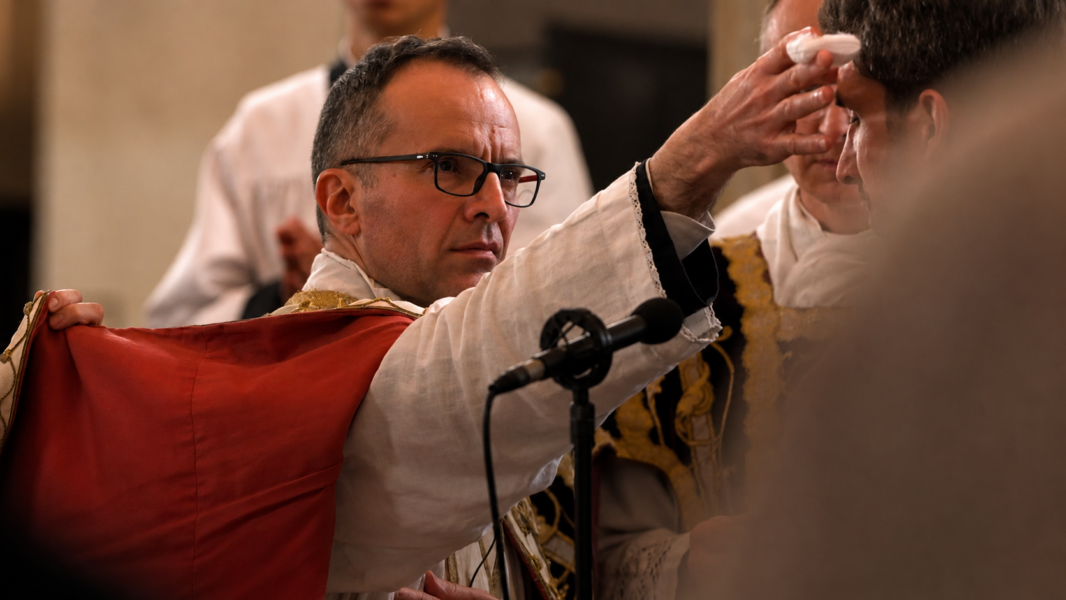
The third and final installment, at least for now, of Traditio is probably the one that most fully conveys the strength of the Society of Saint Pius X. In a kind of journey through the liturgy of Holy Week, the cameras follow a thread as simple as it is profound: the path of the holy oils from their blessing to their arrival at the sacraments administered in the most remote places of the world.
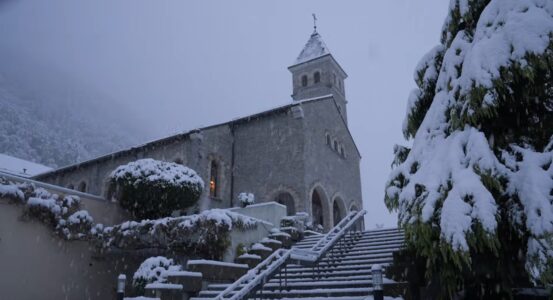
The film opens with images of extraordinary power. Écône, in the Swiss Alps, appears covered by an intense snowfall. The seminary is practically isolated beneath the white blanket while inside one of the most important liturgical moments of the year unfolds. There, at the Chrism Mass on Holy Thursday, Bishop Alfonso de Galarreta blesses the holy oils that, over the following months, will reach hundreds of communities spread across all continents.
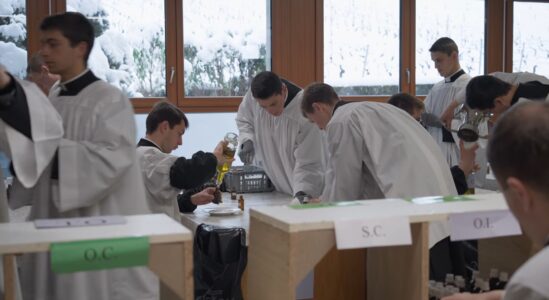
The scene carries an evident symbolic weight. While snow continues to fall outside, inside the seminary the elements that will sustain the sacramental life of thousands of faithful are being prepared. Shortly afterward, as the sky begins to clear and the sun appears over the mountains, the documentary shows several young priests organizing the distribution of the oils with almost millimeter precision. A map serves as a guide while each one receives the destination assigned to him. One of them carefully places the containers in a backpack and sets off. From that moment on, the narrative takes on an intense rhythm: the holy oils leave the Alps to begin a race against time toward the most diverse corners of the planet.
But the documentary does not follow only the physical journey of those oils. It also follows the development of Holy Week in the communities of the Society. As the liturgical days advance, the viewer travels through churches, schools, seminaries, and missions where the Paschal Triduum is relived. The images shift attention to some of the main centers of the work founded by Archbishop Lefebvre.
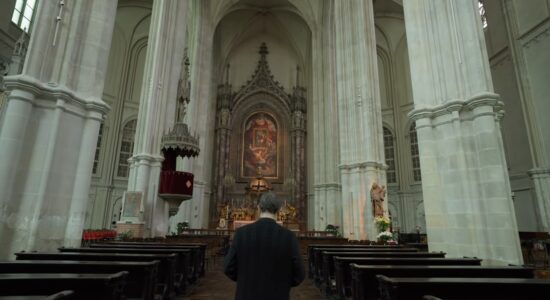
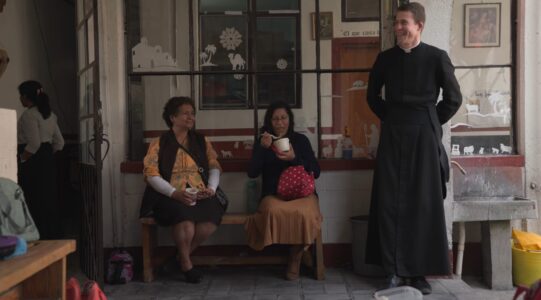
Particularly striking is the presence of large churches located in the heart of major European capitals. Vienna and Paris appear as visible examples of a reality that often remains unknown to those who observe the Society from the outside. These are not small marginal communities or isolated groups. The images show churches of great importance, filled with faithful, integrated into some of Europe’s most significant cities.
Added to this are the major educational works in the United States, where schools with thousands of students reveal a little-known apostolic dimension. Brazil, Mexico, and other American countries complete an international mosaic that allows one to grasp the geographical breadth of this presence. From seminaries to schools, from large cities to the most remote missions, the documentary presents an extraordinarily extensive human and spiritual network.
As the narrative progresses, the true underlying theme emerges clearly. The holy oils are only the starting point for explaining something much deeper: the need for the episcopate to guarantee the continuity of sacramental life. The testimonies recall confirmations celebrated in remote places, visits by bishops to simple families, and endless journeys to attend to scattered communities. Many faithful recount how they received in their own homes one of the bishops of the Society as they traveled thousands of kilometers to administer the sacraments.
Without the need for long speeches, the documentary thus constructs a practical explanation of an issue frequently reduced to canonical debates or ecclesiastical controversies. Here the question is posed from the concrete reality of the sacraments. Confirmations require bishops. Ordinations require bishops. The blessing of the holy oils requires bishops. The very continuity of sacramental life requires bishops.
It is impossible not to notice that this third installment arrives on the eve of new episcopal consecrations. However, Traditio deliberately avoids any vindictive or aggressive tone. There is no confrontation. There is no controversy. There are no reproaches. The chosen strategy is simply to show. To show the communities. To show the schools. To show the seminaries. To show the families. To show the priests. To show the sacraments.
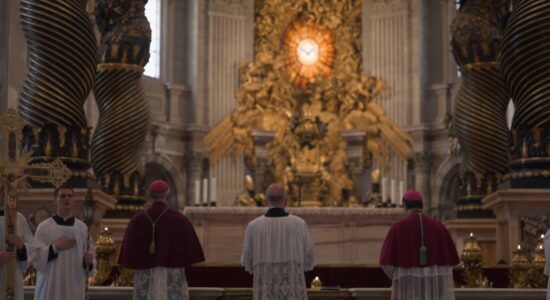
And when it seems the story has reached its conclusion, the documentary still reserves some of its most powerful images. The camera moves to Rome to accompany the pilgrimage of the Society. There, in the heart of Christendom, numerous priests appear advancing together toward St. Peter’s Basilica. The sequence carries enormous symbolic weight. It is the natural close of the entire journey.
After having shown the daily life of the Society across the five continents, after following the holy oils from the Swiss Alps to the most distant places of the world, the film concludes in Rome. Beneath the immensity of the Vatican basilica, the priests appear gathered around the visible center of the Church, while the narration recalls the fidelity to Rome, to the papacy, and to the universal Church that the Society has always claimed since the time of Archbishop Marcel Lefebvre.
It does not seek to resolve all questions or enter into complex debates. Nor does it aim to offer a lesson in ecclesiastical history. What it does is something simpler and probably more effective: to show a living reality. To show an international work that extends from the great seminaries to the peripheries of the missions, from the schools to the altars, from the snowy mountains of Écône to the tomb of the Apostle Peter.
Upon finishing the series, the feeling that remains is not that of having witnessed a vindication, but an explanation. A serene explanation of why the episcopal question is not presented here as an eccentricity or a personal claim, but as a necessity linked to a sacramental life that reaches hundreds of thousands of faithful throughout the world. And that idea, more than any speech, is what ultimately accompanies the viewer when the final images of St. Peter’s fade from the screen.