


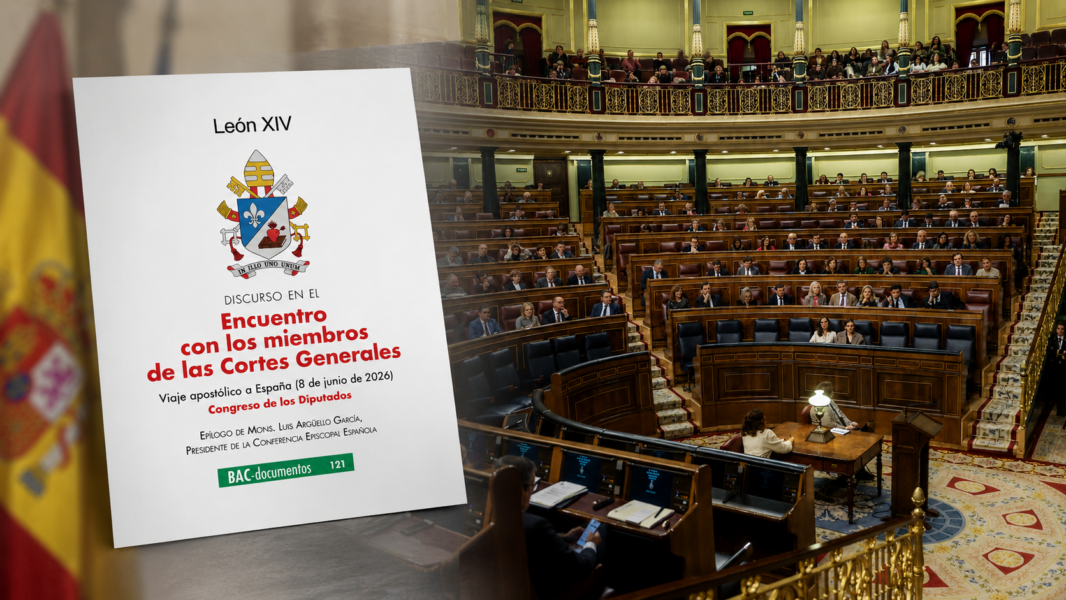
The president of the Spanish Episcopal Conference (SEC), Monsignor Luis Argüello, has sent Spanish deputies and senators a special edition of the address delivered by Pope Leo XIV before the Cortes Generales during his recent apostolic journey to Spain. The publication, edited by the Library of Christian Authors (BAC), includes an epilogue signed by Argüello himself dated June 22, the feast of Saint Thomas More, patron of rulers and politicians.
According to the Spanish Episcopal Conference, the edition has also been sent to the main institutions of the State, to the presidents of the autonomous communities, to representatives of social partners, media directors, and mayors of the cities visited by the Pontiff during his stay in Spain.
A speech the SEC considers historic
In the text accompanying the publication, Argüello maintains that Pope Leo XIV’s address before the Cortes Generales “has already entered, by its own right, into the history of our nation” and highlights both the fact that a Pope spoke in the seat of popular sovereignty and the content of his message.
The president of the SEC also emphasizes the reception given to the Pontiff in the Congress of Deputies, noting that the prolonged applause from parliamentarians reflected a recognition that transcended political differences.
For Argüello, Pope Leo XIV’s speech was not a nostalgic look back at Spain’s Christian past, but an invitation to rediscover in that tradition the spiritual and human resources needed to face current challenges.
A call for dialogue in a context of polarization
The epilogue devotes a significant portion to the question of dialogue between the Church and public life. Argüello recalls that the Church does not seek to replace democratic institutions or encroach on competencies that are not its own, but rather to offer a contribution based on its historical experience and its defense of human dignity and the common good.
In this context, the Archbishop of Valladolid presents Pope Leo XIV’s visit to the Cortes as an expression of the Church’s willingness to maintain respectful and constructive dialogue with society and with political institutions. He also warns of the risks of polarization and social fragmentation, insisting that dialogue is a permanent requirement of any authentic democracy.
Saint Thomas More as a reference for public officials
The date chosen for the epilogue is not coincidental. Argüello signed it on the feast of Saint Thomas More, whom he presents as a model for those who exercise public responsibilities for having united service to the common good with fidelity to conscience.
The president of the Episcopal Conference also interprets the recent apostolic journey as a call to strengthen the presence of Catholic laity in public life and recalls a statement by Pope Leo XIV according to which politics can be understood as “the highest form of charity” when it is sincerely oriented toward service to the common good.
In his conclusion, Argüello expresses the hope that the words spoken by the Pope will continue to inspire “paths of understanding, concord, and hope” both for Spain and for Europe as a whole.