


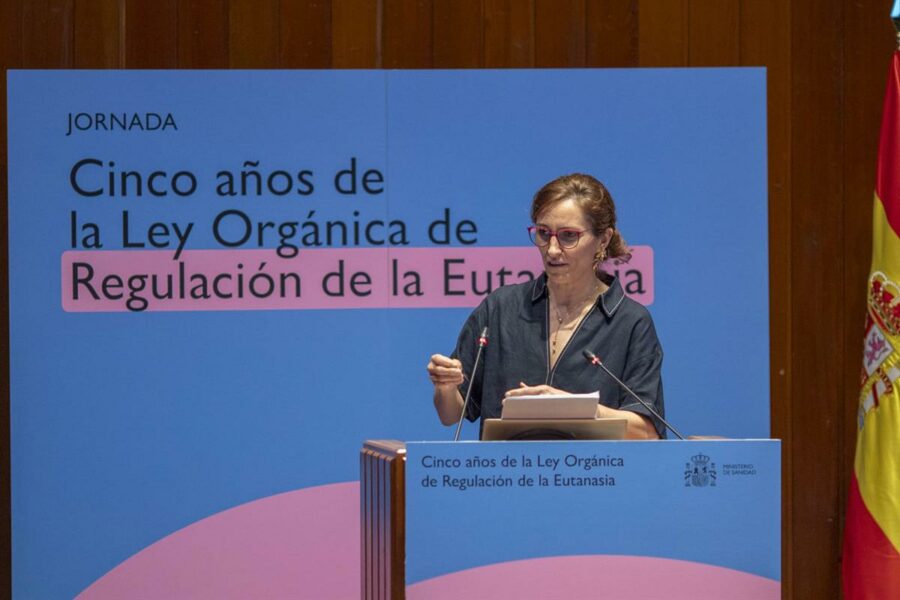
Five years after the approval of the Organic Law Regulating Euthanasia, the Government has held an institutional event to promote a regulation that has already resulted in the deaths of 1,668 people in Spain. The provisional data for 2025, presented by the Ministry of Health, also show a new annual record, with 565 euthanasias performed during the past year.
The Minister of Health, Mónica García, closed the event «Five Years of the Organic Law Regulating Euthanasia: Advancing Rights», organized by the Ministry to review the implementation of the law and advocate for its development throughout the national territory. Since its approval in 2021, euthanasia has been progressively consolidated within the Spanish healthcare system, while the number of deaths caused by this so-called «right» continues to rise.
The number of euthanasias continues to increase
According to data released by the Ministry, 1,284 requests for the so-called «aid in dying» were recorded in 2025, and 565 euthanasias were carried out, the highest figure since the law came into force.
In total, accumulated requests have now reached 3,716, while the number of euthanasias performed stands at 1,668.
The figures show a sustained upward trend since the legalization of this practice. While the Government interprets this development as the consolidation of a new right, the constant increase in cases reflects a growing normalization of the deliberate elimination of patients and vulnerable individuals as a response to suffering.
More than 370 applicants died before the procedures were completed
The report also details the outcomes of procedures concluded in 2025. Of the 1,187 closed cases, 565 ended with the performance of euthanasia.
However, 374 people died before the administrative process required by the law was completed. This figure represents 31.5% of all procedures closed during the year.
Of these deaths, 277 occurred before the Guarantee and Evaluation Commission issued its corresponding report. Another 97 took place after a favorable resolution had been obtained, but before the euthanasia was carried out.
In addition, 157 requests were denied and 91 were withdrawn by the applicants themselves.
Neurological diseases predominate among those who receive euthanasia
Although oncological conditions remain the main cause of initial requests, neurological diseases lead the cases that ultimately end in euthanasia.
Ministry data show that 37% of requests are related to oncological diseases and 31% to neurological conditions. However, among the euthanasias performed, neurological diseases now account for 46% of cases, compared to approximately 30% of oncological processes.
The statistics reflect the growing weight of neurodegenerative diseases and severe neurological disorders among those who ultimately resort to this procedure.
Catalonia leads in requests
Catalonia once again recorded the highest rate of requests, with 6.14 per 100,000 inhabitants, well above the national average of 2.61.
Catalonia was followed by Navarre and the Basque Country, then La Rioja, the Balearic Islands, Cantabria, Asturias, and the Canary Islands.
These differences reflect varying levels of implementation of the law across the autonomous communities and highlight a particularly significant presence of euthanasia in certain regions.
The Government celebrates the expansion of death
Five years after the approval of the law, Spain still lacks a national palliative care law to guarantee all patients access to adequate specialized care. Various medical organizations and entities dedicated to the defense of life have been calling for years for a national strategy to relieve the physical, psychological, and spiritual suffering of patients without resorting to euthanasia.
Political priority has focused on facilitating induced death rather than ensuring that no one is driven to request it out of fear of pain, loneliness, or lack of adequate care. The contrast is hard to ignore: while the State celebrates that more and more people are dying by euthanasia and allocates resources to developing the procedures provided for by law, thousands of patients still lack guaranteed access to comprehensive palliative care.