


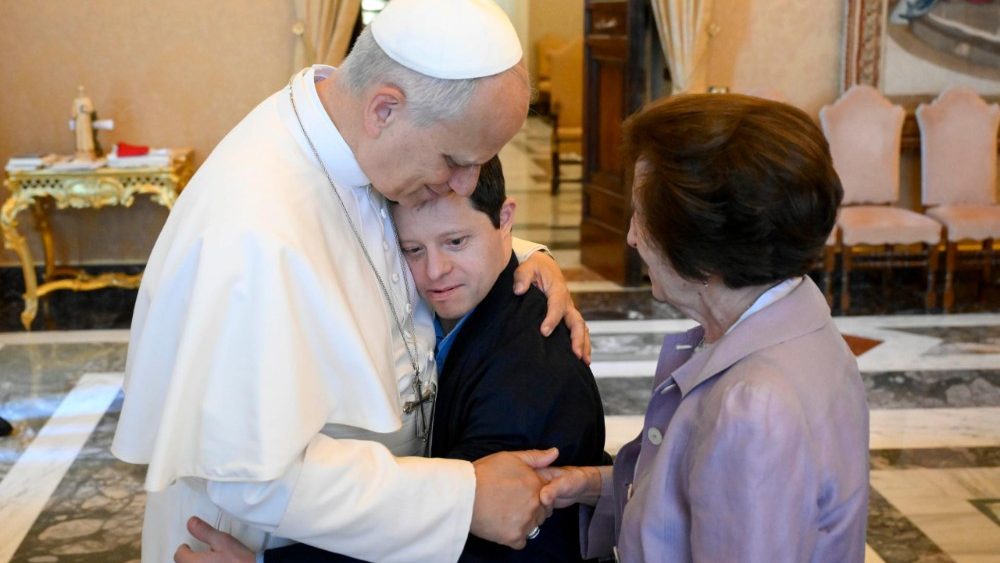
Pope Leo XIV received the members of the Jérôme Lejeune Foundation this Monday at the Vatican Apostolic Palace on the occasion of the centenary of the birth of the renowned French geneticist, considered one of the most influential figures of the 20th century in the defense of human life and of persons with disabilities. During the audience, the Pontiff praised his scientific and moral legacy, denounced eugenic practices directed against persons with Down syndrome, and warned that “medicine can never become the servant of programmed death.”
The audience was marked by the figure of Professor Jérôme Lejeune (1926-1994), discoverer of the chromosomal anomaly responsible for trisomy 21 and one of the pioneers of modern genetics. His discovery revolutionized medical knowledge about Down syndrome and earned him international prestige, but it also led him to become one of the best-known voices in defense of unborn children when he realized that his discovery was beginning to be used to promote the selective abortion of fetuses diagnosed with this condition.
A committed Catholic and close collaborator of Saint John Paul II, Lejeune also played a decisive role in the creation of the Pontifical Academy for Life. His cause for beatification remains open, and the Church currently recognizes him with the title of Venerable.
The scientist who placed his career at the service of the most vulnerable
During his address, Leo XIV emphasized that Lejeune’s greatness was not limited to his scientific contributions.
“He was also a physician by vocation and worked tirelessly to find treatments that would alleviate the suffering of his patients, whom he called ‘the poorest among the poor,’” the Pope recalled.
The Pontiff also evoked one of the French geneticist’s best-known expressions: “Medicine is the hatred of disease and the love of the sick.”
The man who denounced “chromosomal racism”
Lejeune waged a battle after discovering that advances in genetics could be used not to cure diseases, but to eliminate those who suffered from them.
“He quickly understood that his scientific discovery would be used to eradicate persons carrying trisomy 21 before their birth,” the Pope stated.
Faced with this reality, Lejeune publicly denounced what he considered a new form of eugenics. He even coined the expression “chromosomal racism” to describe a practice that selected human lives based on their genetic makeup.
His interventions in defense of children with Down syndrome and of all human life from conception earned him recognition among numerous Catholics, but also strong criticism in certain scientific and political circles.
Leo XIV recalled that the French researcher personally assumed the consequences of that public defense of life.
“He ardently defended the life and dignity of the most fragile, even at the cost of his own career,” he affirmed.
A warning on contemporary bioethics
The Pope took advantage of the commemoration to reflect on some of the challenges posed by current biomedical advances.
He acknowledged the enormous potential of technology to improve medical care, but insisted that scientific progress must always be subject to solid ethical principles.
“Technique can assist medicine, but it cannot replace it,” he stated.
According to his explanation, the problem arises when technology ceases to be oriented toward the service of life and begins to submit to criteria of efficiency, profitability, or utility.
“The value of the person does not depend on what they do or produce,” the Pontiff recalled.
In this context, he made one of the most forceful statements of the entire speech.
“Never should a physician allow himself, based on laboratory algorithms, to decide on the life of an embryo or an elderly person,” he noted. “Never can medicine become the servant of programmed death.”
The Pope’s words come at a time when debates continue on embryo selection, euthanasia, eugenic abortion, and the use of new genetic technologies applied to human reproduction.
The legacy of a work that continues
Leo XIV also devoted part of his intervention to recognizing the work that the Jérôme Lejeune Foundation currently carries out in various countries.
The institution continues the work begun by the French scientist in three main areas: research, medical care for persons with intellectual disabilities of genetic origin, and the defense of human dignity.
The Pontiff especially highlighted the work of the Jérôme Lejeune Institute, which cares for thousands of patients each year, as well as the training programs promoted by the International Chair of Bioethics.
He also encouraged the members of the foundation to continue actively participating in public debates to defend “each person in all circumstances of their existence.”
A model for new generations
At the conclusion of his speech, Leo XIV presented Jérôme Lejeune as an example for scientists, physicians, researchers, and young Catholics.
“May he inspire the courage of truth in the many young people and professionals who desire coherence,” the Pope wished.
The Pontiff also asked that the testimony of the French geneticist help unite “reason and faith, word and deeds,” and reject every form of falsehood while continuing to respect persons.
Finally, he entrusted the members of the foundation and persons with Down syndrome to the protection of the Virgin Mary and imparted his apostolic blessing to all those present.