


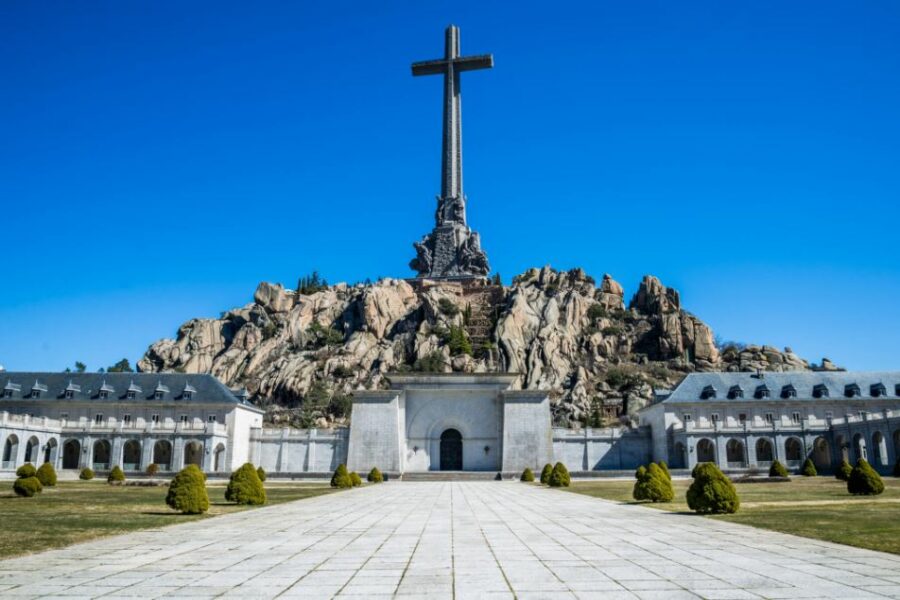
The truly relevant issue in the controversy over the Basilica of the Holy Cross of the Valley of the Fallen is not the Sánchez Government, but the content of the agreement that Cardinal Cobo surprisingly accepted before that Government, concealing it for months from the entire Spanish Church and from public opinion, while also lying about its existence.
According to the documentation incorporated into the administrative file and made public months later, on 5 March 2025 the Archbishop of Madrid conveyed to Minister Félix Bolaños his agreement with the terms set out in the document sent by the Government the previous day. That text envisaged an extraordinarily restrictive delimitation of the spaces considered to be intended for worship within the Basilica, reducing them to the altar and the adjacent pews, while opening the door to the so-called ideological resignification of the rest of the church, including such essential elements as the nave, the dome, the atrium, the vestibule and other spaces integrated into the basilical complex, including the Chapel of the Blessed Sacrament.
The gravity of this position is difficult to overstate. It is not simply an architectural or functional question. What is at stake is the very juridical and religious nature of a Catholic church solemnly dedicated to divine worship.
The Code of Canon Law establishes that sacred places are intended for divine worship and for the proper ends of religion. The dedication of a church does not fall exclusively on an altar or on certain pews, but on the church in its entirety. The liturgical tradition of the Church, expressed in the rite of dedication of churches, precisely manifests that spiritual and juridical unity of the sacred building.
It is therefore difficult to understand how a delimitation could have been accepted which, in practice, fragments the sacred reality of the church and allows large areas of a minor basilica to be destined for uses incompatible with its sacred nature.
The matter acquires an even more worrying dimension when one considers that the religious freedom recognised by the Spanish Constitution and developed by current legislation protects not only the beliefs of the faithful, but also the free exercise of worship and the autonomy of religious confessions in relation to their places of worship. Likewise, the Agreements between the Spanish State and the Holy See expressly recognise the inviolability of Catholic churches.
Recent weeks have also brought to light the practical consequences of that decision. What for months was presented as a fully on-track project has ended up becoming a legal and administrative labyrinth. The Town Council of San Lorenzo de El Escorial has agreed to suspend the start of the works, while the judicial proceedings brought before the High Court of Justice of Madrid have introduced new uncertainties about the immediate viability of the planned interventions. All of this reflects a reality that is difficult to conceal: the resignification project never enjoyed the legal certainty that the Government sought to convey to public opinion.
And it is precisely here that one of the most serious issues of this entire episode lies. It is legitimate to ask whether the Government would have gone so far in its intentions to intervene inside the basilica had it not previously had the agreement expressed by Cardinal Cobo regarding a document that reduced the spaces of worship to the altar and the adjacent pews. That acceptance conveyed to the political authorities the appearance that there was sufficient ecclesiastical cover to act on the rest of the church, when the juridical and canonical reality was exactly the opposite.
For once it was accepted that the nave, the dome, the atrium, the vestibule, the monumental doors and even the Chapel of the Blessed Sacrament could be left outside the practical consideration of spaces intended for worship, the next step became inevitable: to consider legitimate their transformation, resignification or use for purposes alien to the proper nature of the church. The problem is not only that such an approach contradicts current canon law; it is that it also collides with the guarantees of religious freedom, confessional autonomy and inviolability of places of worship recognised by the Spanish legal system.
What is truly surprising is that such a concession should come precisely from someone who lacked juridical competence over the place. The Basilica of the Holy Cross of the Valley of the Fallen is not subject to the ordinary jurisdiction of the Archbishop of Madrid, but to the singular regime deriving from its status as a minor basilica linked to an exempt Benedictine abbey directly dependent on the Holy See. It is difficult to find precedents of an ecclesiastical authority who has sought to authorise the civil power to intervene in sacred spaces over which he lacks jurisdiction, while simultaneously contradicting elementary principles of Canon Law and of state legislation protecting religious freedom.
The current administrative and judicial suspensions constitute, in a way, the confirmation of an evidence that should never have been forgotten: the problem was never in the resistance of the monks nor in the legitimate exercise of judicial actions by the Benedictine community. The problem arose when the Government was led to believe that it could act on a basilica as if it were a partially desacralised space, susceptible of being reorganised according to political or ideological criteria. Recent events demonstrate to what extent that premise was legally unsustainable.
There seems to be no reasonable explanation for an ecclesiastical authority to accept the profanation of sacred spaces in a Catholic church. If such acceptance were due to ignorance of the applicable canonical and juridical principles, we would be facing an extremely worrying situation. If, on the contrary, it responded to a conscious decision to disregard them in order to satisfy the pretensions of the Sánchez Government, the concern would be even greater.
Added to this is another circumstance that is difficult to explain. It does not appear that the Spanish Episcopal Conference, nor the Benedictine Order, nor the community itself affected had knowledge of these commitments when they were assumed. Nor did the successive public statements issued by Cardinal Cobo afterwards seem to reflect the real scope of what was accepted in those communications.
Subsequently, Cardinal Cobo himself attributed the action taken to directives coming from the Secretariat of State of the Holy See. However, it is difficult to reconcile that hypothesis with the profile and experience of those who hold responsibilities in the Holy See, especially when the matter affects such elementary principles of the law of the Church as the nature of sacred places and the legal protection of churches intended for worship.
Meanwhile, the recent visit of the Holy Father to Spain has left a very different impression. His interventions have been characterised by doctrinal clarity, conceptual precision and a constant appeal to the dignity of the human person from conception to natural death. It has been a presence that can hardly be instrumentalised in the service of particular political strategies or of ideological narratives constructed from interests alien to the Church’s own mission.
Perhaps for that reason the efforts of El País and eldiario.es to present Cardinal Cobo as a privileged interpreter of the Pope’s thought or as a figure called to play a historic role in the Spanish Church are especially striking. Facts always end up prevailing over narratives. And the facts show that the one who accepted that a large part of a basilica could be considered alien to worship was precisely the Cardinal Archbishop of Madrid.
The question is no longer whether that decision was the incomprehensible error that it was. The question is whether the person who made it possesses the conditions of prudence, doctrinal firmness and ecclesial sense required for the governance of one of the most important episcopal sees in the Catholic world.
Many of the faithful, priests and even bishops privately express their concern about the course taken in this matter. It is exclusively for the Holy Father to judge when and how the appropriate decisions should be taken. But it is legitimate to ask whether a crisis of this magnitude does not also require a profound reflection on the responsibilities that made it possible.
In any case, Cardinal Cobo has the moral obligation to repair the damage caused, to offer a truthful explanation of what was really accepted in March 2025, to give an account of an action that has decisively contributed to the current legal and administrative chaos, and to assume his responsibility with dignity. Because the recent suspensions of the works and the growing judicialisation of the conflict are nothing but the consequence of an original error that should never have occurred. The initial problem was not with the Sánchez Government, which acted in accordance with its own political objectives, but with the person who made it believe that it could achieve such objectives without violating the sacred nature of the basilica or encountering legal resistance from the Church.