


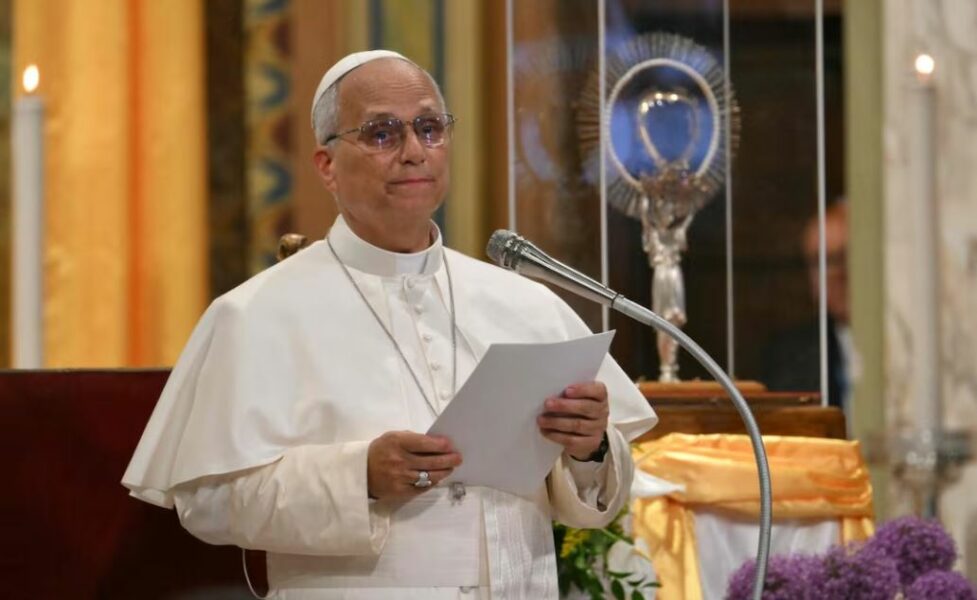
Pope Leo XIV took advantage of his visit to Sant’Angelo Lodigiano, the birthplace of Saint Frances Xavier Cabrini, to warn that the migratory phenomenon continues to be one of the great challenges for the Church and to present the patroness of migrants as a fully relevant model of evangelization. “The migratory phenomenon has entered a different phase, certainly more complex, but no less capable of challenging the Church,” the Pontiff stated during the event held this Saturday at the parish of Saints Anthony the Abbot and Frances Cabrini.
According to the Holy See Press Office, the Pope arrived in the Lombard town at the end of his pastoral visit to Pavia. There he took part in adoration of the Blessed Sacrament and venerated the relic of the saint’s heart before delivering a speech focused on the relevance of her legacy.
From Leo XIII to the Italian migrants in America
Recalling the figure of Cabrini, born in Sant’Angelo Lodigiano in 1850 and who died in Chicago in 1917, Leo XIV highlighted the obedience with which the religious accepted the guidance of Leo XIII when she had to define the direction of her congregation’s mission.
The saint dreamed of evangelizing in China, following in the footsteps of Saint Francis Xavier, but ended up dedicating her life to the Italian emigrants arriving in the United States.
“When the decisive moment came to choose the direction her religious institute’s mission should take, she wanted the Pope to indicate it. And Leo XIII was clear: ‘Not to the East, but to the West,’” he recalled.
The Pontiff noted that Cabrini knew how to read the signs of her time and understood that she had to go where the need was most urgent.
A challenge that continues to question the Church
Drawing from that experience, Leo XIV brought the reflection to the present and maintained that the migratory issue continues to raise questions the Church cannot ignore.
“What must we say if we look at today’s world?” he asked. “That sign, namely the migratory phenomenon, has entered a different phase, certainly more complex, but no less capable of challenging the Church.”
The Pope invited the faithful to contemplate the current reality in light of Saint Cabrini’s example and wondered what the religious would have done in the face of contemporary migratory movements.
“What would her missionary soul say today?” he asked those gathered in the church.
Cabrini, Francis and the Heart of Christ
Leo XIV linked the saint’s work with the Church’s recent magisterium. He recalled that Francis dedicated his last encyclical, Dilexit nos, to the human and divine love of the Heart of Christ, a devotion that, he explained, is the key to understanding Cabrini’s entire life.
“That mystery of infinite charity was the only true driving force of her life, of everything she accomplished and the way she did it,” he stated.
The Pontiff also recalled that in his own apostolic exhortation Dilexi te he cited Saint Cabrini alongside Saint John Baptist Scalabrini when addressing the accompaniment of migrants.
He then evoked some words of the religious that, in his view, summarize the spirit of her mission: “No work will be too difficult, no land too distant, no person too wounded for the love of the Heart of Jesus.”
“What is more relevant than this charism?”
Leo XIV affirmed the relevance of the saint’s work for the Church of our days.
“What is more relevant than a missionary charism placed at the service of migrants?” he asked before the relic of her heart.
The statement was accompanied by recognition of the Missionaries of the Sacred Heart of Jesus, the congregation founded by Cabrini and currently present in numerous countries.
For the Pope, the Italian religious continues to offer a concrete response to challenges that continue to mark the lives of millions of people around the world.
An example for young people
Leo XIV wished to address the new generations in particular and encouraged them to draw closer to the figure of the saint.
“Get to know Saint Frances Cabrini. Read her writings, filled with passion for Jesus and for the mission; her letters, her travel diaries and the notes from her retreats,” he urged.
The Pontiff described Cabrini as a woman capable of uniting contemplation and action, prayer and apostolic work, and assured that her example continues to inspire vocations and Christian commitments.
“Whoever knows Mother Cabrini is won over by her,” he stated.
Before concluding, Leo XIV expressed his desire that the entire Church contemplate the Italian saint as a model of service to the Gospel and to those most in need. “May the whole Church look to this wonderful missionary of Love to learn what it means to serve the Kingdom of God in the midst of history,” he concluded.