


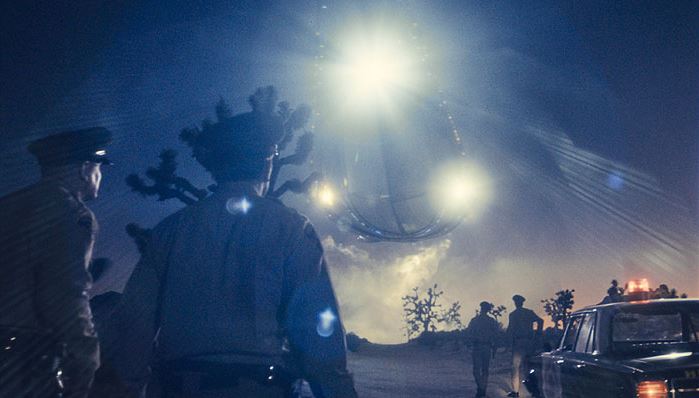
The story goes like this: the governments of the world deliberately conceal verified and corroborated news of communications with extraterrestrial civilizations, and even possess the bodies of aliens recovered from spacecraft that have crashed on Earth. Moreover, this information is so classified that it may not even be known to the current rulers, being handled exclusively by secret agencies—shadowy networks outside the visible structure of the States—and funded through complex mechanisms of financial engineering. In response, a group of honest employees of this ultra-secret organization, driven by deep civic and democratic courage, conspire to ensure that this truth is revealed without reservation to global public opinion, because people have the right to know. Undoubtedly, every man and woman on our planet is mature, serious, and responsible enough to draw the best possible consequences of every kind (including spiritual and religious) from this revolutionary disclosure. Consequently, for motives as philanthropic as those of Robin Hood, they steal the agency’s computer material in order to broadcast it massively on open television channels. And the Agency will try to stop them by any means necessary (including murder).
The above is a synopsis of Steven Spielberg’s latest film, Disclosure Day, the Day of Revelation (2026), a UFO and action movie with a plot that, as we can see, is somewhat conventional. But what sets it apart from similar films is the introduction of explicit religious elements—beginning with the title—such that we could judge it as a kind of Close Encounters of the Third Kind (1977) “in a divine key.” If the previous summary is the body of this film, those elements constitute its soul, its spirit, which leads us to the final scene of the movie, where a Messiah and His Word are to be enthroned. Indeed, the journalist Margaret Fairchild (played by the excellent and beautiful actress Emily Blunt) is presented as much more than a medium who has telepathically received the revelation from a flesh-and-blood alien. Although encoded in a cryptic-mathematical (or gnostic) language, she possesses the wisdom to translate it before a receptive humanity with no trace of original sin. She will do so live and in front of television cameras, where millions of spellbound viewers have previously been watching real images and videos of UFOs and extraterrestrials (some subjected to torture and experiments in military bases; a probable nod to animal-rights idolatry). Already on the air, she will intervene with a single word, and thus the film will conclude. A word that carries such religious significance in itself that it allows us to affirm we are about to receive a new Epiphany from an Anointed One: “Listen to me.”
If we naïvely assume that no blasphemy was intended—parodying the sublime Trinitarian Theophany that occurred during the Transfiguration of the Lord: “This is my beloved Son, listen to him” (Mk 9:7)—I believe we are mistaken. Anyone who has paid sufficient attention to this film will perceive that the allusions to Christianity here are not accidental. Is it a coincidence that, in earlier scenes, Margaret performs astonishing preternatural phenomena? Is it a coincidence that the rebels of that Agency seem to number twelve—the Twelve—and receive her as a messiah, even kneeling before her? Or that a nun from the convent where the protagonists take refuge recites the well-known Johannine passage “you will know the truth, and the truth will set you free” (Jn 8:32), a phrase which, in that ufological context, can mean exactly the opposite of what the Lord intended to teach us—namely, that sinister notion of “You will be like gods, knowing good and evil” (Gn 3:5). Once again we are invited to eat from the “Tree of the Knowledge of Good and Evil,” only yesterday the host was a serpent and today it is an actress in a mere entertainment film. But if we yield to temptation again, who doubts that once more we will excuse ourselves in contrition: “I was afraid because I was naked, and I hid from you” (Gn 3:10). Nothing is accidental.
Initially, we do not know what Margaret will say after that authoritative “listen to me.” The viewer may fill in the blank lines as they wish, although what will come from the lips of this prophetess of the new times is highly predictable. Above all, of course, a Good News (a Gospel): the unquestionable certainty that we are not alone in this cold and immense universe, but that there are other rational beings with an intelligence and technology powerful enough to roll up space-time like a sock in order to reach us with ease. And, of course, not to bring chaos, as Tim Burton suggested with the rowdy “Mars Attacks!” (1996), Roland Emmerich in his American blockbuster “Independence Day” (1996), or that cult 1980s series, “V,” with its villainous lizard-like extraterrestrials. Or even Spielberg himself with his chilling version of the classic “The War of the Worlds” (2005), the dark counterpart to his unsurpassable “E.T.” (1982).
Not at all! our venerable director will now protest, perhaps somewhat embarrassed for having brought to the screen, twenty years ago, such a blood-soaked vision of H.G. Wells’s influential novel. Today’s new aliens will burst among us with the best of intentions, with the generous and altruistic vocation of sharing their rich knowledge, which will bring decisive improvements to the quality of human life (think of diseases and famines). Likewise, it is predictable that, endowed with such prodigious intelligence, they will always act with a high standard of morality. And the three jewels of their crown, their metaphysical reflection: first, their rational idea of God, elaborated by a mind superior to the human. Second, the possibility that they have been granted some kind of Supernatural Revelation (which they will share with us). And finally, the most personal question: Are rational beings immortal? Will we achieve eternal happiness?
All these questions will have a consoling answer, who doubts it—excellent for our reason and hopeful for our will. And their solutions will be applied in our world to such an extent that many will think that an earthly version of the longed-for Kingdom of Heaven is being established. But, in return, humanity will be required to make certain renunciations that will gradually undermine the Christian faith to an unbearable point. The worship of the one God will be transferred to the new extraterrestrial saviors (who, after all, would be, like us, mere creatures of that same God); that is, we would inevitably fall into the grave sin of idolatry. For a universal anthropological principle teaches that superior civilizations absorb inferior ones, and this film seems to tell us that if we believed that beyond man there was only God and His angels, we were mistaken.
Does such a novelty imply that we must rethink our most intimate (religious) beliefs? That Disclosure Day does not risk an explicit answer to this question does not mean that it has not wanted to bring it to the table and even hint at its answer in the most flexible and least dogmatic sense. In fact, the entire film seems to strive to convince viewers to prepare themselves to accept a real (and imminent) event of such magnitude that it will force us to rethink (and even replace) the truths we have received through the supernatural virtue of faith. Spielberg himself hinted at this idea in an interview.
Of one thing I am certain. Any new revelation from creatures superior in intelligence—if it were to occur—would necessarily clash with what we know as supernatural Revelation as we have received it from the Bible and the Tradition of the Church. The reason for that clash is that our God, as He has been revealed to us, is a jealous God (Ex 20:5), who admits no compromises, idolatries, or competitors, and who does not share His glory with anyone (Is 42:8). And His greatest glory has been to reveal Himself and become incarnate in Christ, once and for all, out of love for His favored human creature. With Christ, revelations come to an end (Heb 1:2). It is true that He will come a second time, but not to expand the content of His first and only revelation, but to judge us for our decision regarding it.
Therefore, supposing that something like this were to happen, that an angel from Heaven—an extraterrestrial, in this case— were to announce to us another new piece of good news, our response as Christians can only be to reaffirm the forceful expression used by Saint Paul: anathema sit (Gal 1:8). For stat crux dum volvitur orbis: not a single comma of our revelation can be touched. The God we have seen and heard (by faith) in Jesus Christ is THE ONE WHO IS from eternity, before creation existed; yes, the only one, even if, out of love, He had created, besides ours, billions and billions of universes in which intelligent life could exist, beings capable of relating to Him. For God, who transcends the universe (or universes), is the same yesterday, today, and always, and His revelation to us is closed: “it was given once (hapax, in a final and total way) to the saints” (Jude 3). Consequently, there are no new revelations, for this one was closed with the death of the last apostle. The day of revelation, in short, has already taken place. As Saint John of the Cross explained, “For in giving us, as He did, His Son, who is His only Word, He spoke everything to us at once in this single Word—and He has no more to say.” (Ascent of Mount Carmel, II, 22-3).
In conclusion, Christians must have this decisive truth engraved in our minds, in our hearts, and even on the doorposts of our homes, and even more so in a time of confusion like the present. “Remember, then, what you have received and heard; keep it and repent” (Rev 3:3). I fully understand that, because of this rarefied spiritual atmosphere of our age, some Christian groups (labeled, of course, as “extremely dangerous fundamentalists”) have judged this science-fiction film as satanic, precisely because they suppose it prophesies the imminent manifestation of devils disguised as aliens. They reinforce that perception with the importance the image of the eye acquires in it, a powerful symbol of esoteric societies unmistakably anti-Christian. They even cite the biblical passage of Gn 6:4 as a biblical-historical precedent of non-human, semi-divine beings (called sons of God) who copulated with females of our species, giving rise to a degenerate race that corrupted humanity and deserved to be exterminated by the flood.
A nonsense of Bible Belt fanatics, or a coherent reflection based on the general spirit of Sacred Scripture and on the conviction of living in a world where impiety and technology grow in geometric progression? In my judgment, it matters little. What is relevant is not the conclusion we reach (for we may be mistaken), but to remain—as the Lord warns—“on the watch” (Lk 21:36). In the face of any disturbing event, we must remain vigilant and firm in the faith, even if we err in reading our times; better that than to be “spat out for being lukewarm” (Rev 3:16).
But what if, in reality, we are exaggerating? After all, we are talking about cinema, about one more entertaining film by this mythical director, who has given us so many moments of happiness and reflection throughout our lives. Moreover, the most truthful prophets are not on celluloid but on the pages of the Bible. And what is prophesied there?:
“Let no one deceive you in any way; for that day will not come unless the rebellion comes first and the man of lawlessness is revealed, the son of destruction, who opposes and exalts himself above every so-called god or object of worship, so that he takes his seat in the temple of God, declaring himself to be God.”
(2 Thess 2:3-4).
I have a feeling that the Antichrist, when he appears (and he will, without a doubt) will be human, all too human. In other words, everything will stay within the family. Nothing, therefore, to do with supposedly just and benevolent Martians. Or with repulsive cannibalistic lizards.
Note: Articles published as Opinion express the views of their authors and do not necessarily represent the editorial line of Infovaticana, which offers this space as a forum for reflection and dialogue.