


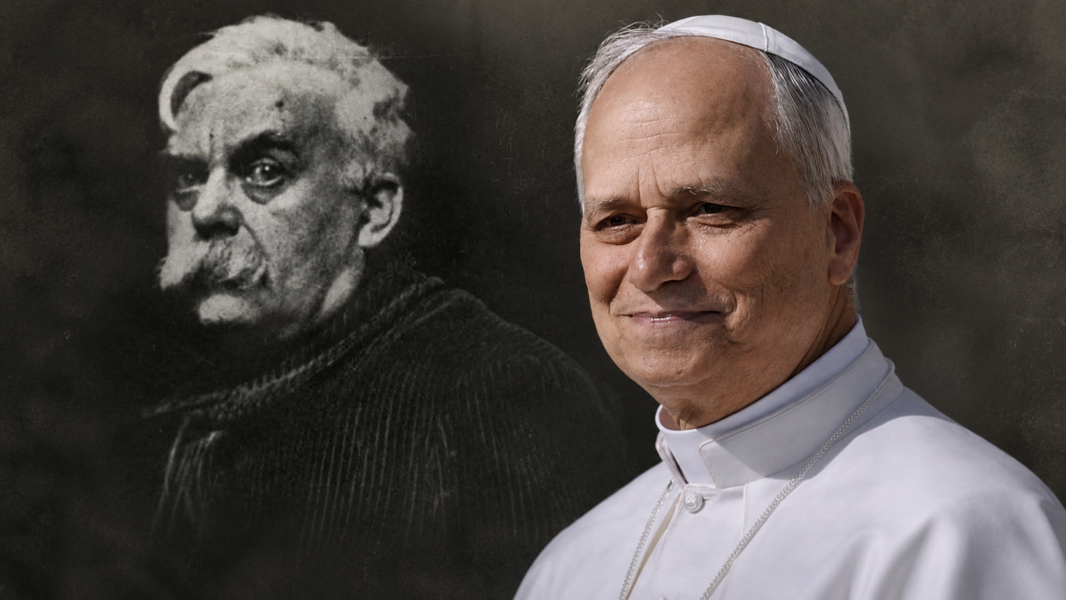
During his trip to Spain, at the Corpus Christi Mass in Plaza de Cibeles, Pope Leo XIV urged the faithful to rediscover the spiritual richness of Spanish religious traditions as a school of living faith, not as a museum of the past to be visited. In Tenerife, at his farewell, he centered his final homily on the Sacred Heart of Jesus. Whoever has ears to hear will have recognized, beneath the pontiff’s serene tone, an ancient warning: faith contemplated with the respect of a tourist has ceased to be faith.
That warning is more than a century old. And it was formulated, with a violence that no one today dares to imitate, by a writer whom his own coreligionists despised without respite.
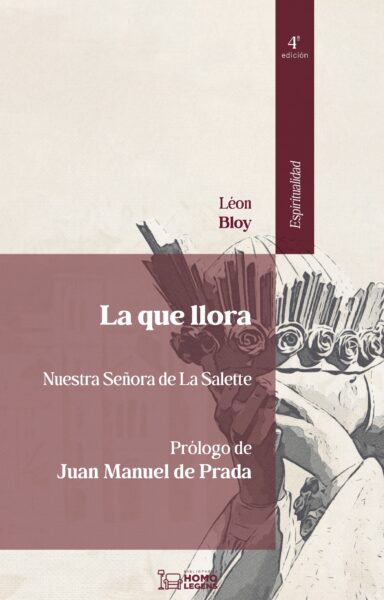
In 1908, Léon Bloy published The Weeping Woman, a book devoted to the apparition of Our Lady of La Salette, which occurred on September 19, 1846, before two illiterate shepherd children, Mélanie and Maximin, in a village in the French Alps. The Virgin appeared to the children weeping bitterly over the sins of men, crowned with roses and also with thorns, and uttered thirty-three prophecies of chastisements for a humanity that refused to convert. The Church approved the devotion in 1851. But the message, too harsh, was soon consigned to oblivion, overshadowed by the gentler light of Lourdes.
Bloy (1846-1917), the great accursed writer of his time, made that uncomfortable apparition the axis of his work. He was struck by the fact that the Virgin had appeared in the very year of his birth, and that she had chosen as messengers two destitute children, like himself. In The Weeping Woman he poured all his holy wrath against a Catholicism that, in his view, was sweetening the Gospel until it became palatable.
Bloy’s diagnosis is of a timeliness that is chilling. He railed against Catholics who demand sweet words from the Virgin and cannot bear her mouth to utter threats; against those who want a Queen of Heaven “crowned with roses, but not with thorns”; against those who demand that the gall and vinegar of Calvary be sweetened so they can be swallowed. A devout sentimentality, he wrote, that would even prefer to forget the Second Coming in order to spare itself the tribulations that precede it.
His most famous sentence sums up the entire book: “Today is the time of lukewarm and pale demons, the time of Christians without faith, of affable Christians.” Lukewarmness, not declared unbelief, is for Bloy the true disease of faith. The affable Christian, who inconveniences no one because he no longer truly believes in anything, is the demon of the last times.
The prologue to this edition is signed by Juan Manuel de Prada, and it is much more than a courteous introduction: it is the key that opens the book to today’s reader. Prada places Bloy in his time, reconstructs his pilgrimage to La Salette and his passionate defense of Mélanie, and preempts the temptation to read this book as an antiquarian curiosity. For the decisive question is posed by him, without circumlocution, in the middle of the prologue.
After tracing Bloy’s diatribe against “devout sentimentality,” Prada pauses and asks: “Is not Bloy, in reality, anticipating the languors of a certain contemporary Catholicism?” The question hovers over the entire volume. And later he hammers home, speaking of Bloy’s bitter accusations against a clergy corrupted by the “execrable clink of coins”: “It is impossible to read these acrid accusations of Bloy and not think of certain behaviors and certain resounding publicity campaigns promoted by our ecclesiastical hierarchies.”
It is Prada, moreover, who draws the thread connecting Bloy to the present through Leonardo Castellani—“surely the most faithful disciple of Bloy”—and his classification of the seven degrees of religious pharisaism, which culminates in the false believer who persecutes the true ones “with blind fury, with implacable fanaticism.” And it is Prada who closes the prologue with one of those phrases of his that remain engraved: “Those who seek to enjoy the roses without suffering the prick of the thorns are… lukewarm and pale demons.”
This is where the journey of Leo XIV illuminates the reading. When the pope calls for a living faith and not a museum, when he once again places the Sacred Heart at the center—which in La Salette appeared crowned with thorns—he is naming, in a magisterial and serene key, the same lukewarmness that Bloy denounced with shouts. The pontiff says it as a shepherd; Bloy said it as a wounded prophet. But the evil pointed out is the same: faith turned into a heritage to be admired from afar, into a tradition inherited without commitment, into a devotion that asks for roses and shuns thorns.
That is why this 1908 book is not a literary relic. It is a mirror. The Weeping Woman disturbs today for exactly the same reason it disturbed then: because it reminds us that the Virgin of La Salette was not weeping out of sentimentality, but over the sins of men; and that a faith no longer capable of weeping is also incapable of saving.
Léon Bloy, The Weeping Woman. Our Lady of La Salette, with a prologue by Juan Manuel de Prada, is in its fourth edition from Bibliotheca Homo Legens (homolegens.com/libro/la-que-llora/; 270 pages; RRP €16.90).