


The president of Peru, José María Balcázar, stated after meeting with Pope Leo XIV at the Vatican that the Pontiff plans to travel to the country during the first half of November. Although the Holy See has not yet officially confirmed the trip, the president announced that the Pope wishes to visit several Peruvian cities, including Chiclayo, the diocese he shepherded for eight years and where he left a profound mark.
According to Balcázar’s explanation to journalists at the end of the private audience held in the Apostolic Palace, Leo XIV authorized him to share some details of the plans being studied for the trip. “He was able to confirm that he will be in Peru during the first half of November,” the president assured.
The long-awaited return to Chiclayo
If the trip is confirmed, one of the most significant moments will be Leo XIV’s return to Chiclayo, the northern Peruvian city where he served as bishop between 2015 and 2023 before being called to Rome.
Since his election as the Successor of Peter, the former diocese of Robert Prevost has become one of the places most closely linked to his personal and pastoral history. During these years, many faithful have recalled the closeness of the then-bishop with the parishes, priests, and the most needy communities in the region.
It is no coincidence that Balcázar, the political representative of Lambayeque, highlighted during his appearance the special relationship that unites the Pontiff with that part of the country.
If the trip is confirmed, the issue of abuses in the ecclesial sphere will also not go unnoticed. Unlike other encounters with victims during apostolic journeys or in Rome, any gesture of closeness from Leo XIV toward people affected in Peru would inevitably have a more personal dimension. After all, the current Pope knows firsthand the reality of Chiclayo and the situations that marked the life of the diocese during the years he led it. Among them is the well-known case of Eleuterio (Lute) Vásquez.
A journey that would include coast, highlands, and jungle
According to the plans outlined by the Peruvian president, Leo XIV would first travel to Lima and later visit Chiclayo, Piura, Pucallpa, and Cusco.
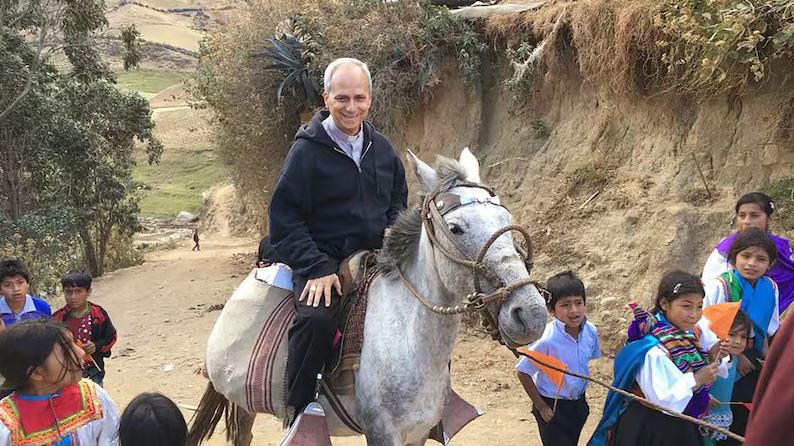
The president also revealed that he suggested to the Pope a trip to the Andean towns of Incahuasi and Cañaris, in Lambayeque, an area with a predominantly Quechua-speaking population and significant social needs. To facilitate these journeys, the Peruvian government would have offered air transport that would allow covering long distances quickly.
Balcázar also did not rule out a possible stop in Arequipa, although he stressed that the final organization corresponds to the team in charge of preparing papal trips.
An audience marked by personal closeness
The president described the meeting with Leo XIV as “magnificent and friendly” and explained that the audience lasted nearly two hours, due in part to the prior acquaintance both shared from the current Pope’s time in Chiclayo.
During the conversation, they also addressed the country’s political situation, as well as various social and international matters.
Among them was the encyclical Magnifica Humanitas, published by Leo XIV last May, dedicated to issues related to artificial intelligence, human dignity, and the common good. They also discussed the phenomenon of migration and the challenges it poses in different countries of the region.
A trip still pending confirmation
Despite the optimism shown by the Peruvian president, the apostolic visit has not yet been officially announced by the Holy See.
At the beginning of June, Balcázar had already publicly announced that Leo XIV could visit Peru on November 10. However, as is customary with papal trips, it will be the Vatican that officially communicates the dates, program, and final itinerary.
If confirmed, the trip would mark Leo XIV’s return to a land he knows deeply and where he carried out a significant part of his episcopal ministry before ascending to the papacy.