


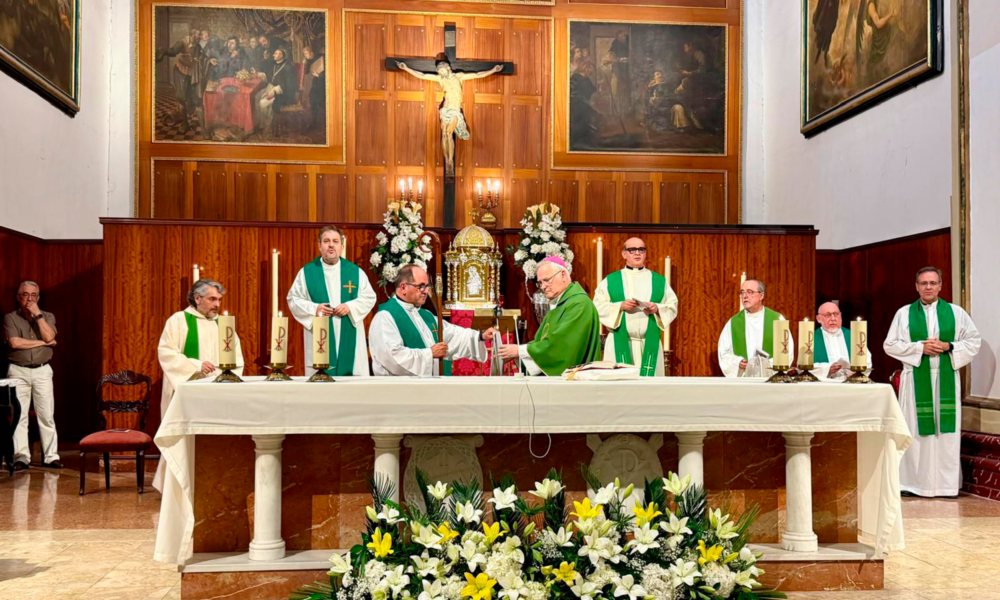
The Society of Jesus has closed its last religious community in the diocese of Cartagena, ending more than 150 years of continuous presence in Murcia since the order’s return in 1871. The official farewell took place last Sunday at the church of Santo Domingo, where the bishop of Cartagena, Monsignor José Manuel Lorca Planes, presided over a large thanksgiving Mass for the work carried out by generations of Jesuits in the region.
The decision responds to the deep vocational crisis affecting religious life in Europe and the Society of Jesus itself. The provincial of the Jesuits in Spain, Father Enric Puiggròs Llavinés, acknowledged that the order is going through “an institutional moment of great weakness” caused by the scarcity of new vocations and the progressive aging of its members.
The closure of this community marks the end of a historical presence that dates back to 1555, when the sons of Saint Ignatius first settled in Murcia.
The closure of the last Jesuit community
The departure of the Jesuits does not affect only the church of Santo Domingo. With it disappears the last stable religious community of the Society of Jesus in the entire diocese of Cartagena.
At the end of the celebration, the official document certifying the closure of this last community was read, in which the diocese expressed its gratitude “to all the Jesuits who have served in this land,” from those who preached and taught to those who quietly carried out their apostolate from the confessional and spiritual accompaniment.
The document also recognizes that the diocese accepts this decision “in a spirit of ecclesial communion,” understanding the circumstances that have made it necessary and committing itself to safeguarding the spiritual heritage received from the Ignatian tradition.
A history that began in the time of Saint Ignatius
The presence of the Society of Jesus in Murcia has its roots in the years of Saint Ignatius of Loyola. As the provincial of Spain recalled, the Jesuits founded the college of San Esteban in 1555, which remained active until the expulsion of the order decreed by Charles III in 1767.
The Society returned to Murcia in 1871, taking charge of the church of Santo Domingo. Years later it also received the monastery of San Jerónimo, now the seat of the Catholic University of Saint Anthony of Murcia. For decades, from these locations an intense educational, spiritual and missionary activity was promoted that left a deep mark on the religious life of the region.
The provincial himself highlighted that from San Jerónimo numerous popular missions departed that helped strengthen the Christian life of the Murcian huerta and spread devotion to the Sacred Heart of Jesus and the Virgin Mary.
In the last fifty years, after abandoning other apostolic works, the Jesuits’ activity had been concentrated mainly around the church of Santo Domingo, the Loyola Center and the ministry of the Eucharist, reconciliation and the Spiritual Exercises.
“It leaves our hearts wounded”
The farewell was marked by a tone of gratitude and sorrow. In his homily, Monsignor José Manuel Lorca Planes confessed that this kind of farewell “leaves the heart wounded” and recalled the spiritual imprint the Society has left on the diocese.
“The Jesuits have left us, throughout the ages, the imprint of education, missionary zeal, love for the Heart of Jesus and obedience to the Pope as a fourth vow,” the bishop stated.
The prelate also evoked previous departures of the order in the region, such as those in Caravaca de la Cruz, Lorca, San Esteban or the monastery of Los Jerónimos, places where the historical imprint of the Society is still visible.
Addressing the religious directly, Lorca Planes thanked them for “their lives spent and worn out for this Church” and assured them that the diocese will continue to receive them “with open arms.”
The retreat of religious life in Europe
The provincial of Spain framed the decision within a phenomenon affecting numerous religious congregations on the continent.
“That things have happened this way, after trying for quite some time to make them otherwise, is one more chapter of that moment of retreat that religious life is experiencing today in the Church of Europe,” he stated.
Puiggròs acknowledged that the Society is forced to reorganize its presences because it can no longer maintain communities alongside all its apostolic works. “We are repositioning ourselves here and there, always experiencing the pain of departure,” he explained.
A farewell that does not want to be final
Despite the closure of the community, the Jesuits wanted to emphasize that Ignatian spirituality will continue to be present in Murcia through various apostolic initiatives and the work carried out by ECCA Social and the Loyola Center.
The provincial concluded his intervention by leaving the door open to a possible future return.
“We place the future in God’s hands and entrust ourselves to the guidance He gives it, with the desire that He may allow our withdrawal not to be definitive.”
With this farewell, a presence concludes that, amid expulsions, returns and centuries of apostolate, has been part of Murcia’s religious history for nearly five centuries.