


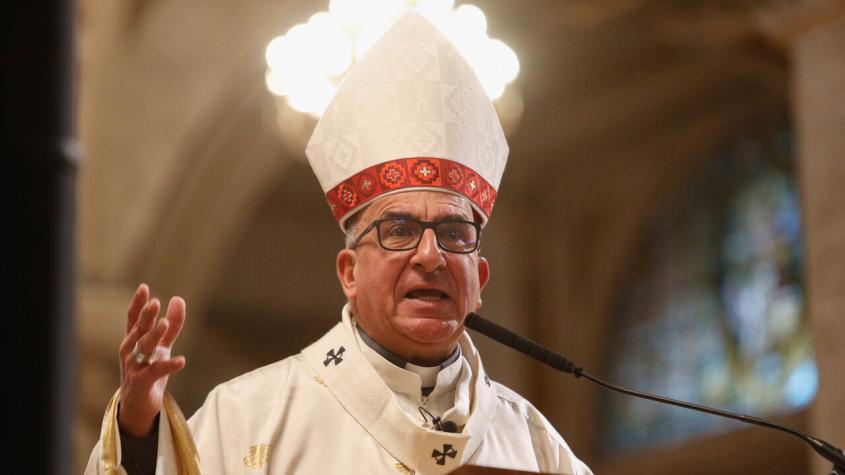
The Archbishop of Santiago de Chile, Cardinal Fernando Chomali, has addressed an extensive pastoral letter to the families of his archdiocese, analyzing some of the main challenges currently facing the institution of the family. Under the title The Family, a Path of Hope, the prelate addresses issues such as the decline in birth rates, the rise in divorces, the fragility of family bonds, economic insecurity, and the loss of meaning affecting many young people.
In the document, Chomali warns that Chile is experiencing a “demographic winter” and maintains that the family crisis cannot be explained solely by economic factors, but also by deeper cultural and anthropological changes. At the same time, he proposes various pastoral and social initiatives aimed at strengthening marriage, encouraging birth rates, rebuilding support networks, and accompanying those going through complex family situations.
Below, we reproduce in full the letter from Cardinal Fernando Chomali.
Letter to the Families of the Archdiocese of Santiago: “The Family, a Path of Hope”
Dear families of the Archdiocese of Santiago:
With affection and gratitude for your lives and your families, I address you to share a perspective on a reality that pains us and, at the same time, calls us to recover hope. We live in a time when family relationships face growing demands, making life more challenging; bonds more fragile; care more solitary; and the future more uncertain.
However, we must not lose sight of the fact that the family is a gift. Behind this statement lies a deep conviction: the family is a gift from God, because it is born of His will. Therefore, when conjugal love is understood as a sacrament, it ceases to be a mere “feeling” and becomes a path and a vocation, whose model of self-giving is Jesus Christ. From this conviction, I dare to call you not to be afraid and to continue working for the care and promotion of the family.
I therefore ask you not only to read this letter, but to reflect on it and share it. It is the fruit of a long journey of discernment by many people of good will, and today more than ever, we need to illuminate society with the Gospel of Jesus Christ. As Pope Leo says in his encyclical Magnifica Humanitas, the Church “cannot consider itself alien to the forces that shape society. On the contrary, the Church actively participates in the processes through which society grows and organizes itself, and offers its contribution to the creation of a more just and fraternal society.” (MH 19)
Some Current Concerns
Among the concerns that urgently press upon us today, I wish to highlight that we are going through a “demographic winter.” In 2025, Chile recorded a birth rate below 0.97%.
This is compounded by the dissolution of bonds: Chile leads divorce rates in Latin America, with figures indicating that nearly 59 out of every 100 marriages end in dissolution. Single-person households are also increasing, now accounting for approximately 22% of the population.
On the other hand, for many people, children are perceived as a burden. This is a widespread feeling that arises because stability is precarious and wages are insufficient, when effective protection and work-life balance policies are lacking, and when caregiving falls on too few shoulders.
But we are not dealing only with data; behind every figure are stories of projects cut short or postponed, difficult decisions, and questions that turn into anguish.
The temptation of our time is to interpret everything through fear. Fear of not having housing or of being unable to support the education of one’s children. Fear of failure and conflict. Fear of loneliness and aging. When the heart is governed by fear, any life project becomes a threat. That is why so many young people who have dreamed of marrying and starting a family now feel insecure and incapable of achieving it. They are afraid. The frustration is great for them, and for us, the older generation, it also represents a shared failure.
Nevertheless, our faith calls us to go beyond diagnosis. It invites us to discern what is happening within people and in the culture, and also to collaborate with the authorities, encouraging them to promote public policies inspired by a Christian anthropology that favors the marital bond and birth rates. We are moved by the conviction that this is a beautiful vocation and a source of great hope.
The Family, a Path of Hope to Reverse the Crisis
There is hope! The family is the heart of social life, for every family reflects the love of God. Alongside the painful reality we have just described, there are thousands of families who, like you, sustain through their daily efforts—at home, at work, in raising their children, and in caring for the elderly—a work that cannot be measured by statistical data. You bear witness to the love of God. In you, in your joys and daily struggles, the Church discovers a privileged path to encounter Jesus, who loves us and always desires our good. Pope Leo XIV says in his recent encyclical: “In that same experience, we continue to be able to intuit a greater fraternity than ourselves and to perceive injustice as a scandal. Authentic culture and art preserve that spark, resisting the normalization of evil.” Encyclical Magnifica Humanitas (MH 122)
The Church seeks to analyze and delve into the challenges surrounding family life, not to reduce the crisis to a single factor, but to reflect on it in all its complexity. A complex web is evident, in which material conditions, emotional wounds, social isolation, and loss of meaning intertwine, alongside a materialism and individualism that have permeated the entire society.
I propose focusing on four factors:
1. The Fragility of Bonds
Fragility can be associated with what has been called the “throwaway culture.” In it, love is understood as a temporary agreement that must “work” in order to be valuable. If fatigue, pain, disagreement, or wounds appear, a replacement is sought instead of repair and reconciliation. Sacramental marriage—and true love—on the other hand, are sustained by grace: spouses, united to Jesus Christ, can cultivate fidelity, forgiveness, and mutual self-giving. It is a true school of love, in which each day one chooses to love the other. I strongly recommend approaching and being captivated by the Christian vision of the family, an inexhaustible source of happiness and joy.
2. The Loss of Networks
This dimension goes hand in hand with the fragility of bonds. In other times, raising and caring for children were experienced with the support of grandparents, aunts, uncles, cousins, and neighbors. Today, however, many families are alone. Daily accompaniment has diminished, and with it comes isolation: motherhood and fatherhood are experienced as a strictly individual responsibility. And when networks are lacking, so too are opportunities for learning: correction comes late, help is sought late, dialogue breaks down, and problems intensify.
3. Material Precarity
When the cost of living exceeds wages or employment is unstable, when housing is an unattainable dream, the family project becomes fragile. To build a family, certain minimum requirements are needed: stability, time dedication, rest, and a dignified quality of life. If all of that is lacking, it is not surprising that the future seems unviable. Precarity not only hinders the decision to have children; it also exhausts patience, hardens dialogue, and turns the home into a place of permanent tension.
4. The Loss of Meaning
The deepest cause of this crisis far exceeds the economic: it is existential. Many young people do not wish to have children because of an inner emptiness, the absence of shared horizons, and the impression that a definitive commitment offers no future. If life is understood only as the consumption of experiences, the “why” of self-giving fades away. Without meaning, everything becomes provisional, and no effort or sacrifice seems worthwhile, much less the patient construction of a family.
A Roadmap to Recover Love
In this scenario, the pastoral question is inevitable: What can we do as a Church? What can families do? What must society do? The Christian response does not remain at the level of discourse, and before proceeding, it is important to consider:
1. Renewing Marriage Preparation: From Bureaucracy to Accompaniment
It is not about increasing formalities, but about changing the approach: moving from a merely bureaucratic focus to genuine accompaniment. Couples need spaces where they can learn to communicate and understand marriage as a sacrament, a vocation, and a self-giving whose model is Christ’s self-giving on the cross. They need to practice healthy ways of resolving conflicts and learn that the promise of “forever,” in addition to effort and will, requires a grace that spouses cultivate united to the Lord.
Preparation is not only about informing: it is about teaching how to build the house on rock, on firm and lasting foundations, bearing witness that crises are also sources of opportunity and new growth. When love becomes insipid, spouses must unite themselves to Jesus so that the water may be transformed into wine and the celebration of love may continue. Those who enter marriage without tools often discover the first crisis as a surprise and, not knowing how to face it, easily become disillusioned and end up drifting away or abandoning it. On the other hand, when one prepares with love and seriousness, difficulties cease to be an insurmountable abyss and become moments of learning. Let us remember the words of Jesus—“without me you can do nothing”—: there we see revealed the close bond that exists between marriage and the Lord.
2. Promoting Shared Responsibility
The family, as Pope Leo says in Magnifica Humanitas, “is a primary social good. Founded on the stable union between a man and a woman, it is the first environment in which each person develops their potential, becomes aware of their dignity, and learns the first forms of truth and goodness, internalizing habits that prepare them for life in society” (MH 165). For this reason, it requires the shared exercise of fatherhood and motherhood. When care is left solely in the hands of one spouse (usually the woman), exhaustion and frustration accumulate, and the home breaks down more easily. Shared responsibility is an act of justice and dignity: it is love made time, presence, and tenderness.
That is why we need to form men capable of accompanying; men who are not emotionally absent, who participate in raising children and engage in daily life. Responsible fatherhood must not be reduced to material provision: it is also about being present, listening, supporting, asking for forgiveness when appropriate, and learning to care.
3. Rebuilding Networks and Fostering Intergenerational Solidarity
As the extended family is lost, the Church, as a family and people of God, is called to take its place and be a school of support: an “extended family” among children of the same Father. A family that reaches out to young people connects families with older adults and creates real bridges.
For its part, the parish is called to be more than a place of celebrations: its vocation is to be a space of accompaniment, where someone cares, listens, guides, or helps in times of need, inspired by Christ, the Teacher. Meetings for mothers and fathers can be created, support networks for parenting, and workshops where the experience of more mature couples sustains those just beginning.
4. Welcoming with Mercy Those Going Through Complex Situations
We think of single-parent families, separated or divorced persons seeking to begin again, and in general, all those who feel outside the traditional model of family. There, mercy will consist in showing the fatherhood of God, who never abandons. The true encounter with Christ heals wounds, makes conversion possible, and allows walking in truth. That is why welcome must be united with accompaniment on a path of reintegration and hope.
5. Creating the Conditions to Live the Family Vocation
The Church cannot limit itself to consoling; it must also illuminate, strengthen, and form, because it is part of its mission to preach the Gospel in season and out of season and to give reason for our hope. And the family is good news, great news for all.
If the family is a social good, society must protect it with concrete policies: housing, decent work, work-life balance, support for parenting, and measures that reduce the precarity that today hinders so many projects. We must also take responsibility for those policies and subsidies that, far from promoting the family, end up weakening it. Here there is a shared responsibility: authorities, businesses, institutions, and communities are called to look at the family as the foundation of the future. As Saint John Paul II said, the destiny of humanity is played out in the family; the best service we can offer is to proclaim its beauty and, above all, its fruitfulness for the country.
At this point, the Pope’s words on Artificial Intelligence and how it may affect the family take on special relevance, as do the new technologies that imply changes in the labor, educational, and social systems: “The family, however, is a fragile social good, which is immediately affected by the economic and technological transformations that are changing the world of work, and which requires cultural, legal, and economic support (…) Sustaining families and young people in this transition requires measures that make stability possible.” (MG 166, 167)
Final Invitation
At the beginning of this letter, I invited you not to be afraid. That does not mean denying the difficulties, but trusting that love is stronger and capable of weathering the storms. The Church does not promise a path without pain: it promises a path with meaning. A marriage does not break only because of conflict; it breaks when hope is lost. That is why conjugal love, even when wounded, can be rebuilt. Grace does not eliminate human effort, but sustains and perfects it. As Saint Paul says: “where sin abounded, grace abounded all the more” (Rom 5:20).
To conclude, I would like to respectfully propose some concrete actions:
- Strengthen communication as the main tool for life together. Do not wait for pain to accumulate. Talk about all topics, especially with young people, about their expectations and fears. Anticipatory dialogue is medicine. That communication will be fruitful insofar as it is sustained by constant prayer, Sunday Mass, and community life.
- Seek accompaniment. No one is called to solve everything alone. A preparation course, a pastoral team, a group of families, or fraternal listening can change the course.
- Protect the bond with actions. Fidelity is not just an idea: it is quality time, care, asking for forgiveness, and learning to forgive. As Catholics, we are called to bear witness and to be living examples for our brothers and sisters. This requires greater spiritual depth, which begins by recognizing marriage as a call from God, and not merely a sociological or psychological fact.
- Build networks. If there is no extended family to turn to, create one. Participate in your parishes, invite older people in your surroundings, connect with neighbors, and open your home to the community when possible. A network does not arise by chance; it is built with patience.
- Recover the sense of life as a gift. Ask yourselves about the “why” of what you undertake. Having children is not only a biological act: it is opening the future and giving hope. It is also a mandate from God Himself, who calls us to be fruitful and multiply.
- Face precarity with dignity. It is not about denying economic reality, but about seeking solutions, support networks, community alliances, advice, and accompaniment in difficult times.
- Allow yourselves to be accompanied in your wounds. To those families who contracted marriage in the Church and who, after having tried, for various reasons were unable to continue, I encourage you to allow yourselves to be accompanied by the Church and its pastors, in order to heal wounds and seek paths of spiritual reparation in truth and justice.
Entrusting you to the intercession of the Holy Family of Nazareth, I renew my pastoral closeness and the commitment of the Church of Santiago to accompany you with mercy, truth, and hope.
With gratitude and hope, I bless you.
Card. Fernando Chomali G.
Archbishop of Santiago de Chile
June 2026