


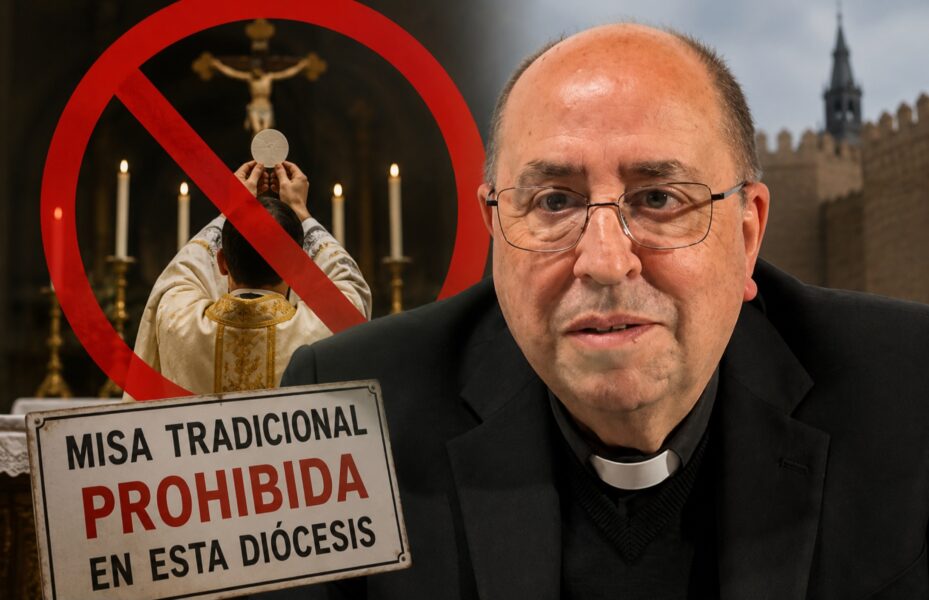
A group of pilgrims from the United States was unable to celebrate the traditional Mass in Ávila after, according to a public statement by priest João Silveira, the Diocese denied authorization to do so in a previously reserved chapel.
The priest, who accompanied the group as chaplain, explained that the pilgrims usually attend the traditional Mass and that, for this reason, they had wanted to travel with a priest who could celebrate according to the ancient rite. However, after already having reserved the chapel, they were informed that celebrating this liturgy required express authorization from the bishop.
Silveira then went to the diocesan curia to request the permission. According to his account, the response was not given personally by the bishop, but by the vicar general, who conveyed it in a blunt manner: “That Mass is prohibited in this diocese.”
The priest questions why a Mass of the Church can be prohibited and under what authority such an action is taken. “Prohibited for what reason? And by what authority? Has this rite been abrogated?” he asks in his public statement.
Silveira also highlights the paradox that this occurred precisely in Ávila. He recalls that the rite he intended to celebrate is the same one used in the convents of the Discalced Carmelites, born from the reform of Saint Teresa of Jesus and Saint John of the Cross. “The rite was good for those great saints, but now it is bad for us?” he asks.
After the denial, the Mass was ultimately celebrated in a hotel room. The priest cites Canon 932 §1 of the Code of Canon Law, which states that the Eucharistic celebration must take place in a sacred place, unless in a particular case necessity requires otherwise, and that in such a case it must be celebrated in a dignified place.
For Silveira, the situation was absurd: there was no need whatsoever to celebrate in a hotel, because the group was surrounded by churches and chapels with altars. That necessity, he maintains, was created by the diocesan authority itself by preventing the Mass from being celebrated in a church.
The priest laments that they were forced to celebrate in a profane space when a chapel was available. “Was Our Lord more praised in a hotel room than in a church? Were the souls of the faithful more edified seeing a table serve as an altar?” he asks.
Silveira describes this type of decision as “tyrannical” and “anti-pastoral,” especially when it comes from those who insist that everyone is welcome in the Church. “But not everyone is. That is quite clear,” he states.
The priest assures that he has experienced similar episodes on other occasions, although until now he had remained silent. This time, however, he considers it necessary to denounce it publicly because, in his view, this situation cannot become the normal state of the Church.
The underlying question is inevitable. Can anyone imagine a similar reaction if it had involved a group of the Eastern rite requesting to celebrate according to their own liturgical tradition? Would anyone consider it normal to prevent a group from the Neocatechumenal Way from celebrating according to their usual practice? Probably not. The reaction would have been immediate: there would be talk of a lack of pastoral sensitivity, of misunderstanding, of rigidity, and of contempt toward a recognized ecclesial reality.
However, when it comes to the faithful attached to the traditional Mass, what would in any other case be presented as an abuse is too often accepted as normal. This is not about an aesthetic preference or cultural nostalgia. It concerns a rite of the Church, venerated for centuries, the spiritual nourishment of countless saints, and a legitimate form of prayer for many Catholic faithful.
That is why it is difficult to understand this hostility toward the traditional liturgy. It is not a private whim being combated, but a living expression of the Catholic faith. If the Church welcomes the diversity of rites, charisms, movements, and sensibilities, there is no convincing pastoral reason to treat traditional faithful as permanent suspects. Authority exists to safeguard communion, not to humiliate those who ask to pray as entire generations of Catholics once prayed.