


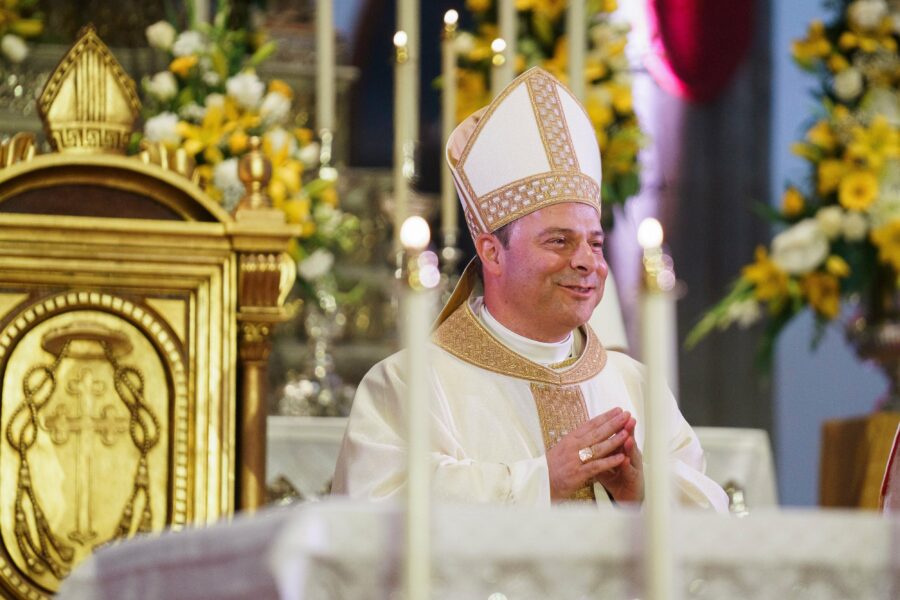
The interview granted by the Bishop of Tenerife, Monsignor Eloy Santiago, to Vatican media following the visit of Leo XIV to the Canary Islands constitutes one of the most explicit episcopal positions in recent months on the migration issue.
Throughout the conversation, the prelate not only offers a positive assessment of the apostolic journey but also takes the opportunity to defend a particular view of immigration and to criticize certain political positions he considers incompatible with human dignity.
The bishop begins by describing the papal visit as “a moment of grace and blessing” that, he claims, was experienced even by people distant from the Catholic faith. “The Pope is seen as an international reference who stands for peace and human dignity,” he maintains.
However, the core of the interview focuses on immigration. Santiago particularly praises the Pope’s call for the conversion of human traffickers. “I hope it reaches the hearts of those who are capable of exploiting the vulnerability of others for profit,” he states.
He adds: “How many lives are lost because of these economic interests that profit from the suffering of others. How many people are treated as objects and not as persons.”
The bishop also addresses the reality of the Las Raíces reception center in Tenerife, where Leo XIV met with migrants. Far from considering these facilities a solution, he expresses a wish that stands out for its scope: “I hope it disappears, that it is no longer necessary.”
According to him, the reason is that he aspires to a model in which countries are open to the regular reception of migrants, thereby avoiding the existence of large detention or temporary reception centers.
“These islands have become a kind of cage for them. It is not normal,” he states. He adds a reflection that summarizes much of his approach: “If one looks at their faces, the human heart cannot make distinctions and all ideological discourses collapse on their own.”
Political criticism appears even more explicitly when he is asked about NGOs that rescue migrants in the Mediterranean and about voices questioning their actions: “I find it hard to accept the attitude of some politicians who show no compassion toward people who are suffering. I do not understand them at all,” he responds.
For the bishop, the migration problem requires a global response and considers it essential to “continue speaking and continue giving voice to migrants.”
When asked directly about remigration, his response is immediate and categorical: “I do not want to hear that word because it is a sign that humanity has failed.”
The phrase encapsulates much of the debate currently taking place in Europe on immigration. The problem is that the bishop does not elaborate on what he exactly understands by remigration, nor does he distinguish between very different situations. He does not clarify whether he is referring to the expulsion of irregular migrants, returns agreed upon by states, voluntary returns, or broader political proposals. He simply rejects the term outright.
Immediately afterward, he maintains that “the right to emigrate safely must be guaranteed” and adds that many migrations are forced: “Everything possible must be done so that people are not forced to flee, but once they have left, they cannot go back. They must be able to live with dignity,” he states.
This last statement is probably one of the most debatable in the entire interview. If taken literally, it seems to suggest that once migration has begun, return ceases to be a legal and legitimate option.
However, the interview does not explain how this idea fits with the existence of national immigration laws, with the return procedures provided for by legal systems, or with the right of states to control their borders. In fact, it is striking that throughout the conversation there are hardly any references to the common good of receiving societies, to the limits of reception capacity, to cultural integration, or to the obligations that also correspond to those who migrate.
None of this diminishes the value of the reminders about the dignity of every person or about the moral obligation to combat the mafias that traffic in human beings. Nevertheless, the interview reflects a very specific vision of the migration phenomenon, in which certain political positions seem to be automatically identified with a lack of humanity, while others appear implicitly endowed with a moral superiority that is not always evident.