


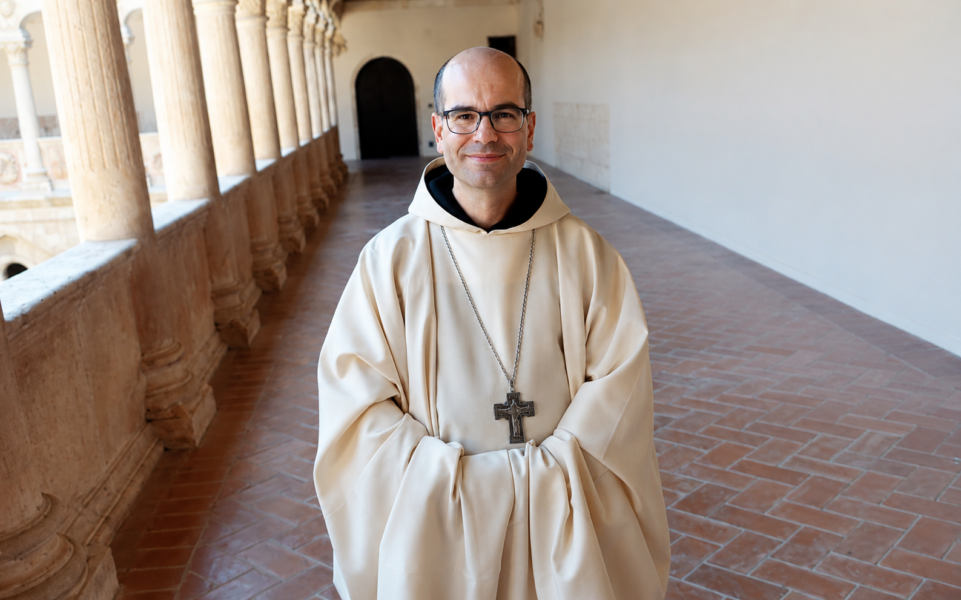
A few weeks after receiving the abbatial blessing, Dom Francisco Rivera, new abbot of the Cistercian monastery of Santa María de Huerta, has warned that the drastic decline in vocations cannot be attributed solely to the cultural changes in today’s society. The monk believes that consecrated life itself must examine whether it continues to offer a coherent and faithful witness to its identity.
“We cannot deceive ourselves” in the face of the drop in vocations
In an interview given to Vida Nueva, the successor of Dom Isidoro Anguita addresses one of the most concerning challenges for the Church: the lack of new religious vocations.
“The reality is that today the influx of vocations has declined drastically,” the abbot acknowledges, rejecting explanations that focus exclusively on external factors such as social media or cultural changes.
In his view, religious communities must also examine themselves. “Perhaps we have become like a kind of insipid salt,” he states, evoking the Gospel warning about the loss of identity and the ability to give flavor to the world.
Rivera maintains that the best vocational pastoral work does not lie in marketing strategies or specific campaigns, but in fidelity to one’s own vocation. In the case of monasteries, he considers it essential to live the Rule of Saint Benedict and the monastic commitments with seriousness.
An authority that springs from prayer and love for one’s brothers
The new abbot also reflects on the exercise of authority within the Church, a particularly sensitive issue in recent years.
Among the advice received from Dom Isidoro Anguita, he highlights three pillars: being a man of prayer, loving the brothers of the community, and acting with common sense.
Rivera warns that all ecclesial authority runs the risk of becoming distorted when it ceases to be oriented toward the good of persons.
“Only the love that arises from seeking the good of the other should order relationships of authority and governance in the Church,” he notes. Otherwise, he adds, there is the danger that those who hold responsibilities may end up governing in an authoritarian manner.
Silence as a response to the digital world
Asked about the value of contemplative life in an age dominated by technology and immediacy, the abbot defends silence as a profoundly human and spiritual necessity.
According to him, silence forces one to confront one’s own inner reality and what one usually flees from through constant noise.
For this reason, he believes that the monastic experience offers a particularly timely message in a society marked by permanent acceleration and the difficulty of stopping.
From Granada to the monastery of Santa María de Huerta
A native of Granada, Dom Francisco Rivera discovered his monastic vocation during adolescence after learning online about the Cistercian monastery in Soria. Participation in one of the vocational courses organized by the community confirmed a spiritual restlessness he had been experiencing for years.
Elected abbot last May, he will officially succeed Dom Isidoro Anguita after receiving the abbatial blessing on July 11.