


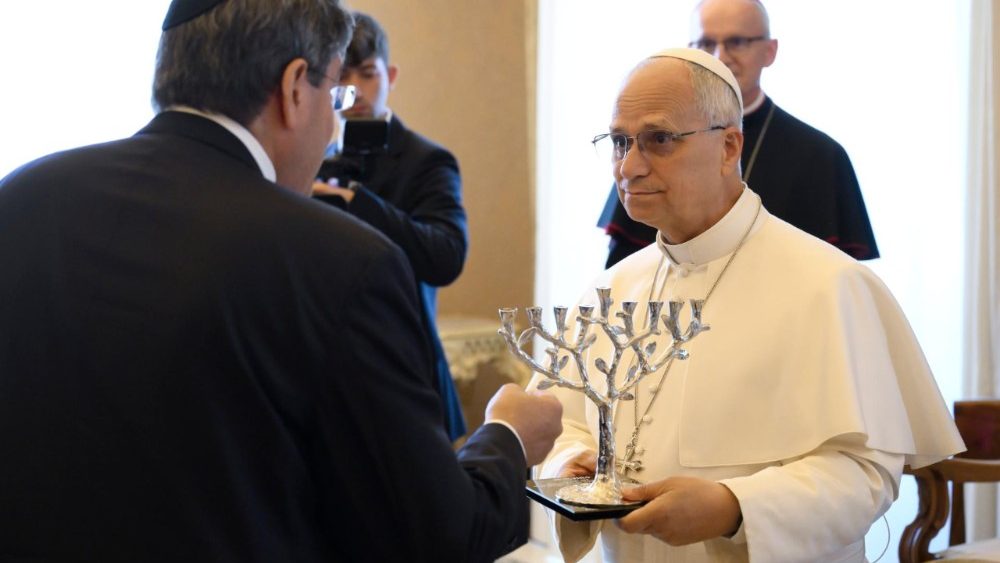
Pope Leo XIV received a delegation from the United Jewish Appeal-Federation of New York, one of the world’s leading Jewish philanthropic organizations, at the Vatican Apostolic Palace on Monday. During the meeting, the Pontiff took the opportunity to highlight the legacy of Nostra Aetate, the declaration of the Second Vatican Council that marked a turning point in relations between the Catholic Church and Judaism, and recalled the role played by Saint John XXIII in that historic process.
Leo XIV placed the encounter within a long trajectory of rapprochement between the two religious communities and recalled an audience held sixty-six years ago, when a delegation from the same organization was received by John XXIII. On that occasion, the Pope spoke words that would go down in the history of Jewish-Christian dialogue: “I am Joseph, your brother,” he said, quoting the Book of Genesis.
According to Leo XIV, that gesture symbolized the recognition of a shared spiritual heritage and helped pave the way for a new chapter in relations between the Church and the Jewish people.
The Legacy of Nostra Aetate
The Pontiff noted that the contacts initiated in those years led to the drafting of a text that would become “the heart and generative core” of Nostra Aetate, the conciliar declaration promulgated in 1965 on the Church’s relations with non-Christian religions.
Leo XIV recalled that the Church celebrated the sixtieth anniversary of that document last year, attributing to it the opening of “a new horizon of encounter, respect, and spiritual hospitality.”
According to him, Nostra Aetate made it possible to overcome decades of misunderstanding and laid the foundations for a closer relationship between Catholics and Jews. “It planted a seed of hope that has grown into a sturdy tree, offering shelter and producing abundant fruits of understanding, friendship, cooperation, and peace,” he stated.
The Pope also emphasized that the document reaffirmed a fundamental truth: that all human beings belong to one and the same human family.
A Clear Condemnation of Antisemitism
Reviewing the fruits of Nostra Aetate, Leo XIV highlighted the Church’s explicit condemnation of antisemitism and reiterated the enduring nature of that commitment.
“Recognizing the inherent dignity of all men and women, Nostra Aetate took a firm stand against antisemitism and declared that the Church rejects all forms of discrimination or harassment based on race, color, condition of life, or religion,” he recalled.
In a world still marked by conflicts, divisions, and identity tensions, the Pontiff maintained that the message of the Council continues to be an invitation to overcome prejudices and misunderstandings in order to work together for the common good.
Service to Those in Need as a Space for Encounter
Alongside dialogue between Jews and Catholics, Leo XIV wished to highlight the humanitarian work carried out by the New York-based organization, which provides assistance to vulnerable people in the United States, Israel, and more than seventy countries.
The Pope especially praised the work done on behalf of the poor, refugees, the elderly, and people with disabilities, noting that this commitment finds common ground with the Church’s social doctrine.
“Love is above all a way of looking at life and a way of living it,” he said, adding that service to the most vulnerable constitutes a privileged opportunity to recognize the presence of God in the midst of the world.
Drawing on the words of the prophet Isaiah, he recalled that when bread is shared with the hungry and the needy are cared for, “light will break forth like the dawn,” an image he used to underscore the spiritual dimension of charity.
A Call for Dialogue and Cooperation
In the final part of his address, Leo XIV thanked the members of the delegation for their commitment in the face of hatred and intolerance and encouraged them to continue working for a more just and peaceful society.
“May your mission strengthen dialogue, deepen mutual understanding, and contribute to the peace our world so urgently needs,” he said.
Full Address of Leo XIV:
Distinguished representatives of the United Jewish Appeal-Federation of New York,
Dear friends:
Peace be with you!
It is a joy to welcome you this morning to the Vatican. Your organization serves as an instrument of global Jewish philanthropy, providing essential humanitarian aid and social services to vulnerable populations—for example, those living in poverty, refugees, the elderly, and people with disabilities—in New York, the State of Israel, and more than seventy countries. These efforts reflect a clear recognition of human dignity and fraternity, in keeping with the Church’s commitment to integral human development and the call to love one’s neighbor.
This shared commitment takes on special meaning in light of our common history. Sixty-six years ago, a delegation from your organization was received by Pope John XXIII. With the simple yet profound words: “I am Joseph, your brother” (cf. Gn 45:4), quoting the Book of Genesis, he affirmed our common humanity as well as our shared spiritual heritage in Abraham, Isaac, Jacob, and Joseph. Later, a document was prepared that described a new relationship between the Catholic Church and Judaism. That text formed the foundation of what became “the heart and generative core” (Address on the 60th Anniversary of Nostra Aetate, Walking Together in Hope, October 28, 2025) of Nostra Aetate, the Declaration of the Second Vatican Council on the Church’s relations with non-Christian religions.
This historic document, whose sixtieth anniversary the Church celebrated last year, “opened a new horizon of encounter, respect, and spiritual hospitality” (General Audience, October 29, 2025). Among other things, it affirmed the truth that we belong to one human family. In this way, it planted a seed of hope that “has grown into a sturdy tree… offering shelter and producing the rich fruits of understanding, friendship, cooperation, and peace” (Address on the 60th Anniversary of Nostra Aetate, Walking Together in Hope, October 28, 2025). By recognizing the inherent dignity of all men and women, Nostra Aetate took a firm stance against antisemitism and declared that the Church rejects all forms of discrimination or harassment based on race, color, social condition, or religion (cf. Nostra Aetate, 4–5). In a world still wounded by divisions and conflicts, it called us to overcome the misunderstandings of the past in order to work together for the common good.
This same spirit of solidarity finds concrete expression in our shared concern for those most in need of help. In my apostolic exhortation Dilexi Te, I observed that “love is, above all, a way of looking at life and a way of living it” (120). Service to the poor, the marginalized, and the defenseless is a means of encountering the sacred; through them, the divine voice continues to speak to us (cf. ibid., 5). As the prophet Isaiah reminds us, when we share our bread with the hungry and care for those in need, the light of the Lord “will break forth like the dawn” (cf. Is 58:7–8). That light invites us to see service to the vulnerable as a path that opens hearts and renews society.
Dear friends, I commend you for the dedication with which you assist the poor and needy, confront hatred and intolerance, and work to build a better world for all. May your mission strengthen dialogue, deepen mutual understanding, and contribute to the peace so urgently needed in our world. Be assured of my prayers for you, for your loved ones, and for all the people you serve.
Thank you.