


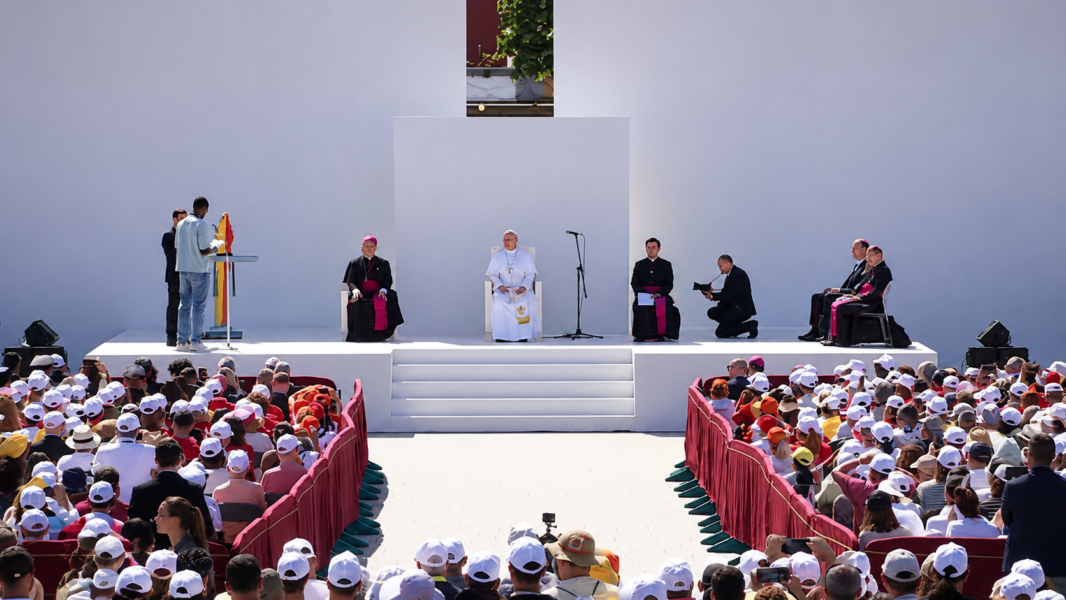
The integration of immigrants cannot be built at the expense of the identity of the societies that receive them, nor can it be limited to mere material assistance. This was one of the central messages of Pope Leo XIV during the meeting with migrant integration realities held this Friday in Plaza del Cristo de La Laguna (Tenerife), one of the events of the final day of his apostolic journey to Spain.
In a speech delivered in French before nearly 4,000 people, the Pontiff addressed the migration issue from a perspective that combined welcome, responsibility, integration, and evangelization. The event was attended by representatives of Cáritas, the Diocesan Delegation for Migration, volunteers, immigrants integrated into Canarian society, and various ecclesial and civil entities working in this field.
Full Speech of Leo XIV in La Laguna
Dear brothers and sisters:
It is a joy for me to share this moment with you here, in San Cristóbal de La Laguna, the seat of this diocese. I was struck by what has been said about this city: that it is a city without walls, an open city.
Perhaps this detail can help us understand that the most difficult barriers to break down are not always made of stone. Sometimes they are in the gaze, or in fear, or in indifference. The sea that surrounds these islands brings us stories that we do not always know how to read: stories of pain, hope, and searching. In a city without walls, the heart too is called to expand in order to welcome them. That is why we need to learn the language of closeness, one that is understood more with the hands than with words.
Braille and other forms of tactile writing remind us that the word can also make its way through touch. Likewise, integration requires learning to read in another way. There are gazes that see and yet do not recognize; they turn a face into a number, a story into a file, and a difference into distance. That is why the Gospel educates us in a deeper reading of reality: one born of closeness, patience, and hands capable of assisting, accompanying, guiding, teaching, and opening paths.
In the works of integration of these brothers and sisters of ours—as in every work of charity—the Church learns to read in the concrete lives of those who suffer in body or spirit a living sign that points back to the holy Gospels and becomes legible through touch and closeness, when we touch the wounds of others. Like Thomas before the glorified body of the Risen One, the Church too learns that wounds, seen through faith, can become a place of recognition: there, where human pain is touched with love, Christ confirms to us that He is present in the hungry, the thirsty, the naked, the sick, the imprisoned, and the stranger (cf. Mt 25:35-40). From this faith that recognizes the living Christ also springs the service of Father Darwin and so many others. Christian charity flows from the love of God poured into the believer’s heart; therefore, before the needy, faith becomes concrete and love for Christ is transformed into gestures.
From this conviction, our presence seeks to bear witness that solidarity is born from the recognition of human dignity and goes beyond any secondary concession or mere act of philanthropy. It is called to commit itself and take the form of a process. Welcome opens the door; integration helps to cross the threshold. Assistance places balm on the wound, and integration rebuilds the future.
To integrate does not mean erasing the history of those who arrive, nor demanding that they leave behind everything that forms part of their memory. Nor does it mean creating parallel worlds, closed off from one another, where people coexist without truly meeting. Integration is a reciprocal path: those who arrive learn to inhabit a new land, and those who receive learn to expand their own home without diluting their identity or closing their hearts to encounter. To you, dear migrant brothers and sisters, belongs a noble and necessary part of this journey: to open yourselves with trust to the community that receives you, to learn its language, to respect its laws, to know its customs, to participate in common life, and to offer your gifts with gratitude.
Every welcoming society has duties toward those who arrive; and those who are welcomed also discover that the dignity recognized as a right flourishes when it becomes responsibility and a sincere desire to build together with others. Thus, those who arrived as strangers can rediscover bonds, rebuild trust, and feel themselves a living part of a community. This is a precious form of mercy.
We are speaking, above all, of persons created in the image and likeness of God, rather than of legal categories or problems to be managed. After difficult journeys and, at times, several attempts—as in the case of Khalid—they seek someone who will say to them, with gestures before words: your life is not disposable, your suffering is not invisible, your dignity has not dissolved in the waters you have crossed—as Mbacke expressed to us. But they also seek something more: a concrete possibility to begin again, to learn, to work, to serve, to participate, and not to remain forever trapped in the condition of victims.
In this sense, I wish to thank the words of Bishop Santiago and, with them, the witness of a Church that, even with limited means, seeks to “walk with those who walk.” Thanks to the diocesan Caritas, the diocesan Delegation for Migration, the parishes, and so many ecclesial and civil realities that go beyond first aid and accompany processes of protection, promotion, and integration. Thank you for making it possible that those who were once accompanied can become—as Thalia reminded us—a bridge for others, returning the love received. When those who needed a hand begin to extend their own, the charity received is transformed into shared responsibility.
At the same time, we cannot forget the many migrants who, coming from Latin America, the Philippines, and other regions, are already a living part of the community and, with their faith, their work, and their gifts, help to renew it. Allow yourselves also to be evangelized by them, for they surely bring gifts that Providence has wished to send you through those who are integrating. They remind us that to integrate is to open space so that a person can feel co-responsible. Thus, the foreigner of yesterday can be the brother and neighbor of today.
To Catholics I wish to ask for something more: that integration not be reduced to a social task, however necessary it may be. Those who arrive at our parishes need bread, shelter, language, work, and protection; and they must also find a community capable of offering, through the witness of life and word, paths to know Jesus Christ, always respecting the conscience and freedom of each person. To evangelize is to share with respect and humility the treasure that sustains our action and our hope. A Church that welcomes is also a Church that proclaims, offering Christ without imposing Him, and at the same time receiving the Gospel from the hands of the poor.
A human conscience, and even more a Christian conscience, cannot remain indifferent before the victims of shipwrecks and the lack of assistance, before those cemeteries of the sea. Every life lost on these routes is a failure for the human family. Nevertheless, there is also a silent shipwreck after arrival: to be left alone in a city, without language, without bonds, without work, without trust, and exposed to those who exploit vulnerability. To integrate is to prevent that second shipwreck. It is to help those who arrived wounded not to remain forever fixed in their pain, but to be able to stand up again, recognize their gifts, and offer them to the community.
And from this square I wish to address a clear word to those who exploit despair; to those who organize routes of death, traffic in persons, withhold documents, exploit workers, threaten women, deceive families, and turn the suffering of others into business. Stop. Convert (cf. Mk 1:15). The tears and blood of these brothers and sisters cry out to God, and their sufferings reach Him (cf. Gn 4:10; Ex 3:7-9). Money taken from the vulnerability of the poor will not bring peace, honor, or future (cf. Jr 22:13; Jas 5:1-6).
For every life lost, every family deceived, every body subjected, every woman threatened, every worker exploited, they will have to appear before divine justice (cf. 2 Cor 5:10). Break those chains and free those under your control (cf. Is 58:6). Return what was taken and repair what you can. Return while there is still time, because the mercy of God can reach even the most hardened sinner, but it enters only through the narrow door of truth, justice, and conversion (cf. Ez 33:11).
Brothers and sisters, the last word cannot belong to fear, indifference, or the violence of those who trade in human life. The last word belongs to Christ, who identifies with the stranger, touches the wounds of humanity, and calls us to recognize Him in every brother and sister who needs to be welcomed, protected, promoted, and integrated. Let us lift our gaze to Him, without turning it away from those who suffer; let us look to the Lord to learn to look with His eyes upon our brothers and sisters.
The Holy Family of Nazareth, which had to migrate to Egypt to protect the life of the Child Jesus (cf. Mt 2:13-15), continues to be for all times a model and refuge for every refugee family, every migrant, and every person forced to leave their land out of fear, persecution, or need (cf. Pius XII, Ap. Const. Exsul Familia). May she sustain the service you offer and make of this land a place where all recognize and treat one another as brothers and sisters. May God bless you. Thank you very much.
A Final Greeting from the Episcopal House
After concluding the meeting and returning to the Episcopal House, Leo XIV stepped out onto the balcony to greet the faithful gathered outside. In some improvised remarks, he once again thanked the work carried out with immigrants and reiterated the message of fraternity that has marked his entire visit to the Canary Islands.
“We are all brothers and sisters: some Peruvians, some Colombians, some Venezuelans, some from Tenerife. We are all one single family,” the Pontiff affirmed.
The Pope especially thanked the welcome given to immigrants in the islands and concluded by imparting his blessing to those present.