


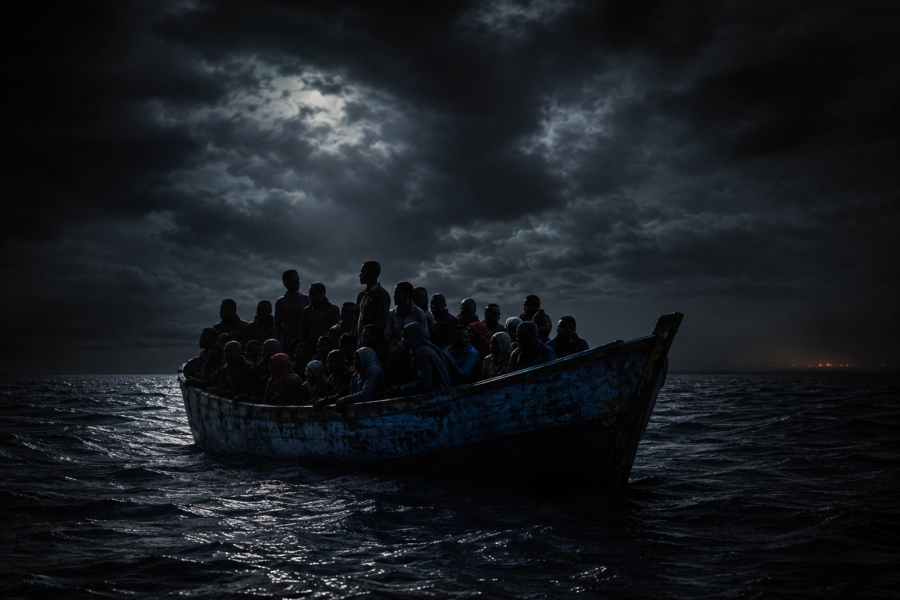
Far from the romantic image that often accompanies the migration debate, the testimonies given before Leo XIV by Blessing and Tito Villarmea describe a scenario dominated by criminal gangs, exploitation, fear, death and the constant risk of shipwreck. That is precisely what turns the “pull effect” into a moral issue that cannot be dismissed with simplistic slogans or those aligned with a political ideology.
From the dream of a better life to slavery
The most harrowing story was Blessing’s, a Nigerian woman who was supposed to share her testimony in person with the Pope, although she was ultimately unable to do so for security reasons.
Blessing was born into a family of eight siblings and knew extreme poverty from childhood. At fourteen she had to start fending for herself. At twenty-two she decided to leave Nigeria. She did not do so because she wanted to emigrate, but because, as she explained, she saw no other way to offer a better future to her two daughters.
What she found along the way was not hope, but a criminal organization specialized in preying on desperate people.
The mafia subjected her to a “juju” ritual used to control victims psychologically and imposed a debt of 25,000 euros that she would have to repay once she reached Europe. She spent six months trapped in miserable conditions, with almost no food and no access to basic hygiene, waiting for the chance to board a boat.
When the time came to cross the sea, she had already seen others die attempting the journey before her.
«I had to choose: live in suffering or cross and take my chances. Die trying, or stay and have nothing»
That moment sums up much of the problem. The decision was not between two good options, but between two different forms of despair.
The real beneficiaries
The “pull effect” is often discussed as a simple ideological dispute. Yet the testimonies heard in Arguineguín show that there is an obvious beneficiary of any narrative that turns arrival in Europe into a goal that justifies any sacrifice: the criminal gangs.
Every person who undertakes the journey represents income for criminal organizations that control routes, forge documents, extort migrants and routinely use violence as a working method.
Blessing’s experience is painful proof of this. During her journey she became pregnant by a member of the mafia. Upon arriving in Spain they took her baby away to force her into prostitution. Her body became merchandise and her motherhood an instrument of coercion. For months she lived under a network of sexual exploitation until a police operation rescued her.
Her story reveals how poverty, lack of opportunities and the hope of a better future can become recruitment tools for criminal networks that end up exploiting those they promised to help.
None of this fits the idealized image that often accompanies the migration debate.
What happens when night falls over the Atlantic
If Blessing showed what happens before and after the crossing, Tito Villarmea explained what occurs during it.
A Maritime Rescue captain aboard the Guardamar Urania, he appeared before Leo XIV to describe a reality he knows firsthand. In recent years, together with his team, he has taken part in the rescue of more than 20,000 people.
«It is a figure that hurts and is not forgotten», he confessed.
His words dismantle any romantic view of irregular immigration.
«We all know the image of the Canary Islands by day, but at night it is another reality: rough seas, absolute darkness and fragile boats loaded with lives».
This is not an academic discussion or a theoretical question. It involves overcrowded vessels navigating for hours or days in extreme conditions, with exhausted, injured or dehydrated people, often at the mercy of chance.
Among all the rescues he has led, Villarmea recalled one that was especially striking. After bringing to safety a small boat carrying both injured people and bodies, he watched a mother approach someone everyone thought was her teenage son. Once on board, she removed his cap and jacket and put gold earrings on him.
«It was a girl».
The scene affected him deeply.
«She cried and I cried, because I am the father of two teenagers. They could have been my daughters».
Behind every number are real faces. Behind every small boat are people who have been convinced that it is worth taking extraordinary risks to reach a coast they barely know.
What Arguineguín brought to light
The accounts of Blessing and Tito converge on the same reality. Both show that behind the migration routes lies a criminal structure that feeds on human desperation.
One describes the business of trafficking and exploitation. The other sees every week the consequences of that business in the middle of the Atlantic.
Blessing’s story shows how a vulnerable woman can become merchandise for criminal organizations that use debt, intimidation and violence to subjugate their victims. Tito’s testimony, for its part, reveals the final link in the chain: precarious boats, nighttime rescues and people risking their lives on one of the most dangerous maritime routes in the world.
Both reveal a reality marked by human suffering and by the enormous power acquired by the criminal gangs operating between Africa and Europe.
«Your life belongs to God»
Leo XIV’s response to Blessing recalled an essential truth. «Your life belongs to God and retains a dignity that no one can take from you», the Pontiff told her.
Precisely because every human life possesses inviolable dignity, it is necessary to ask whether everything that indirectly encourages these routes truly serves the good of the most vulnerable people.
The testimonies heard by Leo XIV in Arguineguín deserve careful attention. Because they do not describe a human epic or a story of overcoming. They describe a hell. The hell of a woman turned into a sexual slave by criminal gangs. The hell of those who board small boats where death is part of the journey. The hell witnessed by those who rescue bodies and survivors in the middle of the night.
What Blessing and Tito brought to light is that these routes represent one of the greatest humanitarian failures of our time. A truly compassionate response does not consist of romanticizing them or resigning ourselves to their existence. It consists of fighting the criminal gangs that feed on them, dismantling the incentives that make them possible and working so that no one is again forced to choose between misery, the sea or slavery.
Because when the protagonists themselves describe suffering, exploitation and death, the conclusion is hard to avoid: we are not facing a route of hope. We are facing a human drama that must end.