


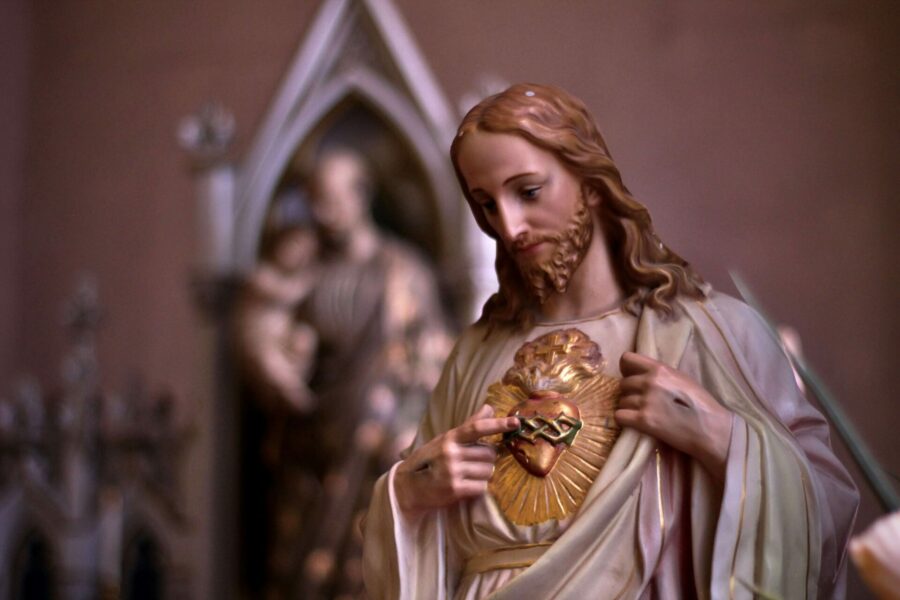
In the framework of the celebrations for the 250th anniversary of the independence of the United States, the country’s Catholic bishops will carry out this Thursday, June 11, a solemn national consecration to the Sacred Heart of Jesus, a spiritual gesture through which they seek to entrust the nation to divine mercy and pray for reconciliation, social peace, and the renewal of faith.
A national consecration on the eve of the Solemnity of the Sacred Heart
The initiative, promoted by the United States Conference of Catholic Bishops (USCCB), will take place on the eve of the liturgical solemnity of the Sacred Heart of Jesus and coincides with the commemorative events marking the 250th anniversary of the signing of the Declaration of Independence, proclaimed on July 4, 1776.
The bishops have invited all dioceses, parishes, and Catholic communities across the country to join this consecration spiritually through liturgical and pastoral materials prepared specifically for the occasion. The resources, published in English and Spanish, include texts from the Roman Missal, biblical readings, and prayers to facilitate the participation of the faithful.
The central prayer of the consecration expresses the desire that the Heart of Christ transform the personal and social life of the nation. Among its petitions is the plea that “families and communities may enjoy peace and happiness,” that “broken relationships may be reconciled,” injustices may be repaired, and “the wounds of our land may be healed.”
Nine days of spiritual preparation
The consecration culminates a national novena held between June 3 and 11, during which the faithful have been invited to meditate on the spiritual meaning of devotion to the Sacred Heart.
According to the U.S. episcopal conference, each day of the novena was dedicated to reflecting on the teachings of saints, pontiffs, and spiritual authors who have deepened their understanding of Christ’s love as manifested in His Heart.
The initiative has sought to unite prayer, formation, and Christian commitment in a context marked by social divisions, cultural challenges, and the growing secularization affecting broad sectors of American society.
Inspired by Francis and Leo XIV
The preparatory novena drew special inspiration from two recent papal documents. On one hand, the encyclical Dilexit nos by Francis, focused on the human and divine love manifested in the Heart of Jesus Christ. On the other, the apostolic exhortation Dilexi te by Leo XIV, dedicated to preferential love for the poor and the most vulnerable.
The organizers highlight that both teachings converge in a single call: to rediscover the love of Christ as the foundation of Christian life and as a response to the fractures running through contemporary societies.
The choice of the Sacred Heart as the axis of this celebration is no coincidence. It is one of the most deeply rooted devotions in Catholic tradition and has historically been linked to moments of particular difficulty for nations and Christian peoples.
Trump supports the national consecration
The consecration also received public support from the President of the United States, Donald Trump, who issued a message in which he stated that he was joining in prayer with the bishops gathered in Orlando for this solemn act.
The president described the consecration as “a powerful moment in our national history” and placed it within the celebrations marking the 250th anniversary of American independence. According to Trump, the event reminds us that “the United States has always been guided by the loving hand of God.”
In his statement, the president evoked the Christian roots of the country, the role of missionaries and pioneers in the nation’s history, and the figure of John Carroll, the first Catholic bishop of the United States, who consecrated the young republic to the Virgin Mary after independence.
Trump also linked the ceremony to the defense of the spiritual heritage of the West, recalling the role played by Ronald Reagan and Saint John Paul II in the fall of communism during the Cold War. “Today we renew our commitment to defend our spiritual identity and our great civilizational heritage,” he stated.
The president concluded by expressing his hope that the United States may continue to be “a land of faith, a country of miracles, and a light to all nations.”