


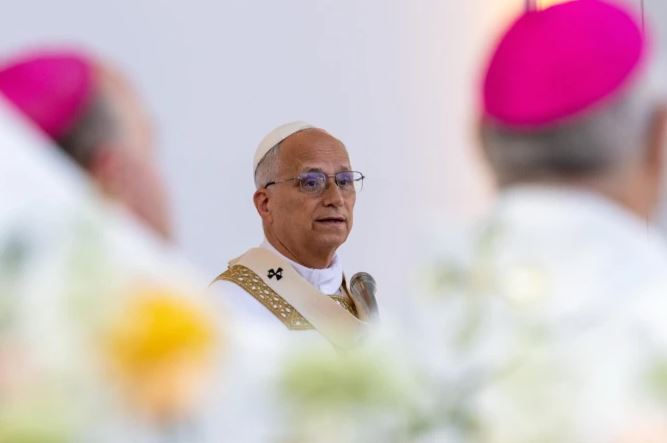
Nearly 50,000 people took part this Thursday in the Holy Mass presided over by Leo XIV in Gran Canaria, the central event of the Pontiff’s day in the archipelago. During the celebration of the Solemnity of the Sacred Heart of Jesus, the Pope prayed for those who have lost their lives at sea and advocated a charity capable of promoting the integral dignity of the person, beyond mere assistance limited to immediate needs.
According to the Holy See Press Office, the celebration brought together the faithful spread across the Gran Canaria Stadium, the adjacent parking area and the adjoining Sports Palace, making it one of the most crowded events of the apostolic journey Leo XIV is undertaking in Spain.
A papamobile tour before thousands of the faithful
The Holy Father left the Episcopal House of Las Palmas at 5:50 p.m. and headed to the Gran Canaria Stadium, where he was welcomed by a multitude of the faithful from the various islands of the archipelago.
Before the celebration began, Leo XIV toured the venue in the popemobile to greet those present. He then moved to the sacristy to prepare for the Eucharistic celebration, which started at 6:30 p.m.
The liturgy unfolded within the Solemnity of the Sacred Heart of Jesus, a devotion deeply rooted in Spain, a nation consecrated to the Heart of Christ.
Below is the complete homily of Leo XIV:
Dear brothers and sisters, after a day rich in encounters and sharing, now celebrating this Eucharist with you, I wish first of all to thank the Lord for all the good that is done here every day, entrusting to Him the commitment of everyone and at the same time the sufferings of which this land bears witness. I also invite you to pray together, in this Holy Mass, for the brothers and sisters who have lost their lives at sea.
We bring everything to the Altar together with the bread and wine, while we enter, with the Evening Celebration of the Vigil, into the Solemnity of the Sacred Heart of Jesus, to whom all of Spain is consecrated. Let us ask the Lord that at this moment the same sentiments of humanity, mercy and compassion of the Saviour’s Heart may be alive in us.
We allow ourselves to be helped, in our meditation, by the Readings we have heard.
In the first, God reminds the Israelites of the gratuitousness with which He loved them. He chose them not because they had privileges, gifts or particular merits, but out of pure love (cf. Dt 7:7-9), and He will continue to love them always, even when, because of their hardened heart, they do not respond to His sentiments.
This is the charity of God, in which our vocation to love is rooted, a love that is not founded on calculation, nor on mere feeling, nor reducible to simple philanthropy, but invades our whole being: fire for the soul, light for the mind, an irresistible impulse for freedom, peace and at the same time torment for the heart, which beats in harmony with other hearts, involving the whole person. For to love is natural to man; indeed, it is the condition for the fullness of his very existence.
Thus love is shown to us in the humanity of the Saviour and in the movements of His Most Sacred Heart: unchanging and faithful even in the face of misunderstanding and rejection, fear, sadness and human resistance (cf. Lk 22:39-46).
And it is in this face of God ever “in love,” who constantly and totally desires our good and our full happiness, that we recognize the way of life, learning a new way of existing and relating, a different criterion for evaluating decisions, a renewed and stimulating style of building communion. In this regard, Pope Francis, speaking of the charity of Christ, said that “the best response to the love of His Heart is love for our brothers and sisters” (Dilexit nos, 167) and added: “there is no greater gesture we can offer Him to return love for love” (ibid.). “Returning love for love”: this is the wonderful exchange, the “admirabile commercium” (cf. First Vespers of the Solemnity of Saint Mary Mother of God, first antiphon), to which the Gospel invites us to be drawn, translating the infinite measure of God’s love into the generosity with which we serve Him, every day, in the brothers and sisters He Himself places on our path. Especially in those most in need, defenceless, unable to give anything in return (cf. Lk 6:32-36). Precisely as happens on this island, in welcome, in sharing, in selfless giving.
The gratuitousness of the Heart of Christ, however, does not stop there. It goes further, committing itself to helping each person not only to survive, but also to regain confidence and resume the journey, to grow and flourish fully in their uniqueness, for the good of all. In this regard, Pope Benedict XVI wrote that the charity “of which Jesus Christ bore witness with His earthly life […] is the principal driving force of the authentic development of every person and of all humanity” (Caritas in veritate, 1).
In the second Reading, Saint John has reminded us that “God sent His only Son into the world so that we might live through Him” (1 Jn 4:9). His words evoke those of Jesus, who said He had come that we might have life and have it in abundance (cf. Jn 10:10), and who commanded the healed paralytic: “Get up, take your mat and walk” (Mk 2:9). In these expressions we recognize the invitation to embrace maternally the one who suffers, but at the same time to prepare and encourage the wounded person to rise and set out again, for a free and dignified life.
Indeed, our charity must not be mere assistance, but must integrate persons for their full realization—spiritual, intellectual and physical—and their dignified and constructive insertion into the community (cf. Fratelli tutti, 129). Only in this way will our encounters, even in the face of difficult and painful events, become occasions to sow seeds of hope on humanity’s journey toward a better future.
But I would like to pause, in the light of the Word of God we have heard, on one last characteristic of the Heart of Christ: humility (cf. Mt 11:29). The Heart of Jesus is humble, and therefore its beats are not felt by the “learned,” the “wise,” that is, those who presume to be self-sufficient, to know everything, to need neither God nor others. To these, in fact, stunned by the clamour of an inflated, omnipresent and restless “I,” the silence necessary to listen within themselves and in their brothers and sisters to the hidden pulse of love is lacking.
“Not infrequently, wealth makes us blind, to the point of thinking that our happiness can only be achieved if we manage to do without others” (Dilexi te, 108). Jesus, on the contrary, teaches us the opposite: to taste the true joy of life, which resides in love, it is necessary to come down from the pedestals of arrogance that divide, in order to meet one another in the humility that unites us.
Saint Augustine said: “where charity is, there is peace, and where there is humility, there is charity” (On the First Letter of Saint John to the Parthians, Prologue). It is so. Where there is authentic humility there is love, and where there is love there is peace, because only in humility do we truly know who we are and, therefore, can we love one another, meet one another, give ourselves and forgive one another in truth.
Dear brothers and sisters, today we adore the Sacred Heart of Jesus, a heart often depicted crowned with thorns and enkindled with a flame, according to the visions of Saint Margaret Mary Alacoque. Let us remember that we are the living presence of the Lord in the world (cf. Lumen gentium, 8). Therefore, let us look at one another, not only on this day but always, with respect and trust, and renew, in this awareness, the commitment to accomplish in ourselves, in charity, what is lacking in the sufferings of Christ, for the good of the Church (cf. Col 1:24). Enkindled by the charity of His Heart, let us be bearers of His mercy and His peace, so that wars may cease in the world and a new humanity, reconciled in love, may grow around us.