


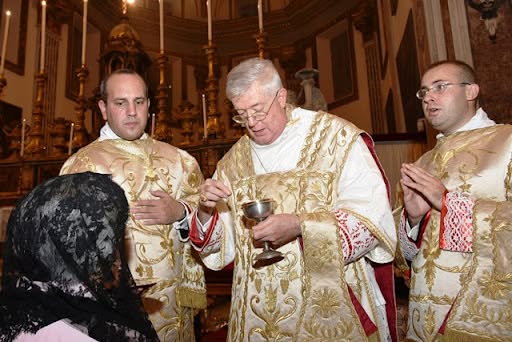
Archbishop Guido Pozzo, one of the recognized voices in the Vatican liturgical sphere, has defended the advisability of each diocese having at least one Sunday Mass in Latin according to the Novus Ordo accompanied by Gregorian chant. He also warned against the “ideological cages” that pit the traditional liturgy against the reformed one, insisting that both expressions of the Roman rite are not incompatible and should not be considered opposed.
In an extensive interview granted to AdVaticanum, Pozzo addressed issues related to sacred music, the role of Latin in the liturgy, the situation of the traditional rite, and the need to recover a vision of continuity between the Church’s liturgical tradition and the reform following the Second Vatican Council.
“Gregorian chant must occupy the principal place”
Currently superintendent of the economy of the Pontifical Sistine Chapel Choir, Pozzo recalled that the Second Vatican Council clearly established that Gregorian chant is the proper chant of the Roman liturgy and that it must retain a privileged place.
He explained that Gregorian chant connects the faithful with the entire Catholic spiritual tradition and fosters contemplation of the divine mysteries. Alongside it, he placed sacred polyphony, whose artistic and spiritual heritage, he stated, must be rediscovered and restored to its rightful place within Catholic worship.
Pozzo also praised the Vatican initiative “Cantemos con el Papa,” promoted by the Pontifical Institute of Sacred Music, which seeks to teach the faithful simple pieces of Gregorian chant to facilitate their participation in liturgical celebrations in Latin.
One Latin Mass in each diocese
Pozzo proposes that all dioceses have at least one regular celebration of Holy Mass in Latin according to the Novus Ordo.
“What seems even more important to me is that in the dioceses there be at least one celebration of Holy Mass in Latin according to the Novus Ordo, animated by Gregorian chant, especially on Sundays and solemnities,” the archbishop noted. In his view, this would help the faithful perceive more clearly the universal character of the Roman liturgy.
Although he did not call for making this practice a legal obligation, he did not rule out the possibility of incorporating certain fixed parts of the Mass in Latin within celebrations usually held in the vernacular.
“The two forms of the Roman rite are not irreconcilable”
Regarding the liturgical debate of recent decades, the archbishop rejected the idea that the Novus Ordo and the Vetus Ordo represent two incompatible conceptions of the Church.
The prelate maintained that the liturgical reform promoted by the Second Vatican Council must be understood as a renewal in continuity with the previous tradition and not as a rupture. For this reason, he called for abandoning ideological approaches that present both liturgical uses as irreconcilable adversaries.
At the same time, he acknowledged that the celebration of the ancient rite can help rediscover doctrinal and spiritual aspects that, in some contexts, have been obscured by deficient or banalized interpretations of the liturgical reform. Among them he mentioned the sacrificial character of the Eucharist, the transcendent dimension of worship, and the specific role of the ministerial priesthood.
Criticism of liturgical deformations
He also denounced the deviations that, in his judgment, have at times affected the celebration of the reformed Mass.
Without questioning the legitimacy of the Missal promulgated by Saint Paul VI, he lamented that some celebrations have been impoverished by improvisations, arbitrary omissions of the rubrics, and creative excesses that ultimately obscure the authentic meaning of the liturgy.
Even so, he insisted that when the Mass according to the Novus Ordo is celebrated with fidelity, recollection, and awareness of the mystery, the spiritual distance from the traditional Roman rite is much smaller than some maintain.
A call for liturgical reconciliation
The archbishop also recalled that Benedict XVI defined the ancient use of the Roman rite as a “precious treasure” for the entire Church and noted that Leo XIV has recently encouraged bishops to favor the reconciliation and integration of the faithful linked to the traditional liturgy, provided they accept the teachings of the Second Vatican Council and do not reject the legitimacy of the Novus Ordo.
For Pozzo, the real challenge does not lie in the language used or in the coexistence of different liturgical forms, but in the liturgy’s capacity to lead the faithful to an encounter with God and to awaken once again the sense of the Christian mystery.