


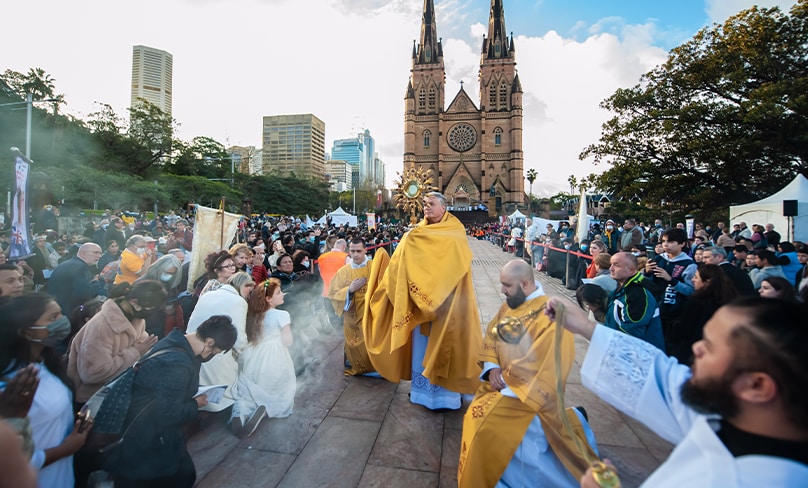
Contrary to what occurred in the diocese of Charlotte in the United States, the Archbishop of Sydney (Australia), Anthony Fisher, has asked the parish priests of his archdiocese to reinstall kneelers wherever they have been removed and has encouraged the faithful to rediscover the traditional gestures of reverence before the Eucharist.
In an extensive pastoral letter published on the occasion of the solemnity of Corpus Christi, the prelate defended the spiritual and liturgical value of kneeling before the Blessed Sacrament and recalled that receiving communion on one’s knees remains a fully legitimate option in the Church.
The letter, addressed to priests, religious, and faithful of the Australian archdiocese, forms part of the spiritual preparation for the International Eucharistic Congress to be held in Sydney in 2028. In it, Fisher invites the faithful to renew their faith in the real presence of Christ in the Eucharist and to strengthen the life of adoration both within and outside of Mass.
“Kneeling reveals what we believe about God”
The Dominican archbishop explains the meaning of bodily postures in the liturgy. After recalling that liturgical life engages the whole person through the senses, he maintains that kneeling expresses with particular clarity the human relationship with God.
“Of all physical postures, kneeling is the one that most clearly reveals what we believe about God and our relationship with Him,” Fisher states.
The prelate recalls that the Church invites the faithful to genuflect before the Blessed Sacrament, to kneel during the Eucharistic Prayer, and at other moments of adoration, such as the exposition of the Blessed Sacrament or the eucharistic blessing. He also emphasizes that some of the faithful choose to receive communion on their knees, a practice he describes as “a perfectly valid option contemplated by the current Missal.”
Recovering a centuries-old practice
Fisher recalls that for centuries receiving communion on one’s knees was the customary practice in the Latin Church and notes that many churches still preserve communion rails as a testimony to that tradition.
The letter also responds to those who consider kneeling an improper gesture for modern man or a form of humiliation incompatible with the dignity of the children of God.
“Some people think that kneeling is degrading, proper to a slave, or a sign of desperation,” the archbishop writes. However, he recalls that Sacred Scripture consistently presents this gesture as an expression of adoration, trust, gratitude, and supplication before God.
To support this claim, Fisher draws on numerous biblical examples, from Moses before the burning bush to the Magi adoring the Child Jesus, including the disciples who prostrate themselves before the risen Christ. He also cites the words of Saint Paul: “At the name of Jesus every knee should bend, in heaven and on earth and under the earth.”
Request to parish priests: return kneelers to the churches
The most concrete proposal of the letter appears in the final section, where the archbishop formulates several requests to the priests of the archdiocese.
Among them stands out the request to extend church opening hours, to offer at least one hour of weekly eucharistic adoration in each parish, and to encourage the presence of perpetual adoration chapels in the various deaneries.
In addition, Fisher expressly asks to “restore kneelers in all churches where they are missing” and to teach the faithful the liturgical postures provided for by the Church’s norms, so that the body may accompany and adequately express acts of devotion.
Adoration and mission, inseparable
Far from presenting eucharistic adoration as an introspective practice, the Australian archbishop insists that worship of Christ necessarily leads to evangelization.
The letter concludes by recalling various biblical passages in which those who prostrate themselves before God are subsequently sent on a mission. Isaiah, Saint Peter, and the disciples of Emmaus appear as examples of how adoration leads to the proclamation of the Gospel.
“We kneel to acknowledge Him and then we rise to make Him known,” Fisher writes at the close of his message.
With a view to the International Eucharistic Congress of 2028, the Archbishop of Sydney appears determined to promote a spiritual renewal centered on the real presence of Christ in the Eucharist, adoration of the Blessed Sacrament, and the recovery of visible signs of reverence that for centuries formed part of the ordinary life of the Church.