


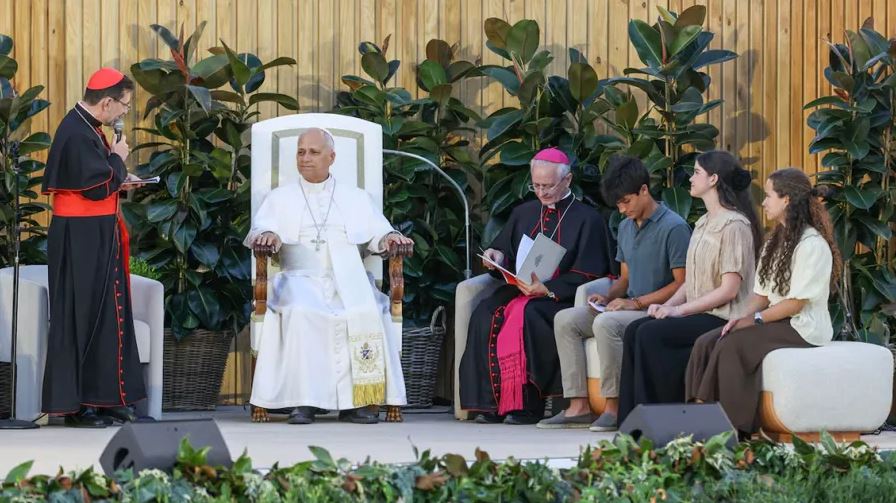
The first day of Pope Leo XIV’s visit to Spain concluded with a prayer vigil alongside thousands of young people gathered in Madrid’s Plaza de Lima. The event, designed as an act that combined music, testimonies, dialogue, and prayer, ended with eucharistic adoration and the blessing given by the Pontiff with the Blessed Sacrament.
Welcoming the Pope, the Archbishop of Madrid, Cardinal José Cobo, presented to the Pontiff “the face of a Church” made up of young people who had come from different parts of Spain. Drawing inspiration from the visit’s motto, “Lift up your gaze,” he stated that the gathering sought to help the new generations avoid remaining trapped “in the immediate or in despair” and to discover that God continues to call each person.
Cobo recalled that among those present were young people committed to their parishes and movements, but also others marked by precariousness, loneliness, the experience of migration, or personal suffering. “We are especially pained by the suffering of those who have lost hope in life and see suicide as a way out,” he said. The archbishop also asked the Pope to encourage the Spanish Church to build “living communities that sustain young people,” capable of awakening vocational questions and opening horizons of mission.
The vigil began with a performance inspired by the musical Godspell—presented as “the Spell of God”—which, according to reports, corresponded to the passage of the Good Samaritan.
The piece is part of a musical originally created by John-Michael Tebelak with music and lyrics by Stephen Schwartz. The work revolves around a group of young people who, in a contemporary urban setting, encounter a character representing Jesus and begin a journey marked by various teachings and parables drawn from the Gospel of Saint Matthew.
An open dialogue with the young people
The gathering continued with an open dialogue between Leo XIV and several young people, who posed questions about vocation, the Christian life, the missionary experience, spiritual discernment, and the challenges facing the new generations.
(1) We know that Saint Augustine is very important to you, but what other saints and what other figures have helped you in your growth as a Christian?
(2) I would now like to ask you about your years as a missionary in Peru. What memory or experience do you treasure from those years?
Well, first of all: greetings to all of you! Thank you for being here and for sharing the faith with all of Madrid and with all of Spain. Regarding the first question about some saints who have been role models for me during my growth and my youth, but also as a bishop and as Pope… You have already mentioned Saint Augustine—and we all know that Saint Augustine is a very important figure for the whole Church—but I have also thought of one of the Fathers of the Eastern Church named Saint John Chrysostom; his name means “golden mouth,” a title this Church Father earned because he had a very beautiful eloquence. Before his baptism, which took place in 368 A.D., he studied philosophy. Afterwards he devoted himself to the exegesis of Sacred Scripture, together with other young people from Antioch, his native city. After an experience as a hermit, he dedicated himself to the service of the Church as a priest and later as a bishop. And here I take the opportunity to say to all of you: Never be afraid to consider a vocation to the priestly life, to the religious life, or to other forms of service in the Church! For John Chrysostom, who carried in his heart this love for the Word of God, after becoming a priest and bishop, gave a great witness, above all through the coherence of his life. If he preached, it was because he lived that message. I have been especially impressed by his catecheses, his sermons, his homilies, and his writings that unite love for the truth and the uprightness of his life. But he also had great courage. He was not afraid to speak before the Emperor, to say things that were in favor of justice and not merely to please others. He was a man of his word.
Another saint I have thought of is Saint Thomas of Villanova, an Augustinian who was also called to become a shepherd of the Church. He was Spanish. He studied at the University of Alcalá and, because of his wisdom, earned the esteem of Emperor Charles V. He was later appointed bishop of Valencia and undertook an intense work of reform in the Church, especially of the clergy, exhorting his brothers to perseverance in prayer, in the life of chastity, and in obedience. Because of his ardent charity he is still known today as “the Bishop of the Poor.” This charity has encouraged me in moments of trial and in moments of service.
Another companion on the journey is Saint Turibius of Mogrovejo, also Spanish. In the sixteenth century he was a missionary in Peru, where he devoted himself with great zeal to evangelization, studying the local languages. Saint Turibius united an intense life of prayer with a commitment to justice, especially in the face of the abuses and corruption of his time. For this reason, he is for me a model of dedication to the people, especially to the poorest, in the name of Christ.
Contemplating the lives of these saints, like Saint Augustine, I said to myself: if they were able, why not I? (cf. Confessions, VIII, 27). A question that I also gladly entrust to you, inviting you to choose examples of good living that prove attractive both to yourselves and to others.
As for the years lived in Peru, as a missionary and later as a bishop, I especially remember the witness of faith of the people, marked by many difficulties, yet full of hope. Precisely the encounter with the wounds and also with the joys of the people helped me grow in the path of following Jesus. While I was proclaiming him, I too was being transformed by the Gospel, transformed by the life and faith of these peoples, often materially very poor, but rich in faith. And experiencing this faith in the word of the Lord, I have seen how the Word of God can turn conflict into peace. It can be a source of reconciliation, peace, and justice.
(3) What do you think would help us recognize the voice of God among so many other voices?
(4) How can we, also as seekers, accompany them in their process of discovering the beauty of faith?
First, we can speak about how to listen to this voice of God, how to discern whether it is truly God who is speaking or something else, another attraction, another difficulty.
To recognize the voice of God, silence can help us above all; I believe it is very important that each of us seek to develop the capacity to be silent. Many times we go around with headphones, with music, with distractions, and we do not know how to be silent. I think it is often precisely in this experience of silence that God can speak to us or where we can discern the voice of God. When we seek silence, we decide what not to listen to and from what noises not to let ourselves be distracted. By freeing ourselves from the clamor of a thousand voices, we recognize that some deceive our desires, others buy us without nourishing us, others speak out of self-interest. In silence we understand that ideologies pass away, while the truth remains. Here I would also like to emphasize the importance of seeking the truth, because many voices, many things on social networks deceive us and tell us lies. Always seek the truth! God is truth! If it takes you far from God, it is not truth! Do not forget that!
Secondly, be certain that God knows your voice well, your voice: He listens to you and will answer you. Do not be afraid to express what you feel in your heart. There is a Psalm that says: “He who made the ear, does he not hear?” (Ps 94:9). Our inner speech becomes prayer, praise, and supplication when it is entrusted to the only one who can hear it. Prayer is a free voice precisely because it does not speak to give an account, to prove that we are prepared, or to make ourselves feel important. When we ourselves become prayer, the Lord answers us with his Word, who became man for us, affirming that he loves us with all his being.
Thirdly, to recognize the voice of God it is necessary to listen to the Word. The Word of God is alive, because it is Christ, whose voice continues to resound in the Church, which is his Body. He fulfills all the Scriptures, that old and new testament given to men as a promise of salvation. Eucharistic adoration, which we share tonight, is precisely the appropriate place to keep silence, to free the heart, and to “be” ourselves before the Lord, dialoguing with him, so that he may become eloquent in his love, made food for all humanity.
Moreover, dear young people, to accompany others in discovering the beauty of our faith, remember that none of us was born a teacher and that, before the Lord, we are all disciples. Therefore, share your spiritual journey, bearing witness to it with coherence of life: the will to follow Jesus will constantly renew you, especially in the hour of weariness. In this it is important to see that no one is alone in believing in Jesus. Look how many of you are here! And so also, in community, in youth groups, in the family, we can all learn what the beauty of our faith is. For by sharing your spiritual journey the will to follow Jesus will constantly renew you. He walks at our pace and lights our path. Following the example of the Master: thus I invite you to act, as shepherds, educators, as friends. If you pray with love, young people will appreciate the importance of prayer. If you burn with faith, you will transmit its living fire. Seek in your hearts this fire of the love of God! For there is the presence of Jesus, and the near presence of Jesus is perceived even in the moments of our falls, because Jesus does not abandon us. Also when we become an outstretched hand, a fraternal embrace, when we seek opportunities to serve others and when we seek how to touch the life of the other with his wounds, in his sadness, in his difficulties. There faith in Jesus Christ becomes alive, and there is where Jesus will help us to sustain one another on the journey.
(5) How can we young Christians live committed to this society?
(6) What is the concrete mission that you ask of us, the young people of the Church?
Well, congratulations on your marriage, Fernando! Here I have also seen other couples who are going to get married: Congratulations and blessings! Because, if earlier I said “do not be afraid to consider a vocation,” marriage is also a vocation. Do not be afraid of marriage and of forming a family!
Throughout the centuries of the Church’s history, Christians have lived in all kinds of societies, going through the changes of the cultures we have shared and helped to shape. There is an ancient text called the Letter to Diognetus, which offers us a beautiful insight in this regard: “Christians are in the world what the soul is in the body” (VI). This is our way of living: the disciples of Jesus are always contemporary, but never prisoners of the time that passes. We are free in Christ! And Christ has set us free with his love. Thanks to this love, we are always free in the face of all coercion and deception. We are free from fashions, because we are disciples of the truth; we are open to the future, because we know that death does not await us. On the contrary, the meaning of history culminates in the eternal communion of life that God prepares for all. From this perspective, especially you young people are called to give a new direction to society, becoming protagonists of change from your everyday bonds, what you live in the family, at university, and at work. Seeing you, dear young people, full of this enthusiasm motivated by faith, I am excited to think of the capacity you have to bear witness to Christ in the world, including digital reality, to communicate the values and beauty of the Gospel (cf. Christus vivit, 105; Greeting at the Jubilee of Digital Missionaries, 29 July 2025).
I therefore invite all of you to be together the salt of the earth and the light of the world (cf. Mt 5:13). To live in this way, it is necessary above all to interpret present-day society, living with wisdom, so as later to be able to transform it as witnesses of the Gospel. The young Christian, in fact, becomes luminous both in joy and in trial, giving flavor to reality because he inhabits it as a person who enjoys life from within, without expecting that taste to be given by wealth, pleasure, or power. This is our freedom, which has its source in faith, which is capable of giving light and good flavor to every society, to every human experience. On the other hand, when life tastes of nothing, it is as if it were taken away from us: we no longer feel it as our own. In the face of the emptiness of indifference and conformism, in the face of the violence of war and lies, be yourselves the spark of a new humanity.
And so, I want to entrust all of you with a mission: that you be human. Yes, be human!: men and women of flesh and blood. Not appearances, but trustworthy faces. People who seek justice because they hunger for it, as for daily bread. People who desire an honest and upright life, because they gladly do to others what they would want others to do to them. Be human as Christ is, the perfect man, the Risen One who shares history with us in every age. Cultivating this commitment, look to the Apostles, to the first Christians, inhabitants of a pagan world. Following their example, be missionaries of the Gospel before the material and spiritual poverties of our time, knowing well that our faith is a way of life that is fulfilled in charity (cf. Gal 5:6). This, dear young people, is the virtue that changes history more than any other. You can change history! Do it with love! Thank you very much.
The eucharistic adoration closed the gathering
After concluding the dialogue with the young people, Leo XIV signed the Youth Cross of Madrid as a memento of the vigil.
The second part of the gathering then began, centered on eucharistic adoration. The Pope returned vested for the liturgical celebration and remained in prayer before the Blessed Sacrament while the Gospel of the multiplication of the loaves and fishes was proclaimed.
The vigil concluded with the eucharistic blessing given by the Pontiff, bringing to an end a day that had begun in the morning with his arrival in Madrid and that ended in Plaza de Lima alongside the young people.