


By: Msgr. Alberto José González Chaves
Coincidence or “God-incidence”?
León XIV’s visit to Spain will certainly be a carefully organized apostolic journey, with minute-by-minute itineraries, institutional meetings, large-scale celebrations, and speeches destined to occupy newspaper front pages and newscasts for days. There will be political analyses, interpretations of every gesture, commentary on every word, and attempts to measure the visit’s success by the number of attendees or the media impact achieved. Yet those who view reality only from the surface often miss what matters most, because the Church’s history is not written where the spotlights point: what is most important unfolds underground, like those hidden, silent, and fruitful veins that for millennia run through the mountain without anyone noticing their patient work.
That is why we must note a detail that has all the appearance of one of those delicate touches with which Providence is wont to sign its works: the Pope will arrive in Spain while the Church is praying the novena of the Sacred Heart of Jesus. And when he leaves our homeland to return to Rome, the final blessing he imparts on Spanish soil will coincide precisely with the liturgical solemnity of the Heart of Christ.
León XIV is not landing in a country whose relationship with the Heart of Jesus is a marginal note in its religious past: he is coming to a land where that devotion penetrated for centuries into the deepest layers of collective life; to a nation whose geography is sown with monuments to the Heart of Christ; with parishes, schools, institutions, town halls, and homes consecrated to Christ the King; to a people who for generations learned to contemplate history not so much from politics as from the mysterious sovereignty of that Heart opened by the lance and set aflame with love for humankind.
The Successor of Peter will travel through Spain while, in thousands of churches, convents, and homes, the novena is being prayed. While speeches fill the headlines and cameras follow the Pontiff’s every move, an elderly woman will pray in silence before the image of the Sacred Heart, inherited from her parents and enthroned in her living room; a contemplative community will offer its sacrifices to the Heart of its Spouse for the fruits of the journey; a priest will recite the litanies of the Heart of Jesus before the tabernacle of a remote parish; parents will teach it to their children; a sick person will unite his sufferings to the Pope’s intentions, gazing at the Divine Heart, his consolation and strength. None of this will appear in the evening news, but it is there that what matters most will be decided, because great changes are born in the hearts of men before they appear on the surface of history. No one can measure how many silent conversions, how many confessions, family reconciliations, priestly and religious vocations may be born of this visit. Grace possesses a fruitfulness that escapes statistics and sociological analyses.
Today Spain suffers from a disenchanting amnesia: a not insignificant part of our society regards its own Christian tradition as one might look at an old family album—recognizing the faces but no longer quite remembering their names. The cathedrals still rise in our cities; religious feasts still mark the calendar; the names of our saints remain engraved on streets and squares. But not many now know how to read the deep meaning of that legacy. Today the most urgent need of our homeland is neither economic nor political: what Spain needs above all is to hear once more the beating of its own soul in its ancient love story with the Heart of Jesus. And when the Pope arrives in Spain, many will be speaking of him to the Heart of Christ.
The Voice Heard in Valladolid
Almost three centuries ago, when Spain, one of the great nations of Christendom, was already beginning to show some symptoms of its long historical decline, a seemingly muted event occurred that was destined to exert an immense influence on the religious soul of our people. It did not take place in a court or a parliament; it was not surrounded by power or prestige, nor was it recorded in the gazettes of the time, nor did it alter the visible course of European politics. It happened in silence, as the things of God usually do.
In Valladolid, the very young Jesuit Bernardo de Hoyos burned with the desire to spread devotion to the Sacred Heart of Jesus, which was beginning to spread in the Church thanks to the impetus of Saint Margaret Mary Alacoque and Saint Claude de la Colombière. That young man received what he understood to be a promise from the Heart of Christ, the Great Promise: “I will reign in Spain, and with greater veneration than in many other places.” Since then that promise has accompanied the history of our nation like a background melody. If at times it has seemed to fade amid wars, persecutions, and apostasies, it has never disappeared.
Devotion to the Heart of Jesus then spread with surprising speed: it penetrated religious orders, seminaries, universities, schools, barracks, and homes; congregations, associations, and apostolic works arose; families began solemnly to enthrone the image of the Heart of Jesus in their houses; towns erected monuments; churches multiplied altars and chapels dedicated to that title. Spain learned to contemplate the Gospel from the open side of Christ, and perhaps this is one of the most beautiful keys to its tradition. For the Heart of Jesus taught generations that Christianity is not a morality or an ideology, but a love story; that divine omnipotence manifests itself under the disconcerting appearance of mercy; that God’s greatness consists as much in His infinite majesty as in His capacity to be moved by human misery.
Even today, when one passes through certain towns in Spain, one finds images faded by time, old ceramic plaques, forgotten monuments, or façades that read: “I will reign in Spain.” These are vestiges of a history far deeper than some imagine: Spain has lived more from its hope in the Great Promise of the Heart of its King than from constitutions, laws, or political events.
From a King Kneeling on the Cerro de los Ángeles to a Spain That Does Not Kneel
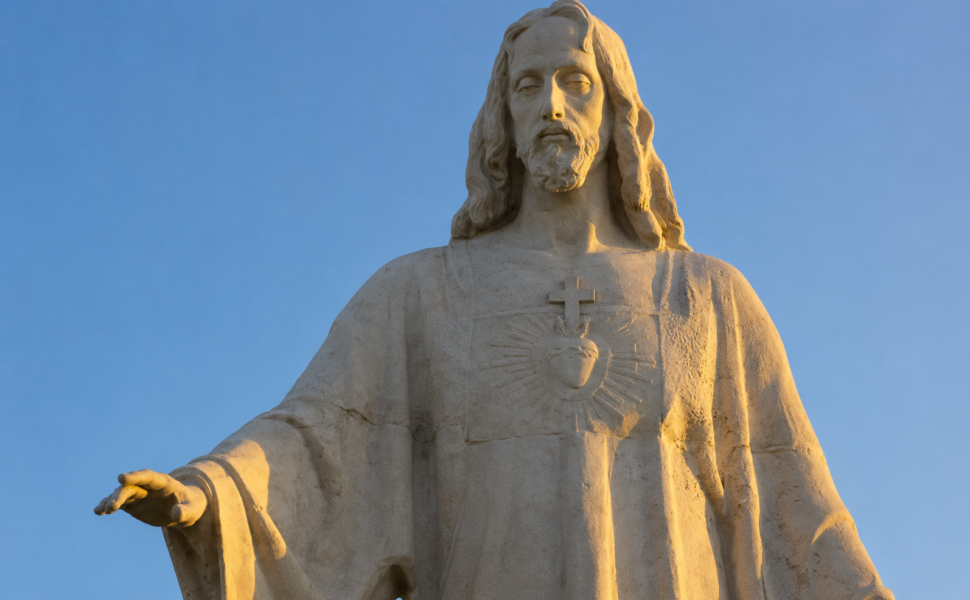
That spiritual current born in the silence of a Jesuit cell found its most solemn expression on a luminous spring morning in 1919. Spain was living through complex times: as so often throughout its history, extraordinary energies and deep tensions coexisted within it; the twentieth century was emerging laden with threats. In that context, on 30 May 1919, an immense multitude gathered at the Cerro de los Ángeles. That place, situated at the geographical heart of the Peninsula, was ideal for visualizing a purpose of the Spanish people: to place Christ at the center of national life by erecting a great monument to the Sacred Heart. And Alfonso XIII came there.
The photograph still moves us today: a young king, an immense crowd, the bishops of Spain, the entire government, all beneath the majestic image of Christ with arms outstretched, His Heart also openly displayed. The monarch then pronounced a formula of consecration that still retains impressive force today, publicly acknowledging that persons and nations find their true greatness only when they place upon themselves the reign of Love. To our self-sufficient, individual-exalting age, the scene seems provocative: a king kneeling, a nation consecrated, a people recognizing that it is not the absolute master of its destiny. Yet therein lies precisely the relevance of that gesture. For during the century that has passed since then, almost everything has changed: political regimes have disappeared; ideologies that seemed invincible have fallen; new forms of power, new cultural currents, new ways of understanding life have emerged. But the fundamental question remains the same: On what foundation does Spain wish to build its future? On pure self-interest? On the strength of shifting majorities? On the economy? On technology? Or on a vision of man that recognizes his origin and destiny in God?
That is why the Cerro de los Ángeles is much more than a monument: it is a question carved in stone raised over the heart of Spain. Will León XIV’s visit, precisely during the novena of the Sacred Heart, remind us of it?
Spain is going through an evident crisis of self-confidence: political tension is suffocating; public debate seems incapable of rising above partisan slogans; truth is drowned in self-serving narratives; the family is weakening; birth rates are collapsing; individualism is advancing; spiritual emptiness grows beneath the lure of material well-being.
But it would be a mistake to think that Spain’s main problem is political or economic: those are symptoms; the illness is deeper. Spain, like much of the West, suffers a crisis of the soul. We have learned to organize many things and have forgotten why they exist. We possess instant means of communication, yet true encounter between persons has never been so difficult. We multiply the instruments for comfortable living and cannot answer the decisive question: Why do I live? Benedict XVI spoke of a society that grows accustomed to living etsi Deus non daretur, as if God did not exist. And when a nation lives that way, it loses its self-awareness, because man understands himself fully only when he discovers where he comes from and where he is going.
His Heart Does Not Forget Spain
Providence has willed that Peter should come to Spain during the days of the Heart, and that his final image in our homeland should be that of a Pontiff raising his hand to bless a nation consecrated more than a century ago to the Heart of Christ. For peoples, like individuals, can drift away, become distracted, grow weary, and even forget. But the Heart of Jesus does not know how to forget. And perhaps the deepest grace of this visit consists precisely in reminding us that, above our divisions and wounds, the Heart that promised to reign in Spain with special veneration continues to beat over her. Therefore, while León XIV prepares to travel our roads, perhaps the best preparation to receive him is to listen once more to the ancient invitation of the liturgy, the same that has resounded in the Mass of all centuries, in the Church’s one language: Sursum corda! Lift up your hearts! For Spain does not so much need to learn new things as to raise her gaze once more to see that the Heart which once loved her continues to love her and waits patiently, like the father of the prodigal son.
Tomorrow we will see León travel through our cities, meet the faithful, deliver speeches, and exercise the ministry of confirming in us the faith that Christ entrusted to Peter. But the most beautiful image of the entire journey will be that of the Vicar of Christ carrying in his hands, in adoration, the consecrated Host in which the eucharistic Heart of Jesus truly beats. Thus he will point out to the world that the center of the Church is not the Pope. Nor the bishops, institutions, synods, or pastoral programs. The center is Christ. Always Christ. Christ alone.
The final blessing that León XIV will impart over Spain will take place precisely on the solemnity of the Sacred Heart of Jesus. All the speeches, meetings, and celebrations will be summed up in one reality: the Heart of Christ continues to call, to wait, to love Spain. But when Father Hoyos heard that promise—“I will reign in Spain, and with greater veneration than in many other places”—he was not hearing merely a reference to peninsular Spain. Spain was then much more than a territory: it was a civilization, a spiritual community of peoples, an immense family of nations united by one faith, one language, and one Christian vision of man. That Great Promise also embraced Spanish America, the peoples born of Hispanic evangelization, the countless sister nations that still preserve, alongside their own national traits, a deep common spiritual heritage. The entire map of the Hispanic world, from California to Tierra del Fuego, from the Antilles to the Philippines, that immense Hispanic world spread on both sides of the Atlantic, has been marked by devotion to the Heart of Jesus. The images of the Divine Heart that preside over Mexican, Colombian, Ecuadorian, Peruvian, Argentine, and Spanish homes speak the same language. The monuments to the Heart of Christ raised in cities and mountains throughout the Hispanic geography are like visible milestones of one and the same spiritual memory. Therefore the blessing of León XIV will not fall only upon one nation: it will also reach that great dispersed family we call the Hispanic world. All those peoples who preserve a common root born of the Cross of Christ and of the Gospel proclaimed by Spain.
Peter will arrive during the novena. He will accompany the Lord in the Sacrament on the solemnity of Corpus Christi. And he will bid farewell to Spain on the day of the Heart of Jesus, the pierced Heart that reigns from the Cross and continues to seek a place in the hearts of men. And all this under the maternal gaze of Mary. If Father Hoyos heard the promise of the reign of the Heart of Christ over Spain, the little shepherds of Fatima heard another promise destined to sustain the Church’s hope in even darker times: “In the end, my Immaculate Heart will triumph.” These are not two different messages: they are two beats of the same divine design. For the triumph of the Heart of Mary consists precisely in leading men to the reign of Jesus Christ, which is neither a pious metaphor nor a historical nostalgia: it is the Church’s permanent aspiration that Christ may truly reign in souls, in families, in education, in culture, in institutions, in laws, and in the life of peoples. That He may reign over individuals and over nations; in the depths of consciences and in the visible structures of society. That He may reign on earth in order to lead us to His eternal Kingdom.
A nation of saints, founders, martyrs, and missionaries that hears the echo of the Great Promise made to Father Hoyos and looks to the Virgin of Guadalupe, of the Pillar, of Covadonga, of Montserrat, may well be filled with hope: the Immaculate Heart of Mary will triumph, and with her maternal triumph there will come, for individuals, families, institutions, and nations—for the entire Hispanic world—the personal and social reign of that Love which burns in the Breast of Christ and to whom we confess, weeping and smiling: “Sacred Heart of Jesus, I place my trust in Thee.”