


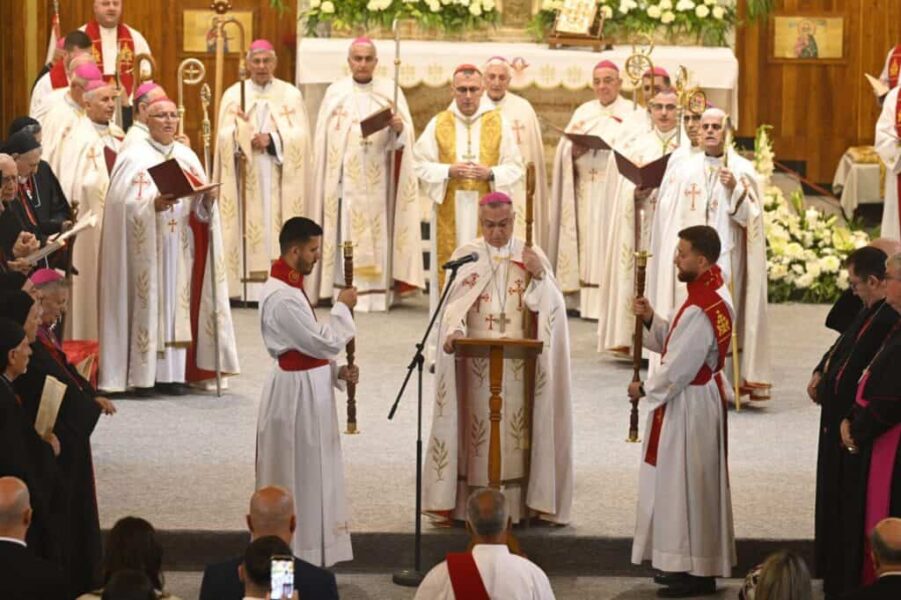
The new patriarch of the Chaldean Catholic Church, Paul III Nona, presided over his enthronement Mass in Baghdad with a call to move “from the logic of fear to the logic of faith” and with a reflection on the need to safeguard the spiritual, liturgical and cultural heritage of the Chaldean tradition amid the challenges facing Christians in the East and in the diaspora.
During the celebration held on May 29 at St. Joseph’s Cathedral in Baghdad, the new patriarch outlined some of the pastoral priorities he considers essential for this new stage of the Chaldean Church, one of the world’s oldest Christian communities.
“Do not be afraid; only believe”
Taking as his starting point Christ’s words recorded in the Gospel of Saint Mark—“Do not be afraid; only believe”—the new patriarch invited the faithful to live with trust in God even amid difficulties.
“Faith means seeing what cannot be seen and trusting in what surpasses human logic,” he affirmed during the homily.
For Paul III, the Christian is called to remain steadfast even when human securities disappear, convinced that God continues to act even in moments of trial and apparent silence.
The patriarch explained that he wishes to undertake his new mission supported by two fundamental pillars: faith and trust. “With trust despite fear; with faith despite challenges; and with openness to all despite the temptation to withdraw into ourselves,” he noted.
Six priorities for the new stage of the Chaldean Church
During his homily, Paul III highlighted several areas he considers essential for the future of the Chaldean Church: ecclesial unity, spiritual life, formation of the clergy, co-responsibility of the laity, preservation of Chaldean culture, and fraternity with other Catholic Churches.
Referring to the communities scattered throughout the world, he rejected viewing the diaspora solely as a loss for Iraq. On the contrary, he stated that the presence of Chaldean faithful in other countries constitutes a providential opportunity for evangelization and Christian witness.
At the same time, he stressed the importance of strengthening the Christian presence in Iraq and in the countries of the East, where the Chaldean tradition was born and developed over the centuries.
The defense of Eastern tradition
His remarks on Christian identity addressed the influence of the Western world on the rites and traditions proper to the Eastern world.
“We live in an age and within a global culture that seeks to erase identities, merge cultures, and dilute traditions and received heritages,” the patriarch affirmed.
In light of this situation, he underscored the need for the Chaldean tradition to remain the foundation of ecclesial life and of the transmission of the faith to new generations.
Paul III insisted that preserving one’s own tradition does not mean rejecting the modern world or retreating into the past. On the contrary, he maintained that spiritual, cultural, and liturgical roots enable Christians to engage with other cultures without losing what gives them identity.
His words take on special relevance at a time when numerous Eastern Churches express concern over the progressive loss of languages, customs, and traditions among communities that have emigrated to the West.
A Church of many rites and one faith
The new patriarch also wished to recall that the richness of the Catholic Church is expressed precisely in the diversity of its traditions.
He compared Catholic communion to a garden filled with flowers of different colors and fragrances, united by the same faith in Christ. In this context, he highlighted the importance of strengthening bonds of fraternity among the various Eastern and Western Catholic Churches.
Finally, he recalled that all pastoral projects will be fruitless if they are not sustained by prayer, unity, and fidelity to the Gospel.
A tribute to his predecessor
To conclude, Paul III offered words of gratitude to Cardinal Louis Raphael Sako, who led the Chaldean Church for thirteen years.
The new patriarch thanked him for his service and asked for him a time of rest, stability, and prayer after a long life dedicated to episcopal ministry.