


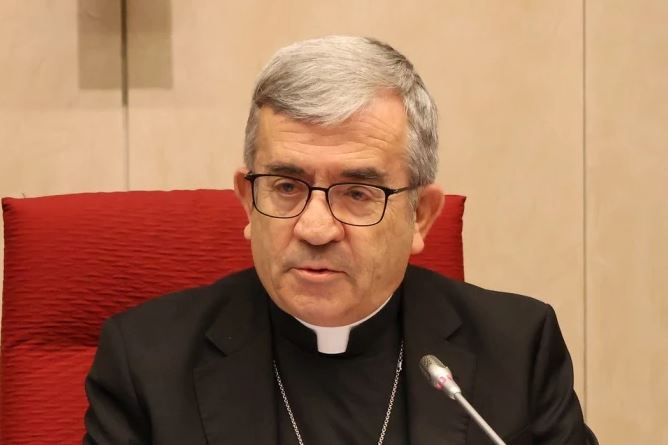
With the solemnity of Corpus Christi approaching, the president of the Spanish Episcopal Conference, Monsignor Luis Argüello, has recalled some fundamental truths about the Eucharist and the dispositions necessary to receive it worthily. In his pastoral letter published by the Archdiocese of Valladolid, the archbishop insists that sacramental communion requires coherence of life and a genuine interior disposition to encounter Christ.
“The Eucharist is sacrifice, banquet, and real presence,” writes Argüello at the beginning of his reflection, inviting the faithful to rediscover the profound meaning of the sacrament that constitutes the center of Christian life. For the prelate, it is not enough to attend Mass out of habit or to approach communion in a routine manner. “We cannot go in haste, with the attitude of one who is merely fulfilling a routine,” he warns.
Preparing to receive the Lord
The prelate encourages the faithful to examine their conscience and to ask themselves sincerely about the disposition of their heart before approaching the altar.
“Examining one’s conscience means becoming aware of the state of our heart, of its disposition to welcome the very God who, as a Body given, is offered to us as the Bread of life,” explains the archbishop. This preparation also includes, when necessary, approaching the sacrament of Penance.
“The Lord is merciful; He desires to seat us at His table and to offer Himself as food that heals and restores,” he affirms. However, he reminds us that when grave sin exists, “healing, eucharistic healing, must be sealed in the Sacrament of Penance.”
Those who cannot receive communion
The president of the Episcopal Conference points out that there are objective situations incompatible with the reception of sacramental communion until there is a genuine conversion of life.
“If our situation or state of life is incompatible with full communion with the Lord and His Church (…) we cannot approach to receive communion without a firm decision to change our life,” he writes. Among these situations, he explicitly mentions sinful relationships, abuses against other persons, and the public defense of positions contrary to Christian morality.
A reminder for the divorced and remarried
The letter also dedicates a specific section to those who, after the breakdown of a sacramental marriage, have entered into a new conjugal union.
“These persons, who continue to be part of the Church, must know that this rupture of the Sacrament of the Covenant prevents eucharistic communion,” the archbishop states. Therefore, he adds clearly that “receiving communion is not possible” while that situation persists.
Far from presenting it as an exclusion, Argüello considers that the suffering caused by this situation can become a call to seek a solution in accordance with the truth of both sacraments. “The pain of not receiving communion should rekindle the desire to seek a solution that respects the meaning of the two sacraments at stake: Marriage and the Eucharist,” he writes.
“We cannot go in haste or as one who fulfills a routine”
Beyond issues related to sacramental discipline, Argüello’s pastoral letter constitutes a profound reflection on the central place the Eucharist occupies in Christian life. The archbishop invites the faithful to rediscover wonder before a sacrament he defines as “sacrifice, banquet, and real presence,” which constitutes the heart of the Church’s life.
For this reason, he insists on the need to prepare adequately for the Sunday celebration. “We cannot go in haste, with the attitude of one who is merely fulfilling a routine,” he warns. In his view, participation in Holy Mass requires a preparation that begins long before entering the church, nurturing throughout the week the desire to encounter Christ and meditating on the Word of God.
Argüello also encourages living the liturgy with a spirit of adoration and recollection. “How important it is to care for the moment of approaching communion with a spirit of wonder and adoration,” he writes, recalling that the Eucharist is not a social gesture or a religious custom, but the real encounter with Jesus Christ present under the species of bread and wine.
The Eucharist, source of communion and mission
Participation in Holy Mass does not end with the final blessing. The Eucharist is meant to transform the lives of the faithful and to extend into daily life. “We are called to incarnate communion in the Christian community,” affirms Argüello, inviting Catholics to prolong throughout the week what was celebrated at the altar through prayer, fraternity, forgiveness, and commitment to the common good.
He also recalls that Corpus Christi is a privileged opportunity to publicly manifest faith in the real presence of Christ and to bring the Lord into all spheres of society. “We must prepare ourselves, as on the day of Corpus Christi, to be custodians who bring the Lord into ordinary life,” he states.
The letter concludes with a call to rediscover the greatness of the eucharistic mystery and to live it with renewed intensity. “We are permanent apprentices of the Eucharist and of Sunday,” writes Argüello, expressing his desire that the upcoming solemnity of Corpus Christi may move the faithful to proclaim with conviction the mystery of faith: “Every time we eat of this bread and drink from this cup, we proclaim your death, O Lord, until you come again.”