From June 6 to 12, 2026, Pope Leo XIV will make his first apostolic journey to Spain, accepting the invitation of King Felipe VI and the Church in our country. Madrid, Barcelona, and the Canary Islands—with stops in Tenerife and Gran Canaria—will welcome the successor of Peter. The Episcopal Conference, in announcing the visit, wisely asked that it not be seen primarily as a media event or diplomatic gesture, but for what it truly is: “an event of faith,” a call to ecclesial communion, to hope, and to the renewal of the Christian heart.
It is worth taking the bishops at their word. Because the temptation these days will be to interpret the trip through the single lens already circulating everywhere. This very Monday, the Vatican presented Magnifica humanitas, the first encyclical of Leo XIV, signed on May 15—the exact 135th anniversary of Rerum novarum—and dedicated to safeguarding the human person in the face of artificial intelligence. The reading is immediate and, to a certain extent, irresistible: if Leo XIII confronted an industrial revolution, Leo XIV faces one that is even more disruptive; if the former inaugurated the Church’s social doctrine, the latter updates it in the presence of machines that learn. The pontiff himself stated this to the cardinals two days after his election. And the encyclical confirms it.
It is not an incorrect reading. It is an incomplete one.
There is a second thread
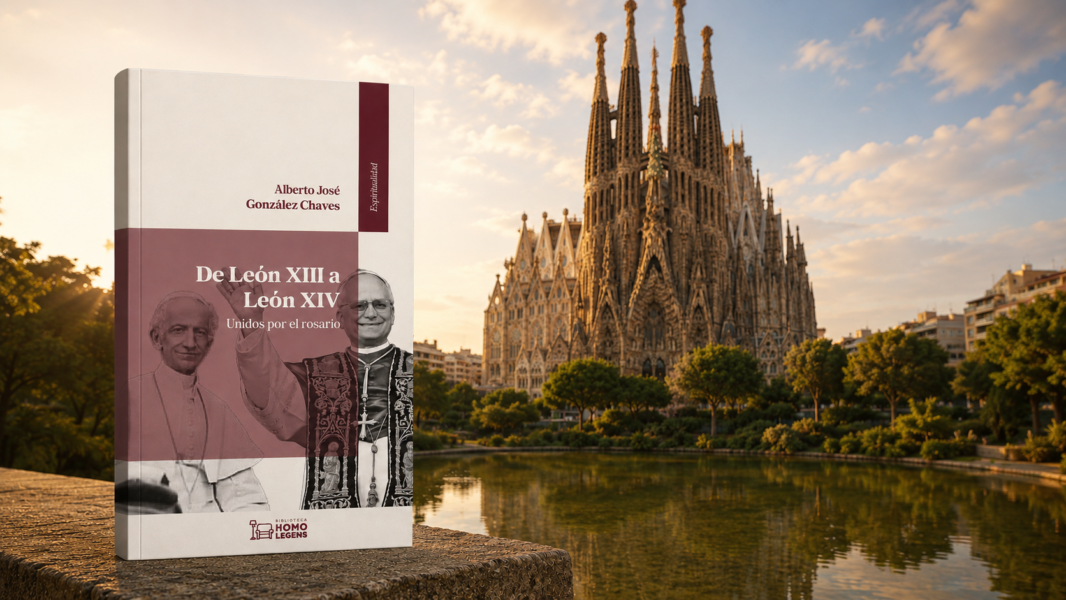
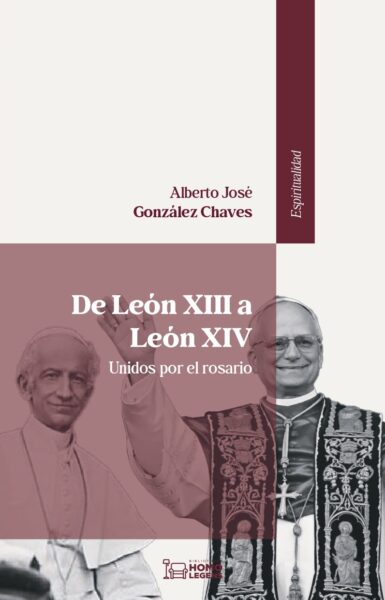
There exists between the two Leos a continuity that is less discussed but no less profound. This has been demonstrated, with erudition and without stridency, by Monsignor Alberto José González Chaves in From Leo XIII to Leo XIV: United by the Rosary (Bibliotheca Homo Legens), a book that also had a notable intuition: when it was published, it asked aloud whether the new pope would dedicate an encyclical to the new “industrial revolution” and to artificial intelligence. The question posed in those pages now has an answer. But the book did not stop there; it maintained something harder to see and, for that very reason, more necessary to say.
What unites Leo XIV with Leo XIII is not only the name, nor only the social question. Above all, it is Mary. And, within Marian devotion, a specific prayer—popular, almost disarming in its simplicity: the rosary.
Leo XIII was the great renewer of contemporary Mariology. He dedicated nearly a dozen Marian letters to this single devotion, from the Supremi apostolatus officio of 1883 to the Diuturni temporis of 1898, convinced that the rosary is not sterile repetition but a pedagogy of love capable of introducing even the simplest of the faithful to the contemplation of the mysteries of Christ. Leo XIV has begun his pontificate along the same path. He was elected on May 8, 2025, the day of the traditional Supplication to Our Lady of the Rosary of Pompeii, and that same afternoon, from the balcony of St. Peter’s Basilica, he prayed a Hail Mary with the crowd. It was not an improvised gesture: as Bishop of Chiclayo he had consecrated Peru to the Sacred Heart of Jesus and the Immaculate Heart of Mary, had requested the pilgrim image of Fatima for his diocese, and had composed a Marian consecration prayer himself. Two days after his election he paid a surprise visit to the Augustinian shrine of the Madonna del Buon Consiglio in Genazzano. And in September he invited the whole Church to pray the rosary every day in October for peace. Like Leo XIII. Like his predecessors. Today as yesterday.
Why this matters to Spain
This is where the June visit takes on particular significance. Because if a Marian pope comes to Spain, he comes to a land shaped by the rosary.
This is not pious rhetoric: it is history. González Chaves’s book traces it without sentimentality. The Reconquest that began at the feet of the Virgin of Covadonga and culminated in Granada in 1492. And above all, Lepanto: on October 7, 1571, before the fleets met in the Gulf of Corinth, the Christian troops of the Holy League—with soldiers from the Papal States, Venice, Genoa, and Spain, under the command of Don Juan of Austria—prayed the rosary with devotion. St. Pius V prayed it at the same time in Rome. The victory was attributed to the intercession of the Virgin, and from that the feast of Our Lady of the Rosary was born. Spain is not a country that needs to be told what the rosary is: it is a country that carries in its memory what the rosary has sustained.
Receiving Leo XIV, therefore, is not merely receiving a head of state or the protagonist of a timely encyclical. It is recognizing in him the same trust that underpins our own spiritual history.
Gaudí, the Canaries, and a concrete invitation
Within a broad program, the Holy See has already confirmed two eloquent signs. In Barcelona, the pope will inaugurate the new and tallest tower of the Sagrada Família, on the centenary of Antoni Gaudí’s death. It will continue what Benedict XVI began in 2010 when he consecrated that church: beauty placed entirely at the service of faith, which is also a form of prayer. And in Madrid, he will address the Cortes Generales—not as a political leader, but as the guiding light our society needs.
The bishops have asked that the visit be prepared with prayer, conversion, and “interior availability.” The simplest, most Spanish, and most faithful way to what unites the two Leos has a name that fits in the palm of a hand: the rosary. Monsignor González Chaves’s book—prologued by Francisco Pérez González, Archbishop Emeritus of Pamplona and Tudela—is, in this sense, much more than an occasional work. It is a guide to understanding, and to living, what will take place in June. Its prologue says it better than any summary: united to Mary through the rosary, from Leo XIII to Leo XIV, we walk with hope toward Christ.
Spain does not await only a pope. It awaits the opportunity to pray once again as a Church. And it already has, printed, the map of that path.