


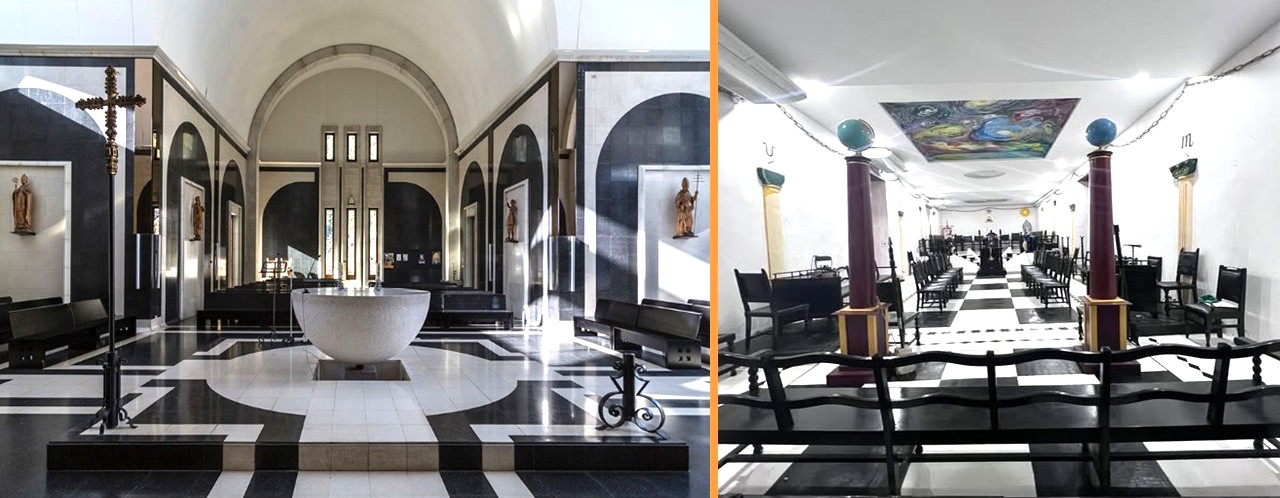
The image on the left corresponds to the interior of the sanctuary of Our Lady of Meritxell, in Andorra, diocese of Urgel. The one on the right, to a Masonic lodge.
How is such a resemblance possible? How is it possible that the church of Meritxell does not look like a Catholic temple?
Let us see what has happened in the recent history of this sanctuary.
The Virgin of Meritxell is the patroness of Andorra, “the country of the Pyrenees”. Tradition tells that on the day of the Epiphany, a shepherd was heading toward Canillo to attend Mass. Halfway there, passing by the place where the sanctuary now stands, he saw something surprising: a bush, which should have been bare due to the cold, was full of flowers. Attracted by that unusual phenomenon, he approached and, under the bush, found a wooden carving of the Virgin Mary. The shepherd alerted the villagers, who, moved by the discovery, took the wooden carving to the church of Canillo and placed it on the main altar, with the promise of building a chapel of its own. But the next day, when the sacristan entered the church, the wooden carving of the Virgin was no longer there. They searched everywhere until they found it under the same bush. There were other attempts to move it to other places, but it always returned to the original spot. So the locals thought that meant the Virgin wanted to stay there, and they built a sanctuary for her.
In 1873 Meritxell was officially declared patroness of Andorra and in 1921, after papal approval, she was crowned.
On the night of September 8 to 9, 1972 the sanctuary of Meritxell, where the image of the Virgin had been venerated since the seventeenth century, was consumed by flames and reduced to ashes. Only some of its walls remained standing. Neither the medieval image of the Virgin nor the artistic and liturgical heritage of the church could be saved from the fire.
The shock was total, and it was immediately decided to rebuild the sanctuary. Two options were then considered: to rebuild the church in the historical style or to reconstruct it according to the architectural fashions of the 1970s. The second option was chosen (oh, surprise of the post–Vatican II Church) and the project was entrusted to one of the most prominent architects of the time: the Catalan Ricardo Bofill. His architecture studio included engineers and urban planners, but also sociologists, designers, and artists from various disciplines, all with an innovative and eclectic outlook. Their goal was to create works that would adapt to the place and context in which they were situated. And so the reconstruction of the sanctuary of Meritxell was carried out.
Who financed the reconstruction of the sanctuary? Who chose the architect? What role did the bishop of Urgel, Joan Martí i Alanis (1971 – 2003), play? Well, in Andorra we already know that politics and religion go hand in hand, and not exactly for the good, so it is difficult to say whether it was the Andorran government or the bishopric, especially since the bishop is co-prince.
Reconstruction work began on September 8, 1974, and the inauguration took place on September 8, 1976, although the work was not yet finished, coinciding with the feast day of the Virgin of Meritxell. When designing the new sanctuary, the architect stated that he wanted to reflect certain symbolic elements that would express the particular connotations of the space: with the sun embedded above the altar he intended to signify the name Meritxell, which, according to the philologist Coromines, comes from the Latin word “meridien,” meaning midday; with the two naves that cross, he sought to represent the confluence of the paths leading from one border to the other; with the walls cut horizontally at the top and the open cloister, he aimed to reflect the protection of the Virgin, who watches over the sky of Andorra.
The sanctuary was inaugurated in 1978, and the result can be seen in these images: a large temple of slate and wood surrounded by mountains and forests. The materials are typical of local building traditions. It is supposed that the inspiration for the thick walls, the semicircular arches, and the tall bell tower comes from Romanesque hermitages. These traditional inspirations are complemented and transformed by Bofill’s postmodernist architecture. An article in the newspaper La Vanguardia describing the temple considered typical of Bofill’s architecture “the disappearance of the mural paintings typical of the Middle Ages and the use of an intense white color, which contrasts even more with the almost black dark tone of the slate”.
Well, what La Vanguardia considered “a revision of tradition” seems more like an exercise in iconoclasm and the replica of a Masonic lodge than a Catholic temple.
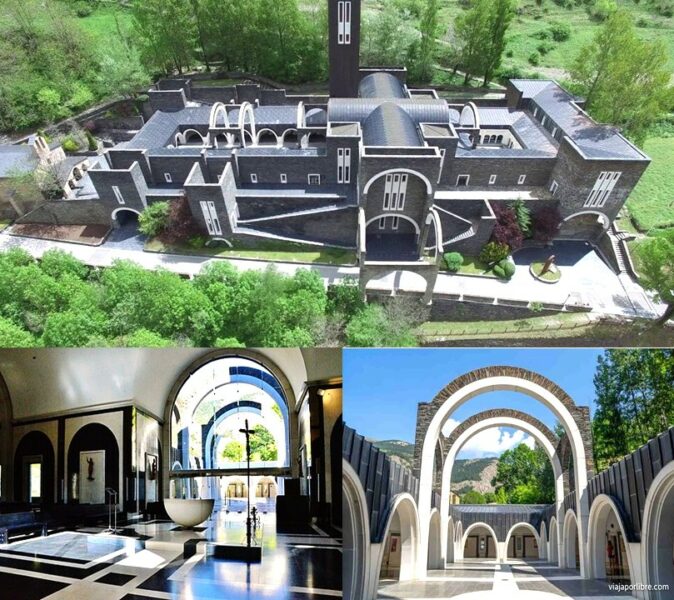
Just look at the images that illustrate this text. And let us consider the full name of the main architect of the reconstruction: Ricardo Bofill Leví. Bofill Leví was born in 1939 in Barcelona, to an Italian Jewish mother and a Catalan father. And as you know, Judaism is transmitted through the mother: if the mother is Jewish, the son is Jewish. From the mid-1950s, Bofill Leví was a member of the Unified Socialist Party of Catalonia (PSUC), studied in Barcelona and Geneva, and in 1963 founded his own architecture studio. The studio received countless international awards from its beginnings due to the “originality” of its works. In 1970 he established a second office in Paris, and Bofill Leví obtained the title of architect in France from the Ordre National des Architectes. His relationship with the French authorities was close. These were the years of Georges Pompidou, a symbol of the modernization of France. Pompidou, De Gaulle’s right-hand man since the end of World War II, had been director of the Rothschild Bank in the 1940s and in his youth had been a Trotskyist militant.
The architect Bofill Leví, for his part, with a multidisciplinary creativity, did not devote himself only to architecture; he also ventured into film and writing. Notably, in 1975 he published in the Revista de Occidente the “Devil’s Manifesto on Architecture and Urbanism”.
I have been searching for references to the unsettling resemblance between the interior of the church of Meritxell and that of a Masonic lodge, but nowhere is it mentioned. The temple only receives praise. But you cannot deny that it is disturbing. The play of black and white inside the church (a minor basilica, by the way), that circular altar with the faithful on all sides, and the aforementioned total absence of images. And all that Trotskyism, Freemasonry, and Judaism surrounding the people involved, directly or indirectly, in the reconstruction.
The choice of a non-Catholic architect was not an isolated event in the construction of churches during the dizzying 1970s, which seemed to compete for the title of ugliness. But was it necessary that he also be so left-wing, so disruptive, and Jewish? Is it possible to find recollection and to look upward (now that “raising one’s gaze” is so fashionable, just like that, without mentioning God) in such a black-and-white box, without any image that calls to devotion?
Call me a conspiracy theorist, but I believe General Franco was not far off the mark with the “Judeo-Masonic and communist conspiracy.” If the Church is not infiltrated by Freemasonry and if the Jews have nothing to do with this anti-Catholic philosophy, let God come and say so. He who reads, let him understand (Mt 24, 15).