


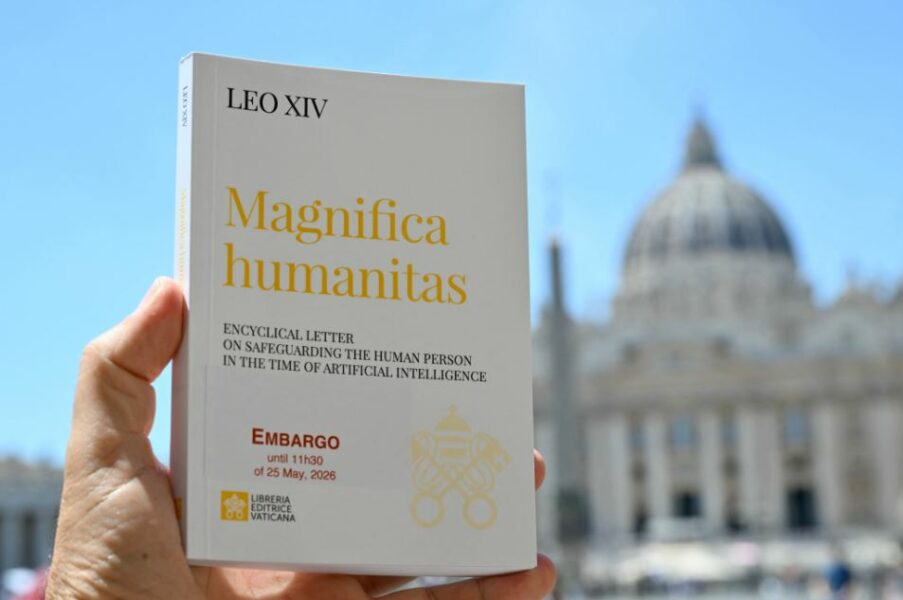
The radio station of the Spanish Episcopal Conference presented one of the passages from the encyclical Magnifica Humanitas, claiming that Pope Leo XIV “dismantles” the concept of just war; accompanying that assertion with a quote in quotation marks: “There is no just war”.
The matter may seem minor, but it becomes especially relevant when dealing with a magisterial document meant to guide theological and moral debate in the years ahead. One thing is to interpret the meaning of a text; quite another is to attribute to the Pope words he never wrote.
What the encyclical actually says
The reference appears in number 192 of Magnifica Humanitas, within a chapter devoted to the growing normalization of war in contemporary culture.
After denouncing the rearmament of numerous countries, the loss of historical memory of the tragedies of the twentieth century, and the role of social media and algorithms in polarizing societies, Leo XIV writes:
“Today more than ever it is important to reiterate the overcoming of the theory of ‘just war,’ invoked too often to justify any war, without prejudice to the right to legitimate defense, understood in the strictest sense.”
The formulation is significant.
The Pope does not write that “there is no just war.” Nor does he state that every form of armed defense is immoral. What he maintains is that the just-war theory has been invoked too frequently to legitimize conflicts and that humanity today possesses more suitable instruments for addressing international crises, such as diplomacy, dialogue, or forgiveness.
The sentence, moreover, appears within a broader reflection on propaganda, disinformation, and the cultural construction of war as an ordinary instrument of politics.
The Catechism remains
The problem with some hasty readings—including the one circulated by COPE on social media—is that they present Leo XIV’s text as if it canceled, with a single stroke, the entire Catholic moral tradition on legitimate defense. But the Catechism is still there.
The doctrine of just war was not born to justify wars, but to limit them. From Saint Augustine to Saint Thomas Aquinas, Christian reflection sought to establish moral criteria capable of preventing the recourse to force from being left to the sheer law of the strongest.
That tradition is still recorded in the Catechism of the Catholic Church.
Number 2265 recalls that those who bear responsibility for the lives of others possess not only the right but also the duty to protect them. And number 2309 sets out the conditions that must be met for armed defense to be considered morally legitimate: that there be grave, lasting, and certain damage; that peaceful means have failed; that there be well-founded prospects of success; and that the use of force not cause greater evils than those it seeks to avoid.
The Church has never taught an absolute pacifism that obliges the innocent to allow themselves to be exterminated. It has taught that war is always a very grave evil and that armed defense may be contemplated only under extraordinarily restrictive conditions.
That is why it is difficult to maintain that Leo XIV intended to abolish this entire tradition explicitly when the text itself explicitly preserves the reference to the right of legitimate defense.
What Czerny and Staglianò say
The first Vatican interpretations of this passage have come from Cardinal Michael Czerny, prefect of the Dicastery for Promoting Integral Human Development, and from Archbishop Antonio Staglianò, president of the Pontifical Academy of Theology.
Both consider that Leo XIV is promoting a profound revision of the way the Church today addresses the question of war. However, neither of them maintains that all armed defense is illegitimate.
Czerny expressly acknowledged that whoever is attacked retains the right to defend themselves. In fact, he proposed a significant distinction: “I would not speak of just war. I would speak of just defense.”
For his part, Staglianò interprets that current technological conditions have eroded the classical criteria of proportionality on which the traditional theory rested. According to his analysis, the destructive capacity of modern conflicts makes it increasingly difficult to apply the limits that historically sought to contain war.
Nevertheless, he too insists that legitimate defense continues to be recognized by the encyclical, albeit understood “in the strictest sense.”
The statements of both show that even within the Vatican the debate is being framed in far more nuanced terms than some headlines suggest.
A more complex debate than it appears
The underlying question is not whether the Church blesses war. It does not. Nor whether Leo XIV wishes to strengthen a culture of peace. Clearly he does.
The real discussion is another: how to protect the innocent when there is a grave and unjust aggression and all peaceful means have failed.
That question is not theoretical. It affects real situations in which entire communities suffer attacks, persecutions, or systematic campaigns of violence. And it is precisely here that the classical doctrine of legitimate defense has historically played a central role within Catholic morality.
What Magnifica Humanitas raises is that the just-war theory has been invoked too often to legitimize conflicts that ultimately stray from the moral limits it originally sought to impose. But that does not necessarily amount to denying every possibility of armed defense.
Between interpretation and quotation
It can be argued that Leo XIV is taking the critique of the classical just-war theory further than his predecessors. It can also be defended that the encyclical opens a new stage in Catholic reflection on war and peace.
But turning that complex reflection into a quotation that never appears in the text does not help to understand the document. Rather, it simplifies to the point of distorting a serious doctrinal question.
Interpreting that doctrinal development is legitimate. Turning it into a verbatim quotation that never appears in the encyclical is another matter. Rigor in quotations should be a basic requirement, especially for a media outlet belonging to the Spanish Episcopal Conference itself.