


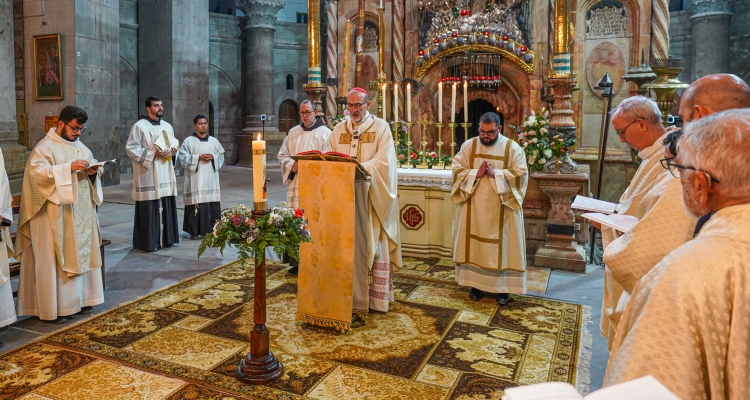
Cardinal Pierbattista Pizzaballa, Latin Patriarch of Jerusalem, on Thursday officially welcomed Archbishop Giorgio Lingua on his solemn entry as the new Apostolic Delegate in Jerusalem and Palestine and Apostolic Nuncio in Israel. The ceremony took place at the Holy Sepulchre, one of the most sacred sites for Christianity, where the patriarch highlighted the challenges and responsibilities that accompany the Holy See’s diplomatic mission in the Holy Land.
Last January 22, Pope Leo XIV appointed Msgr. Giorgio Lingua to succeed Archbishop Adolfo Tito Yllana, who had represented the Holy See in Jerusalem since 2021. Prior to this appointment, Lingua carried out his diplomatic work as Apostolic Nuncio in Croatia and previously in Iraq, Jordan, and Cuba.
A welcome from the heart of the Christian faith
In his welcoming address, delivered before the Edicule of the Holy Sepulchre, Cardinal Pizzaballa underscored the special significance of the place where the ceremony was held.
“We are gathered in a place that has no equal in the world, the heart of the Christian faith, before the Holy Sepulchre, where death was conquered and life triumphed,” the patriarch stated.
Pizzaballa emphasized that the arrival of the new apostolic delegate is a visible sign of the closeness of the Successor of Peter to the Christian communities living in the Holy Places. He explained that the presence of the pontifical representative recalls “the deep bond that unites the local Church with the universal Church.”
Jerusalem, a city called to encounter
The Latin patriarch devoted a large part of his remarks to reflecting on the unique reality of Jerusalem, a city marked by political, religious, and social tensions, yet also endowed with a special vocation to dialogue.
“Jerusalem is called to be a city of encounter and dialogue,” Pizzaballa noted. He also recalled that Jews, Christians, and Muslims coexist in the city in a context frequently marked by mutual distrust.
In this setting, he indicated, the mission of the new apostolic delegate will consist in fostering spaces for encounter, supporting the Christian communities, and promoting initiatives that contribute to reconciliation.
The challenge of sustaining the Christian communities
Pizzaballa did not conceal the difficulties currently faced by Christians in the Holy Land. In his address he mentioned the demographic decline of the Christian communities, the social and political tensions affecting the region, and the risk of discouragement experienced by many of the faithful.
Nevertheless, he recalled that precisely in the land where Christianity was born, believers are called to be “witnesses of the Risen One” and guardians of a hope that does not disappear amid difficulties.
The patriarch stated that the new apostolic delegate must carry out his mission as a sign of the Pope’s pastoral solicitude, a promoter of ecclesial communion among the various Catholic realities present in the region, and a constant voice in favor of peace.
A diplomat with extensive experience in the Middle East
The appointment of Giorgio Lingua comes at an especially delicate moment for the Holy Land. The Italian prelate has a long career in the Holy See’s diplomatic service and knows the reality of the Middle East firsthand thanks to his years of service in Jordan and Iraq.
During the ceremony, Pizzaballa assured the new pontifical representative of the collaboration and support of the local Christian communities, highlighting the importance of the Holy See’s presence in a region where pastoral and political challenges continue to be especially complex.
The patriarch concluded by entrusting Msgr. Lingua’s mission to the Risen Lord and to the protection of the Virgin Mary, asking that his service contribute to strengthening hope, communion, and peace among all the inhabitants of the Holy Land.