


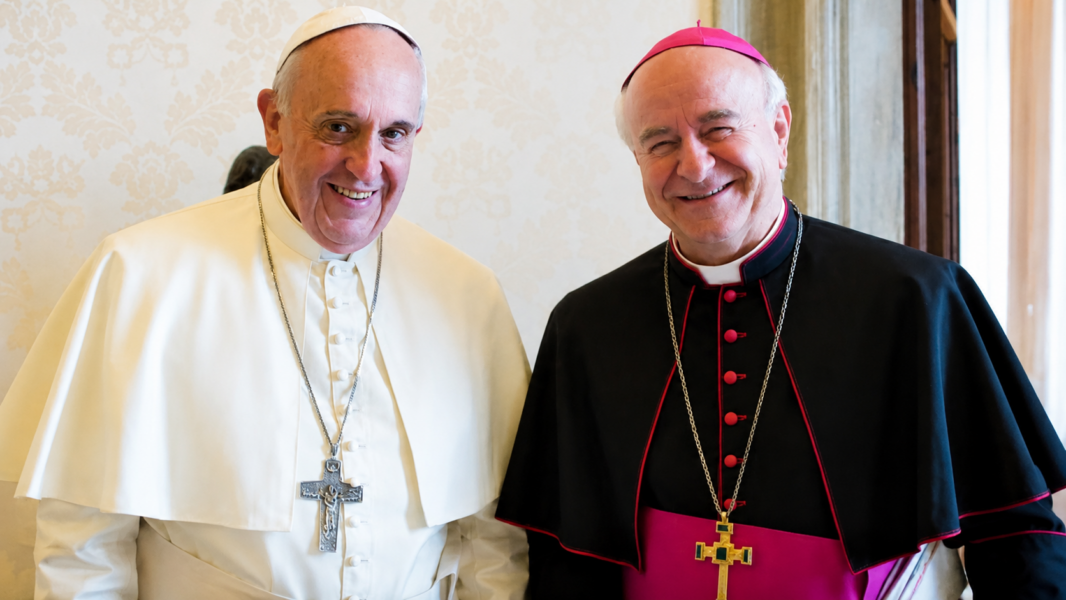
Archbishop Vincenzo Paglia has once again defended some of the most controversial reforms promoted during Pope Francis’s pontificate. In an extensive interview given to the Italian portal Settimana News, the Italian prelate stated that the Pope considered certain “updates” to the encyclical Humanae Vitae necessary in order to address contemporary challenges related to sexuality, family, and bioethics.
The statements come one year after Paglia’s departure from the presidency of the Pontifical Academy for Life, already under the pontificate of Leo XIV. The transition had been expected, as the archbishop had reached retirement age.
Francis asked for reflection on an update of Humanae Vitae
During the interview, Paglia affirmed that it was Francis himself who asked him to prepare a text on the occasion of the fiftieth anniversary of Humanae Vitae, the encyclical published by Paul VI in 1968 that reaffirmed the prohibition of artificial contraceptive methods.
According to the Italian archbishop, the Pope wished to highlight the document’s prophetic character, but also to reflect on possible developments in its interpretation.
“Francis felt the need to adapt doctrine to the new times,” Paglia stated. “He asked me to prepare a text that would underscore its prophetic dimension, but also some necessary updates.”
The former president of the Pontifical Academy for Life assured that the Pontiff viewed positively the work carried out by a group of theologians and later encouraged him to continue that line of research.
A defense of the reforms promoted by Francis
Paglia also took the opportunity to justify the profound transformation of the Pontifical John Paul II Institute for Marriage and Family Sciences, one of the most controversial decisions of the previous pontificate.
The archbishop maintained that the institute founded by Saint John Paul II had become excessively focused on marital morality and was based, in his words, on a “static and immutable” vision of natural law.
In his view, both the John Paul II Institute and the Pontifical Academy for Life had turned into centers of doctrinal resistance to the pastoral orientations promoted by Francis after the publication of Amoris Laetitia.
“The task entrusted to me was to restore to these institutions the capacity to listen to the living magisterium,” he stated.
The reforms promoted by Paglia led to the departure of several professors identified with the theological line developed during the pontificates of Saint John Paul II and Benedict XVI, generating strong criticism at the time.
Criticism of “non-negotiable values”
The archbishop explicitly questioned the language of so-called “non-negotiable values,” an expression popularized during Benedict XVI’s pontificate to refer to fundamental principles such as the defense of life, the family, and religious freedom.
According to Paglia, this approach risks reducing complex issues to the mere application of doctrinal norms without sufficiently taking into account people’s concrete circumstances.
The prelate instead defended a more pastoral and contextualized approach to contemporary challenges related to family and sexuality.
The Academy for Life and a broader vision of bioethics
Paglia also defended the broadening of the profile of the members of the Pontifical Academy for Life, incorporating experts from disciplines such as economics, robotics, artificial intelligence, or the social sciences, as well as non-Catholic and even non-believing professionals.
He explained that the goal was to expand reflection on the defense of life beyond issues traditionally associated with bioethics, such as abortion or euthanasia.
This orientation marked one of the most visible characteristics of his mandate at the head of the Vatican institution.
A legacy that continues to generate debate
Paglia’s statements once again bring to the table some of the most intense debates of Francis’s pontificate: the interpretation of Humanae Vitae, the scope of Amoris Laetitia, the reform of the John Paul II Institute, and the role of the Pontifical Academy for Life.
During his time leading these institutions, the Italian archbishop was the target of criticism from numerous theologians, intellectuals, and representatives of the pro-life movement, who considered that some of his initiatives represented a break with the orientation established by Saint John Paul II.
Now, already retired from his responsibilities in the Curia, Paglia maintains that those reforms responded directly to Francis’s desire to promote a theology capable of engaging with contemporary cultural challenges.
His words, however, show that the discussions opened during the previous pontificate remain far from closed and will continue to occupy a prominent place in the Church’s intellectual and pastoral life under Leo XIV.
A debate that remains open under Leo XIV
In March, Leo XIV convened bishops from around the world for a global evaluation of family pastoral care ten years after the publication of Amoris Laetitia, the apostolic exhortation of Francis that marked much of the debates on marriage, family, and pastoral accompaniment over the past decade.
The meeting was set for October, from the 7th to the 14th, with the support of the General Secretariat of the Synod.