


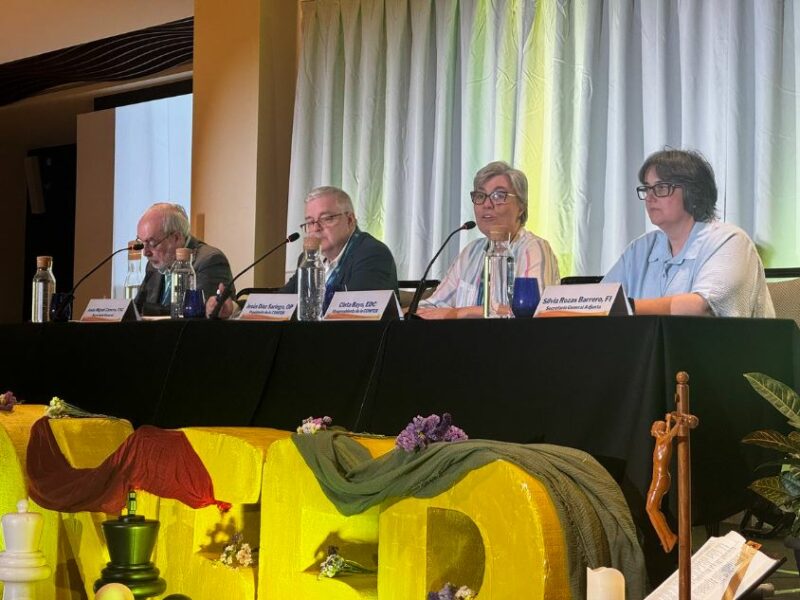
Spanish religious life continues to advance along the synodal path marked out by Rome. After three days of meetings, presentations and group work, the 32nd General Assembly of CONFER concluded in Madrid with an invitation to deepen the practice of synodality, address internal conflicts within congregations and continue driving the transformations proposed by the recent Synod.
The assembly, held under the motto “All, all, all. Synodal Kairos,” began with addresses by Cardinal José Cobo, the President of the Spanish Episcopal Conference, Luis Argüello, and the Prefect of the Dicastery for Institutes of Consecrated Life, Sr. Simona Brambilla.
Brambilla encouraged religious to move forward in a “conversion of relationships and structures” and urged them to keep walking together in the synodal process. The Prefect stressed that consecrated life is called to review not only personal attitudes but also community and institutional dynamics, in line with the priorities of the current ecclesial process.
From theory to practice
One thing that became clear during the CONFER days is that synodality is no longer presented as a theoretical reflection or a mere working methodology.
In the closing address, CONFER President Jesús Díaz Sariego and Vice-President Cinta Bayo maintained that congregations have entered a new phase in which synodality must become a daily experience and a concrete form of community life.
For the institution’s leaders, the Assembly achieved its intended goals: awakening the so-called “Synodal Kairos,” strengthening mutual listening and learning to address issues that usually remain hidden in community life.
Looking under the rug
The Assembly highlighted the need to “look under the rug.” With this image, the organizers referred to the conflicts, tensions, fears and experiences that are often sidelined in community life. The final document itself acknowledges that learning to manage conflicts remains one of the most difficult tasks for religious congregations.
The reflection also included references to “silenced voices,” the need to overcome personal fears and the effort to put oneself in the place of those who think differently.
The “chessboard of synodality”
One of the central concepts was the invitation to “reinvent the chessboard of synodality,” a metaphor the CONFER leadership used to summarize five essential moves for the future of congregations.
These include the conviction that no one is indispensable, the need to overcome rigidity, the integration of those who create discomfort within communities, the value of walking together and the importance of the so-called “silence of the Spirit” for discerning the way forward.
Five conversions for a new stage
Another focus of the Assembly was reflection on the five synodal conversions outlined in the Synod’s final document: spiritual, relational, procedural, institutional and missionary.
Participants insisted that the current challenge is to integrate all these dimensions simultaneously, preventing synodality from being reduced to organizational or structural changes.
Read also: The Vatican accelerates the implementation of the Synod with new assemblies until 2028
To this end, CONFER proposes cultivating interior life, learning to sustain tensions without breaking communion and embracing processes of transformation summarized by another characteristic phrase from these days: moving “from order to disorder and from disorder to reordering.”
With the Assembly concluded, CONFER thus reaffirms its intention to continue accompanying religious congregations in the unfolding of synodal processes. A path that, judging by the conclusions of these days, appears to be only just entering a new phase and continues to generate an abundant repertoire of concepts, conversions and metaphors called to transform the religious life of the future.