


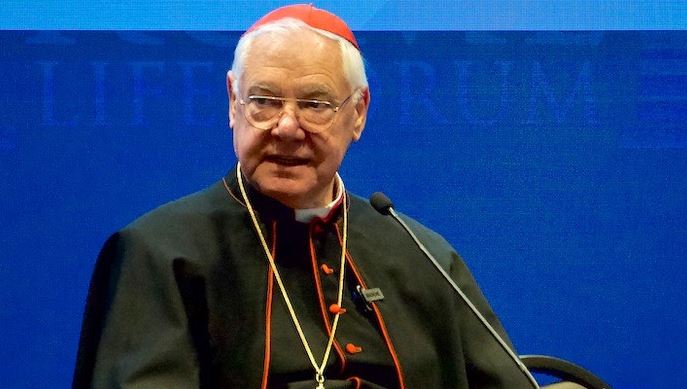
Cardinal Gerhard Ludwig Müller has warned that the Priestly Fraternity of St. Pius X cannot dictate to the Pope the conditions for its full reintegration into the Catholic Church and has insisted that any eventual regularization requires acceptance of the Church’s teaching in its entirety, including the Second Vatican Council.
In an extensive interview granted to kath.net, the former prefect of the Congregation for the Doctrine of the Faith spoke about the episcopal consecrations that the FSSPX plans to celebrate on July 1 in Écône, Switzerland, without a pontifical mandate. Müller maintains that no one has the right to claim episcopal consecration to guarantee the survival of their own organization, since the episcopate belongs to the Church and not to particular groups.
A warning regarding the July consecrations
In response to the FSSPX’s announcement of new episcopal consecrations to address the advanced age of the two surviving bishops consecrated by Marcel Lefebvre in 1988 and to ensure the continuity of priestly ordinations and its mission, the cardinal holds that an episcopal consecration without the Pope’s authorization could only be morally justified in an extreme situation of persecution, when all contact with Rome and the universal Church would be impossible.
Müller also recalled that an ordination can be valid from a sacramental standpoint and, at the same time, illicit and morally unjustifiable if carried out in open contradiction to the Roman Pontiff.
The problem is not the traditional liturgy
Avoiding reducing the conflict to a liturgical issue, the cardinal states that the problem is not the old rite or the new one, but the FSSPX’s accusation that the post-conciliar Church has abandoned the Catholic faith.
Along these lines, the prelate also criticizes the indiscriminate restrictions against the traditional liturgy. According to Müller, a purely disciplinary suppression of the old rite and the generalized suspicion toward its faithful as if they were necessarily enemies of Vatican II is pastorally imprudent and dogmatically unsustainable.
The former prefect defends that the Roman rite prior to the liturgical reform possesses a spiritual richness that must be recognized, while at the same time rejecting the thesis that the reformed Mass contains doctrinal errors or contradicts Catholic tradition.
Vatican II, religious freedom, and ecumenism
Müller places the doctrinal core of the conflict in the reception of the Second Vatican Council, especially regarding religious freedom and ecumenism.
He explains that the FSSPX interprets religious freedom as if it were equivalent to the relativist liberalism of the nineteenth century, whereas the Council distinguishes between the natural right of the person not to be coerced by the State in religious matters and the moral obligation to seek and embrace the truth revealed by God.
The cardinal also considers it anachronistic to defend today a model of a confessional State that would impose the Catholic faith socially through political means. In pluralistic societies, even those hostile to Christianity, Müller emphasizes that Catholics precisely need to be able to invoke religious freedom and freedom of conscience to reject abortion, euthanasia, or the redefinition of marriage.
Regarding ecumenism, the former prefect affirms that Vatican II did not deny the uniqueness of the Church of Christ but sought ways to restore unity with separated Christians without abandoning Catholic doctrine.
A critique also of progressivism
Müller’s position is not a defense of ecclesial progressivism. In the interview he insists that neither the progressivism that hands revealed truth over to the spirit of the age nor a traditionalism reduced to a few fixed ideas can be the path of the Church.
This point supports the reflection published by the cardinal himself in February 2026, in which he already defended that full communion with the Pope is a constitutive element of catholicity, but also warned against the delegitimization of the traditional rite and against the liturgical abuses committed after the Council.
For Müller, the defense of orthodoxy must be carried out within the Church and not from a position that ends up presenting itself as an instance of control over the Pope and the bishops.
The FSSPX is not a particular Church
The cardinal rules out the possibility that the Fraternity could receive a status similar to that of the Eastern Catholic Churches. In his view, the FSSPX is not a particular Church but an association of priests and faithful that conceives of itself as a bulwark against supposed errors tolerated or promoted from Rome.
Müller admits that a canonical structure, such as a personal prelature, could be considered, but only if the Fraternity recognizes Catholic doctrine in its entirety, including the teachings of Vatican II as authentically interpreted by the bishops in communion with the Pope.
The precedent of Lefebvre
The interview recalls the 1988 precedent, when Archbishop Marcel Lefebvre consecrated four bishops without a pontifical mandate. That decision was considered by Rome to be a schismatic act and led to the excommunication of Lefebvre and the consecrated bishops.
In 2009 Benedict XVI lifted the excommunication of the surviving bishops as a gesture of mercy and in the hope of facilitating reconciliation. However, Müller recalls that the measure did not entail a doctrinal rehabilitation nor the resolution of the underlying problem.
The question remains whether the FSSPX is willing to recognize not only in theory but also in practice the doctrinal and jurisdictional authority of the Pope.
A wound for the Church
Müller acknowledges that a formal rupture would be a painful wound for the Church, also because the Fraternity attracts numerous faithful and Catholic families. Nevertheless, he warns that unity cannot be built at the cost of relativizing the authority of the Magisterium.
The cardinal calls on the FSSPX not to shut itself within its own circle and to learn from the errors in the history of the Church, citing the precedents of the Donatists, Jansenists, and Old Catholics.
The interview thus leaves a clear message: Rome can grant liturgical spaces and prudent canonical solutions, but it cannot accept that a particular group sets itself up as judge of the Council, of the Pope, and of the doctrinal continuity of the Church.