


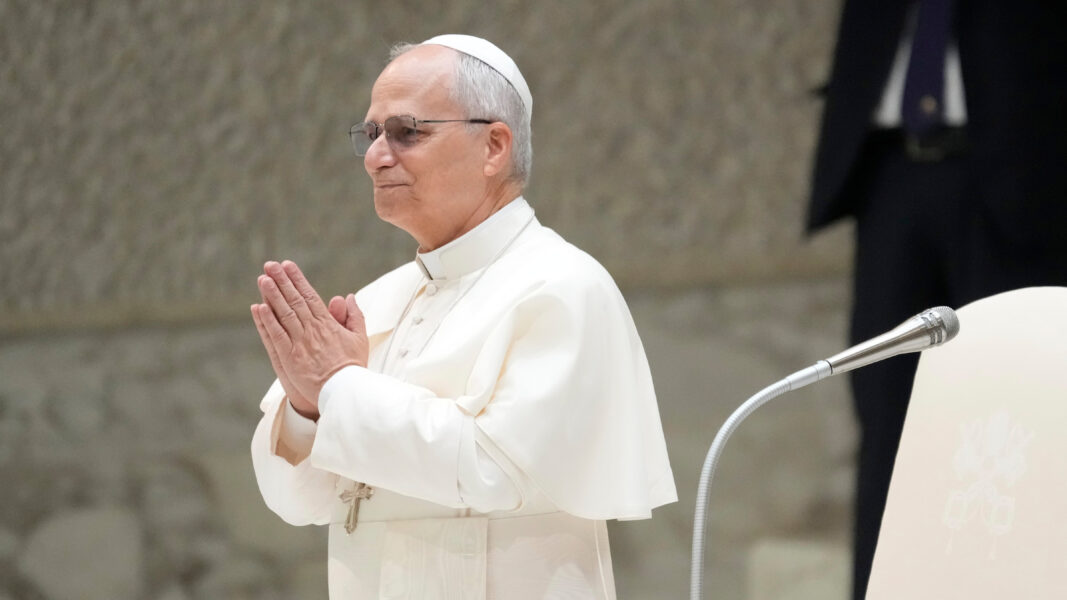
During the general audience held this Wednesday in St. Peter’s Square, Pope Leo XIV dedicated his catechesis to the conciliar constitution Sacrosanctum Concilium and called for a liturgical reform in continuity with the Church’s Tradition, warning against improvisations or arbitrary modifications in the celebration of the liturgy.
Continuing the cycle of catechesis on the documents of the Second Vatican Council, the Pontiff focused his reflection on the constitution on the sacred liturgy, defending that authentic liturgical renewal can only be understood from the balance between tradition and legitimate development.
“Preserve sound tradition and open the way to legitimate progress”
According to Leo XIV, the Second Vatican Council adopted as its own the principle already expressed by Pius XII in the encyclical Mediator Dei: the Church is a living organism which, while keeping its doctrine intact, can develop and adapt to historical circumstances.
The Pope recalled that Sacrosanctum Concilium proposed “preserving sound tradition and opening the way to legitimate progress,” a formula he defined as the authentic key to the liturgical reform promoted by the Council.
In this context, he also cited Benedict XVI, who spoke of a “program of reform” based on the balance between the great liturgical tradition of the past and the future of the Church.
“Tradition and progress are not opposed,” explained Leo XIV, stressing that liturgical development must spring organically from the living tradition of the Church and not from artificial ruptures.
The liturgy cannot be modified “on one’s own initiative”
The Pontiff insisted that the Church distinguishes between immutable elements of the liturgy—because they are of divine institution—and other aspects that are open to reform throughout history.
However, he warned that any change must be carried out with prudence, after serious theological, historical and pastoral research, and always in continuity with Catholic tradition.
In one of the most significant statements of the catechesis, Leo XIV recalled that the Second Vatican Council expressly discourages anyone from “adding, removing or changing anything on their own initiative” in liturgical matters.
The Pope especially exhorted the priests entrusted with presiding over the liturgy to safeguard “respect for the liturgical texts and norms,” as an expression of humility before God and fidelity to ecclesial communion.
The liturgy as a driving force of evangelization
Leo XIV also defended that the liturgy has historically been “a driving force of evangelization,” precisely because it knew how to incarnate itself in different cultures without losing its profound identity.
For this reason, he stated that today it is necessary to renew that evangelizing force while remaining in continuity with “the authentic and living Catholic tradition.”
The Pope concluded by asking that the liturgical renewal strengthen ecclesial communion and help the faithful to participate more fully in the holy mysteries.
New appeal for Ukraine
At the end of the audience, Leo XIV also expressed his concern over the intensification of the war in Ukraine and conveyed his closeness to those suffering because of the recent attacks on civilians.
“War does not solve problems; it aggravates them; it does not build security, but multiplies suffering and hatred,” the Pontiff affirmed.
The Pope finally entrusted all peoples wounded by war to the protection of the Virgin Mary, Queen of Peace.
We now leave you with the words of Leo XIV:
Dear brothers and sisters, good morning and welcome!
In the encyclical Mediator Dei, the venerable Pius XII writes that “the Church is a living organism, and therefore, also with regard to the sacred liturgy, while keeping its teaching intact, it grows and develops, adapting and conforming itself to the circumstances and needs that arise over time” (I,V).
In full continuity with this principle, the Second Vatican Council, in the prologue of the constitution Sacrosanctum Concilium (SC), recognizes as “its duty to concern itself in a special way also with the reform and promotion of the liturgy” (n. 1). The conciliar assembly had in fact been convoked with the aim of “making the Christian life of the faithful grow ever more, adapting better to the needs of our time those institutions subject to change, fostering whatever can contribute to the union of all believers in Christ and strengthening what helps to call all to the bosom of the Church” (ibid.).
At that historical moment, the need for a renewal of the ritual forms through which, for centuries, the Church had carried out the glorification of God and the sanctification of the Christian people was strongly felt. Thanks to the Liturgical Movement, the conviction had matured, later expressed by Saint John Paul II, that “there is a very close and organic bond between the renewal of the liturgy and the renewal of the whole life of the Church. The Church not only acts, but also expresses herself in the liturgy and draws from the liturgy the strength for life” (Letter Dominicae Cenae, 13).
To foster the faithful’s access to the richness of the gifts of grace dispensed by the sacred liturgy, the constitution Sacrosanctum Concilium indicates, with a very effective formula, the direction to be followed: “preserve sound tradition and open the way to legitimate progress” (SC, 23).
Pope Benedict XVI perceived in this declaration of intent the “program of reform” of the conciliar Fathers, “in balance with the great liturgical tradition of the past and the future,” observing that “too often tradition and progress are clumsily set in opposition,” whereas “in reality, both concepts are integrated: tradition in some way includes progress within itself. As if the river of tradition also carried its source within itself and tended toward its mouth” (Address to participants in the Congress for the 50th anniversary of the founding of the Pontifical Liturgical Institute of Saint Anselm, 6 May 2011).
The Council affirms the legitimacy of this progress rooted in authentic Tradition, distinguishing within the liturgy “a part that is unchangeable, because it is of divine institution,” from “parts open to change, which over time may or even must vary, when elements less in keeping with the intimate nature of the liturgy itself have been introduced into them or have become less opportune” (SC, 21).
Changes of this kind have constantly taken place over the centuries to allow the faithful a fruitful participation, through ritual actions, in the paschal mystery of Christ, the foundation of the Christian faith. The Church’s worship has thus “become incarnate” in the cultural forms of each age and has been able to influence them and even transform them. The liturgy has been, for centuries, a driving force of evangelization.
Today it is necessary to renew this energy in continuity with the authentic and living Catholic tradition, that is, according to a dynamic oriented toward introducing believers into the fullness of the truth.
It is then understandable why the conciliar Fathers recommended that the revision of the rites, when it responds to “a true and proven usefulness for the Church,” always be carried out “with the precaution that the new forms in some way arise organically from those already existing” (SC, 23).
For the good of the whole Church, every reform must always be “preceded by careful theological, historical and pastoral investigation” (ibid.). In this way, the conciliar Magisterium invites us to avoid disorienting the faithful, dissuading anyone from adding, removing or changing anything in liturgical matters on their own initiative (cf. SC, 22).
The progress evoked by the conciliar constitution in no way compromises ecclesial communion; rather, it intends to confirm and foster it.
I therefore exhort all those called to prepare the celebration of the divine mysteries, in particular the priests who exercise the ministry of liturgical presidency, always to safeguard that respect for the texts and norms of the liturgy which springs from an interior attitude of availability and trust in God, manifesting humility before his greatness and sincere fidelity to ecclesial communion.